Botanical species
Matthiola tricuspidata
(L.) R.Br.
Violaciocca marina
Description
Morphological description
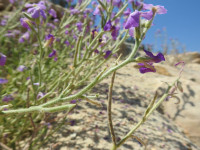
Matthiola tricuspidata is an annual herbaceous plant of the family Brassicaceae, with a scapose habit and a height ranging from 10 to 40 cm. It has branched stems from the base, generally procumbent or prostrate-ascending, covered by a gray-tomentose pubescence made up of short branched and stipitate glandular hairs, giving it a woolly appearance.
The basal leaves are arranged in a rosette, are fleshy, oblanceolate-spatulate in shape, about 3-5 cm long and 1-1.5 cm wide, with revolute margins and a pinnatifid surface with regularly subrounded lobes with sinuate-crenulate margins and rounded apex. The cauline leaves are smaller and almost entire.
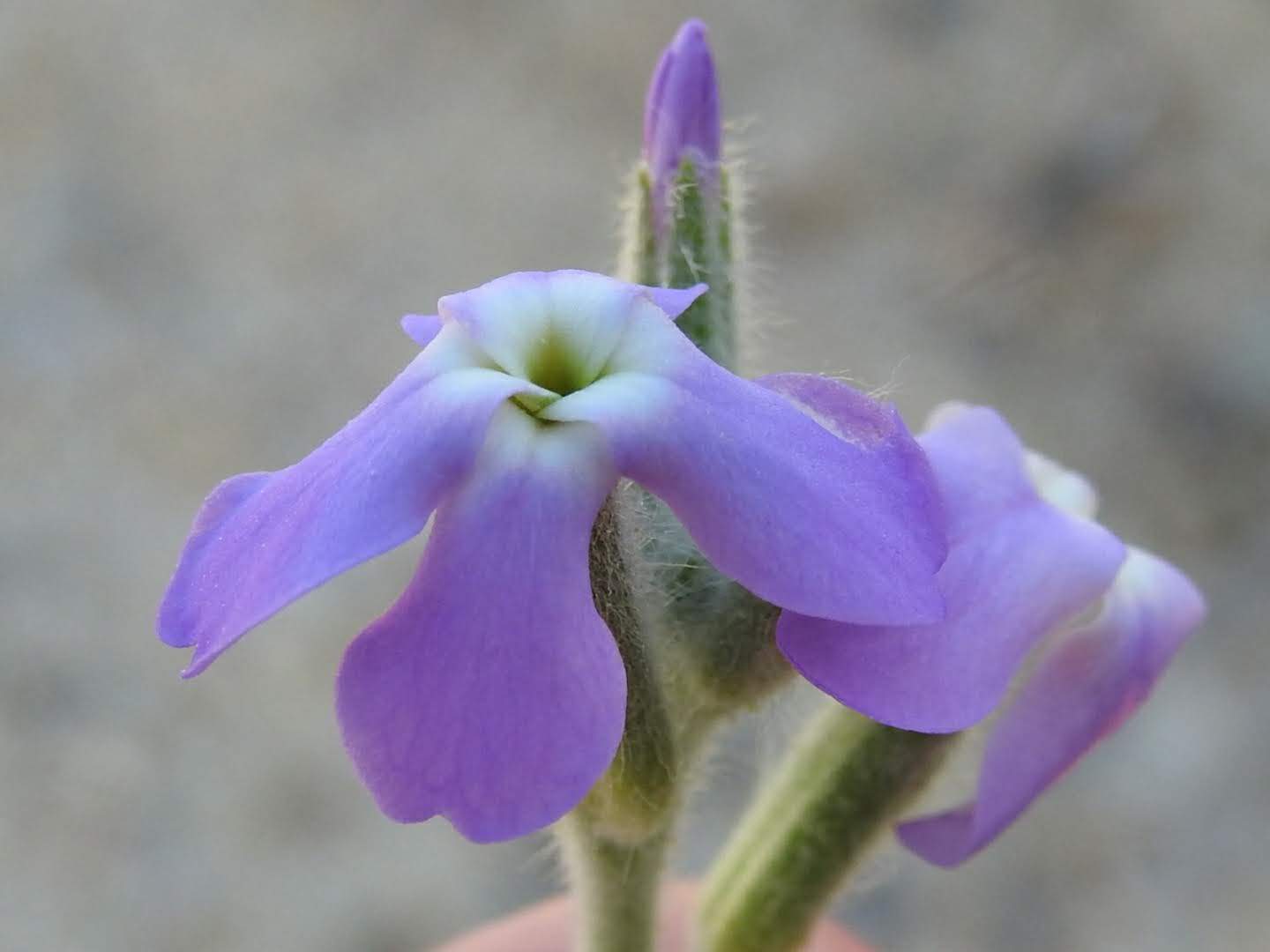
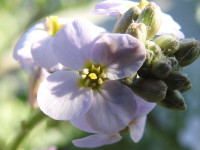
The flowers, hermaphroditic and tetramerous, are gathered in sparse terminal racemes, with very short peduncles (2-7 mm), almost the same length as the calyx. The calyx is very villous, with sepals up to 9 mm long, gray-violet in color, with the lateral sepals saccate at the base. The petals, obovate in shape and measuring 3-5 x 14-17 mm, are generally pink-lilac or violet, rarely white, with an emarginate apex and a yellowish-white basal area at the throat. The androecium is tetradynamous, with four stamens, the two upper longer than the two lower, while the style is very short.
The fruit is a silique 40-70 mm long and 2-3 mm wide, cylindrical and covered with stiff woolly hairs mixed with glandular hairs, with a well-marked median nerve. The most distinctive characteristic is the presence at the apex of three sharp horns, 3-4 mm long, with the two lateral ones patent or reflexed, which give the species its specific name. The seeds are uniseriate, oval, and wingless at maturity.
The root system is slender, suitable for growth in sandy substrates.
Habitat and distribution
Matthiola tricuspidata is a typical species of Mediterranean coasts, with a distribution ranging from Spain to Greece, also including the Mediterranean maquis area of peninsular Italy, Corsica, and the French Var. It grows mainly in psammophilous environments, that is on sandy and pebble beaches, coastal dunes, and maritime sandy shores, also on Mediterranean islands, where it can also colonize inland areas with sandy substrates.
It prefers sunny exposures and well-drained soils, typical of beach habitats, with thermophilous and psammophilous characteristics. In Italy, it is commonly found along the Tyrrhenian and Adriatic coasts, up to 100 meters of altitude.
Flowering period
Flowering extends from April to July, peaking in May and June. In some areas with milder climates or favorable microclimates, flowering can start as early as April and continue until July. No significant geographical variations in flowering are known.
Ecology and pollination
Matthiola tricuspidata is an annual species well adapted to dynamic coastal environments, with sandy and brackish soils. The flowers, fragrant and violet in color, attract various pollinating insects, including bees and butterflies, which favor entomophilous pollination.
The presence of a tetramerous flower with a tetradynamous androecium suggests an adaptation to specialized pollinators, while the fruit structure with three sharp horns may facilitate mechanical or secondary seed dispersal, although no specific studies on dispersal mode are detailed. Germination preferably occurs in sunny sandy substrates, with good colonizing ability in disturbed environments.
Curiosities and traditional uses
No specific traditional food or medicinal uses are documented for this species, probably due to its limited distribution in coastal environments and its annual and rather modest nature. The common name “violaciocca marina” derives from the characteristic color of the flowers and the marine habitat.
The genus Matthiola is dedicated to Pietro Andrea Mattioli, a sixteenth-century Sienese physician and botanist, known for translating and commenting on the work of Dioscorides, fundamental for ancient botany and medicine.
Etymology
The genus name, Matthiola, honors Pietro Andrea Mattioli (1500-1577), an important Italian botanist and physician. The specific epithet “tricuspidata” derives from the Greek “tréis, three” and the Latin “cuspis, point or tip,” referring to the three characteristic points that end the silique, a distinctive trait of the species. The common name “violaciocca marina” refers to the violet color of the flowers and the coastal marine habitat in which the plant develops.
Sources
- Prof. S. Pignatti, Flora d'Italia
- Acta Plantarum - Flora delle regioni italiane (scheda di Anja Michelucci)
- Tela Botanica / H. Coste, Flore descriptive et illustrée de la France
Characteristics
Scheda botanica
| Famiglia | Brassicaceae |
|---|---|
| Fioritura | aprile – luglio |
| Forma biologica | Scapose |
| Habitat | with purple flowers, psammophilous plant, plant with a prostrate-ascending habit |
Domande frequenti
- Quando fiorisce Violaciocca marina?
- Violaciocca marina fiorisce aprile – luglio.
- Che tipo di pianta è Violaciocca marina?
- Violaciocca marina è una Therophytes (Scapose) secondo la classificazione di Raunkiaer.
- A quale famiglia appartiene Violaciocca marina?
- Violaciocca marina appartiene alla famiglia botanica Brassicaceae.
Where I found it (10 sightings)
Classification
- Kingdom
- Plantae
- Family
- Brassicaceae
- Full name
- Matthiola tricuspidata (L.) R.Br.
- Synonyms
- Cheiranthus tricuspidatus L.
- Life form
- Therophytes scapose
Similar species
Search for species with similar characteristicsFurther reading
Noticed an error in the identification? Write to me
Other species of the same family
Brassicaceae
Explore
Other species of Brassicaceae