Botanical species
Torilis arvensis
(Huds.) Link
Spreading Hedge-parsley
Description
Morphological description
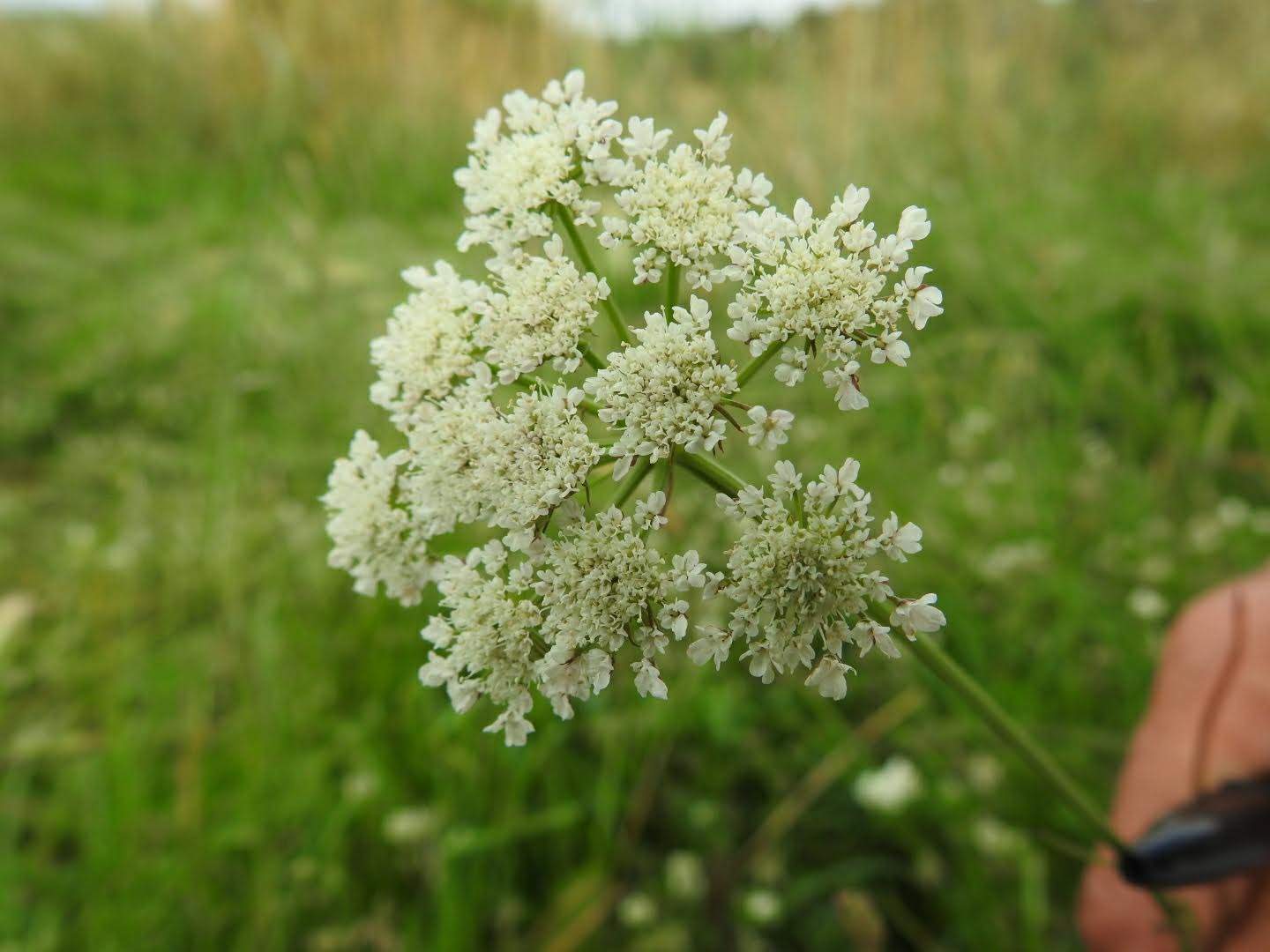
Annual herbaceous plant, Spreading Hedge-parsley has a scapose habit with an erect, slender, and branched stem, which can reach a variable height from 20 to 100 cm. The stem is characterized by a rough and scabrous surface, due to scattered downward-facing bristles, giving it a slightly rough texture to the touch. The root system is taproot, typical of annual plants with a well-developed main root.
The leaves are imparipinnate, with a deltoid-acuminate blade extending 3-6 cm. They are composed of 2-4 pinnules, with narrow and elongated terminal segments, about 1-2 mm wide, covered by whitish strigose hairs, especially on the underside, which makes the surface slightly rough. The median and upper leaves are similar but with thinner and shorter segments, sometimes reduced to three elongated and subentire or sharply serrated segments.
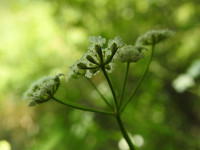
The inflorescence consists of compound umbels, with 3-12 divergent rays at less than 90°, which rarely or never have 1-2 very ephemeral bracts. The umbels are borne on peduncles 1.5 to 13 cm long, often leafless (scapose). The flowers are small, pentamerous, with five white petals, sometimes slightly pinkish. The central petals are small and regular, while the outer ones are zygomorphic, with two larger petals (8-12 mm), giving the inflorescence a characteristic appearance. The ovary is inferior, bicarpellate, with a style about 0.7 mm long, which exceeds the stylopodium by 2-3 times.
The fruit is an oblong-ovoid schizocarp or polachenarium, 3-6 mm long, dark green in color and covered with straight, cylindrical, and slightly curved prickles up to 1 mm long, ending with a small hook-shaped tip. The secondary ribs of the fruit are rough and ciliate, with erect spines that facilitate adhesion to animal fur or clothing, a characteristic that gives rise to the common name "Spreading Hedge-parsley." The mericarps, that is the two halves of the fruit, are similar and bear these spines, regularly distributed along the ribs.
Habitat and distribution
Spreading Hedge-parsley is a subcosmopolitan species present throughout almost the entire Italian territory, with a widespread distribution especially in the central-southern regions and the major islands. It is common in plains and hills, up to about 1340 m altitude. It preferably grows in arid or semi-arid environments, such as road edges, abandoned cultivated fields, vineyards, ruderal and uncultivated lands, showing some adaptability to poor and dry soil conditions.
In Italy and the Mediterranean basin, the species is considered a common weed, often present in disturbed and anthropized environments. It grows on various substrates, preferring well-drained and sunny soils, typical of xerothermic habitats. Although it favors full sun exposure, it can also be found along the edges of open woods and sparse shrublands.
Flowering period
Flowering extends from April to August, with the peak concentrated between May and July. In some more northern or mountainous regions, flowering may start later and end by July-August. The long flowering window allows the species to exploit favorable climatic conditions and ensure a constant seed production.
Ecology and pollination
Spreading Hedge-parsley is anemophilous and entomophilous, relying mainly on pollination by pollinating insects, particularly bees, wasps, and small hymenopterans and dipterans, attracted by the white flowers and the umbrella arrangement, which facilitates access to nectar and pollen. The flower structure, with larger and zygomorphic outer petals, helps make the inflorescences more visible to pollinating insects.
Seed dispersal occurs mainly through epizoochory: the hooked spines of the fruit easily attach to animal fur or people's clothing, promoting dispersal over considerable distances. This strategy is particularly effective in open environments and along road and path margins, where animal and human traffic is frequent.
Curiosities and traditional uses
Spreading Hedge-parsley is not widely documented for traditional medicinal or food uses, probably due to its nature as a weed and the small size of its flowers and fruits. However, its common name "Spreading Hedge-parsley" derives precisely from the characteristic of its fruits equipped with hooked prickles, reminiscent of burdocks, i.e., plants of the genus Arctium, known for their ability to cling to clothing.
In folklore, plants with spiny fruits like this are often associated with protection and the ability to “cling” and resist, a symbolism that can also be extended to their effectiveness as pioneer species in disturbed environments.
Etymology
The generic name Torilis has an uncertain origin, but it may derive from the fusion of the names of two related genera of the Apiaceae family: Tordylium and Caucalis. The specific name arvensis means “of the fields,” indicating the typical growth habitat of the species, i.e., cultivated or open areas.
The Italian common name “lappolina canaria” refers to the small spiny fruits capable of adhering to animals and clothing, similarly to burdocks (Arctium), while “canaria” could be a regional or traditional appellation without precise taxonomic meaning.
Sources
- Prof. P.V. Arrigoni, "Flora analitica della Toscana", "Flora dell'Isola di Sardegna"
- Acta Plantarum - Flora delle regioni italiane (scheda di Roberta Alberti)
- World Flora Online (WFO)
Characteristics
Scheda botanica
| Famiglia | Apiaceae |
|---|---|
| Fioritura | aprile – agosto |
| Forma biologica | Scapose |
| Habitat | with white flowers, plant with a scapose habit |
Domande frequenti
- Quando fiorisce Spreading Hedge-parsley?
- Spreading Hedge-parsley fiorisce aprile – agosto.
- Che tipo di pianta è Spreading Hedge-parsley?
- Spreading Hedge-parsley è una Therophytes (Scapose) secondo la classificazione di Raunkiaer.
- A quale famiglia appartiene Spreading Hedge-parsley?
- Spreading Hedge-parsley appartiene alla famiglia botanica Apiaceae.
Where I found it (5 sightings)
Classification
- Kingdom
- Plantae
- Family
- Apiaceae
- Full name
- Torilis arvensis (Huds.) Link
- Life form
- Therophytes scapose
Similar species
Search for species with similar characteristicsNoticed an error in the identification? Write to me
Other species of the same family
Apiaceae
Explore
Other species of Apiaceae