Botanical species
Chaerophyllum temulum
L.
Rough Chervil
Description
Morphological description
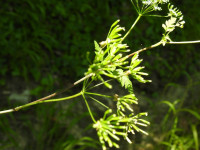
Biennial herbaceous plant or, less frequently, annual, 30 to 100 cm tall, with an erect habit and full, striated, and hairy-pubescent stems. The stems are characterized by a typical purple coloration at the base and show evident swellings at the internodes, especially at the point of insertion of the leaf petioles. The stem surface is covered with short hairs directed downwards, with a quadrangular section.
The leaves are compound, herbaceous in texture and dark green in color, predominantly tripinnate or bipinnate, with oval-obtuse leaf segments and shallow incisions. The lower leaves are larger, long-petiolate, with an ovate-triangular outline, while the upper ones are smaller, sessile, and less divided, with a base sheathing the stem. The upper surface of the leaves is generally more velvety than the lower one.
The root system consists of a fusiform, slender root, typical of biennial Apiaceae.
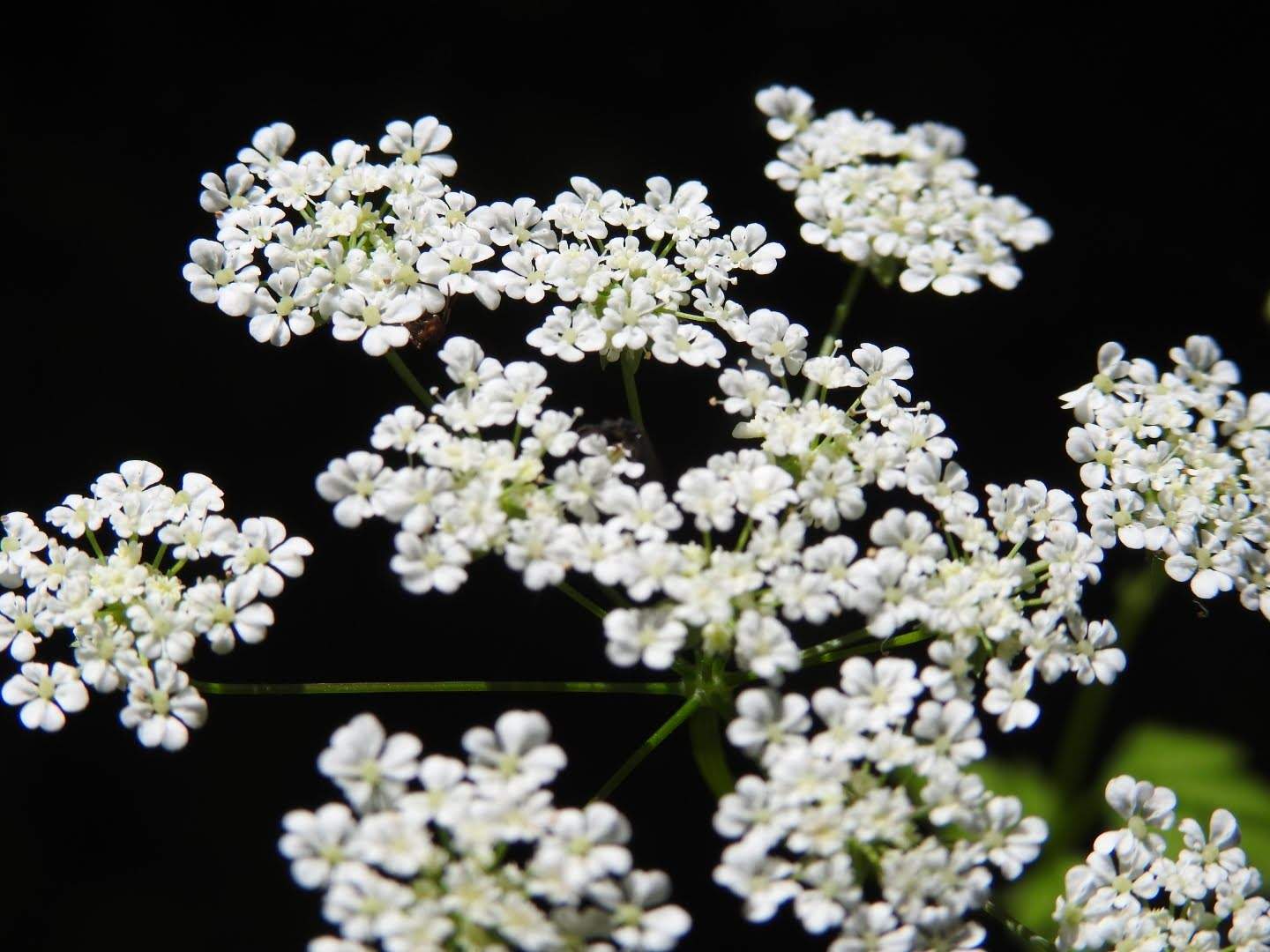
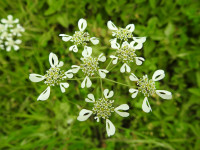
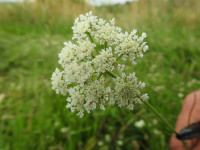
The inflorescence consists of compound umbels, pendulous before anthesis, with 6-12 hairy rays. The umbellets are provided with an involucre formed by 4-8 lanceolate, ciliate bracteoles reflexed outward with scarious margins. The involucre is generally absent or reduced to one or two lanceolate bracteoles that fall early.
The flowers are small, with predominantly white petals, but can occasionally be pinkish or yellowish. The petals have a bifid limb, are glabrous, and lack marginal cilia. The calyx is toothless. There are 5 stamens and an inferior bilocular ovary, with two monospermous carpels. The styles are two, short, divergent, and the same length as the stylopodium.
The fruit is a fusiform diacarp (schizocarp), 5-7 mm long, generally glabrous and without a beak, with a stylopodium that gradually tapers. The surface may show variations in hairiness depending on the forms, with a more widespread variant in the Peninsula characterized by fruits hairy with erect bristles.
Habitat and distribution
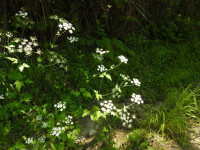
This species is widespread in Europe, from the Eurasian belt extending to Japan, and is particularly present in Italy and temperate Mediterranean regions. It grows preferably in mesophilic environments such as uncultivated places, hedges, edges of forest roads, rubble, and forest paths, often in semi-shaded areas. It prefers substrates with slightly acidic pH and is found from low altitudes up to 1200 meters above sea level.
In Italy it is frequent especially in regions with temperate and submontane climates, where it can colonize disturbed areas and forest edges. The species is considered common in many hilly and mountainous environments.
Flowering period
Flowering generally occurs between May and July, with some local variations related to latitude and altitude. In Italy, the peak flowering period is concentrated in late spring and early summer.
Ecology and pollination
The plant is entomogamous, i.e., pollinated by insects, which are attracted by the small white flowers arranged in umbels. The most common pollinating insects are bees, hymenopterans, and other typical Apiaceae pollinators. The reproductive strategy is based on cross-pollination favored by the structure of the inflorescence and the presence of many flowers arranged in an umbrella.
The seeds, contained in schizocarp fruits, are mainly dispersed by falling to the ground; no particular long-distance dispersal method is known, such as transport by animals or wind. However, its presence in disturbed environments suggests a good capacity to colonize open areas.
Curiosities and traditional uses
This species is commonly known in Italy by the popular names "Rough Chervil". The plant is toxic: ingestion causes effects similar to strong intoxication, with states of confusion and dizziness. For this reason, any food or medicinal use without proper supervision is discouraged.
Despite this, in the past medicinal properties were attributed to the species, although today it is mainly considered a poisonous plant. Food or pharmaceutical use is rare and discouraged, and the plant is not commonly employed in modern herbal medicine.
From an ethnobotanical point of view, the common name "Rough Chervil" explicitly reflects its toxic character and the intoxicating effects resulting from accidental or voluntary ingestion.
Etymology
The genus name derives from ancient Greek: "kháiro" means "to rejoice" and "phýllon" means "leaf", referring to the visual pleasure caused by the leaves of some related species, such as common chervil.
The specific epithet "temulum" comes from the Latin "temulus", meaning "drunk" or "intoxicated", recalling the psychoactive effects of ingesting the plant.
The popular name "Rough Chervil" is of traditional Italian origin, while "Rough Chervil" explicitly indicates the toxic character and intoxicating effect of the species.
Sources
- Prof. S. Pignatti, "Flora d'Italia"
- Acta Plantarum - Flora delle regioni italiane (scheda di Anja Michelucci)
- World Flora Online (WFO)
Characteristics
Scheda botanica
| Famiglia | Apiaceae |
|---|---|
| Fioritura | maggio – luglio |
| Forma biologica | Scapose |
| Habitat | with white flowers, toxic plant, biennial plant |
| Tossicità | Tossica — non consumare |
Domande frequenti
- Quando fiorisce Rough Chervil?
- Rough Chervil fiorisce maggio – luglio.
- È tossica Rough Chervil?
- Rough Chervil è una pianta tossica o velenosa. Non consumare nessuna sua parte senza aver consultato un esperto.
- Che tipo di pianta è Rough Chervil?
- Rough Chervil è una Therophytes (Scapose) secondo la classificazione di Raunkiaer.
- A quale famiglia appartiene Rough Chervil?
- Rough Chervil appartiene alla famiglia botanica Apiaceae.
Where I found it (3 sightings)
Classification
- Kingdom
- Plantae
- Family
- Apiaceae
- Full name
- Chaerophyllum temulum L.
- Synonyms
- Chaerophyllum temulentum L.
- Life form
- Therophytes scapose
Similar species
Search for species with similar characteristicsNoticed an error in the identification? Write to me
Other species of the same family
Apiaceae
Explore
Other species of Apiaceae