Botanical species
Eryngium campestre
L.
Field Eryngo
Description
Morphological description
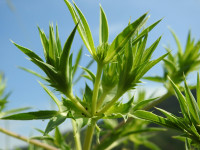
The Field Eryngo is a glabrous perennial herbaceous plant, generally 20 to 60 cm tall, with an erect and strongly branched habit. The stem, woody at the base, is robust, cylindrical and shows a reddish coloration, especially at the base, with an angular section and ascending branches. The plant has a taproot that can reach depths of up to 2 meters, allowing good anchorage and access to soil water resources.
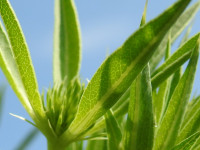
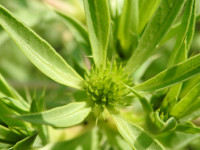
The leaves are leathery, green-whitish or green-yellowish in color, with shapes varying between ovate and triangular; they are mostly pinnatifid or pinnatipartite, with spiny margins and well-defined veins. The basal leaves are large (up to 32 x 20 cm), petiolate, with a petiole thickened at the base into a veined sheath, often persistent even after flowering. The upper cauline leaves are sessile and clasping, with two spiny auricles embracing the stem. The leaf margin is leathery, with spiny lobes, and often the lower leaves have a spiny sheath.
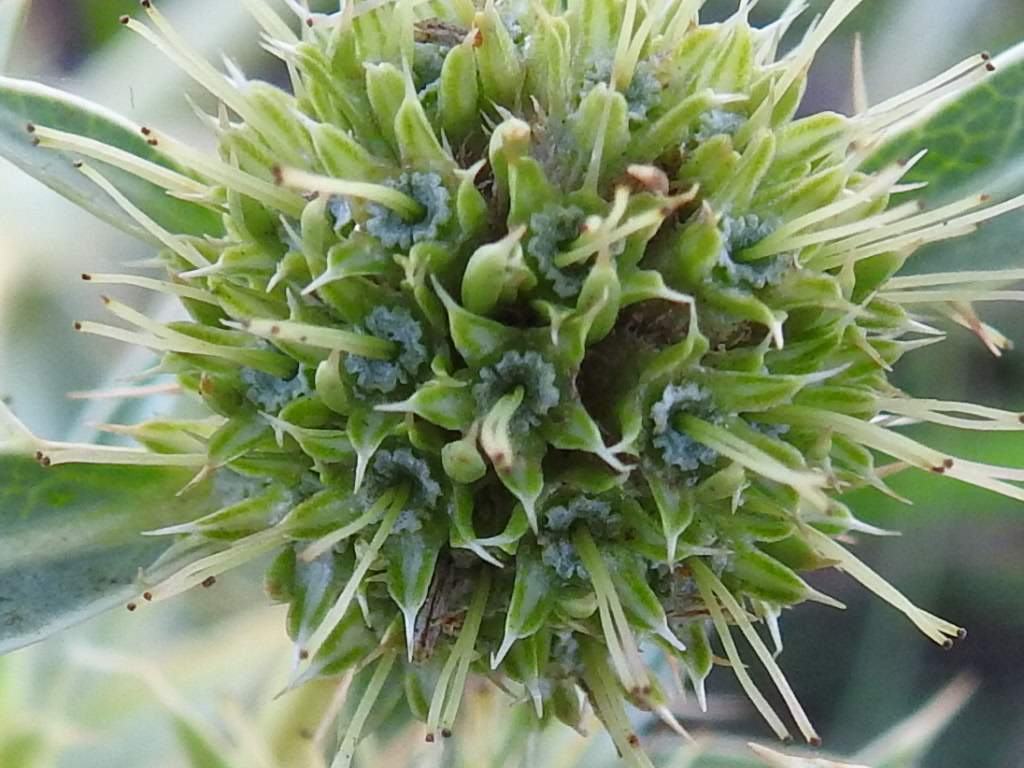
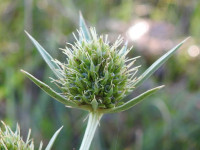
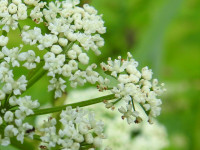
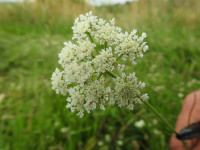
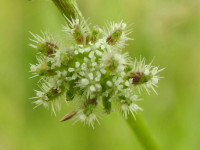
The inflorescence is a corymbose cluster composed of numerous subspherical or ovoid capitula, 1-1.5 cm in diameter, pedunculated and arranged compactly. Each capitulum is surrounded by an involucre formed by 4-7 linear-lanceolate bracts, rigid and spreading, generally spiny or with dentate margins and acuminate tips, green-whitish or white in color. The bracts are up to 15-40 mm long, with a wider opening towards the middle. The inner bracts (bracteoles) are similar, as long as the flower. The flowers are small, white-greenish, with five narrow lanceolate petals, five stamens and a fruiting calyx with straight teeth that persist on the fruit.
The fruit is an ovoid achene about 2.5 mm long, strongly scaly with pointed scales, adapted for mechanical and possibly animal dispersal. The overall appearance of the plant is spiny and leathery, a characteristic that gives it some resistance to herbivores and environmental stresses.
Habitat and distribution
The Field Eryngo is widespread throughout Italy, from the plains up to mountainous altitudes of about 1500 meters, preferring dry pastures, road edges, rocky environments and calcareous or stony soils. It is a typical species of xerothermic and hilly-mountain environments, especially common in areas with poor and well-drained soils.
Its distribution extends across southern and central Europe, up to northern Europe (Denmark), western Asia and North Africa. In Italy it is present in almost all regions, with populations also in alpine environments where it may show variable morphological characteristics. The preferred habitat is represented by dry grasslands, arid and calcareous soils, often in sunny and well-ventilated exposures.
Flowering period
Flowering mainly occurs from July to September, with some variation related to altitude and latitude. In warmer climates or at lower altitudes, flowering can begin as early as July, while in mountainous or northern environments it may extend until September.
Ecology and pollination
The plant is adapted to arid climates and poor environments, with leathery and spiny leaves that reduce water loss and predation by herbivores. The taproot system allows it to reach deeper water, an advantage in dry pastures and calcareous soils.
Pollination is entomogamous, favored by pollinating insects attracted to the compact capitula and white-greenish flowers. The corymbose inflorescences, with small but numerous capitula, offer an abundant source of pollen and nectar. Seed dispersal occurs mechanically; the globose capitula, once dried, tend to detach easily and roll, carrying the seeds far from the mother plant, a mechanism known as "Field Eryngo" or "rolling" dissemination.
Curiosities and traditional uses
The scientific name of the genus derives from the Greek “eryngànein,” meaning “to belch,” referring to the carminative properties of the plant, i.e., its ability to promote the elimination of intestinal gases. The Field Eryngo has a long history of medicinal and food use in Mediterranean traditions. Young shoots are edible, consumed raw in salads or cooked, and can be preserved in vinegar to be used as pickles similar to gherkins.
From a pharmaceutical perspective, the plant is rich in mineral salts, essential oils and saponins, with diuretic, aperitive, emmenagogue properties and historically also used to treat jaundice. These uses have been documented since antiquity, with Dioscorides already mentioning its virtues.
Besides practical uses, the Field Eryngo is also featured in literary and popular imagery. A notable example is the description of its way of dispersing by rolling in the wind (“crivatz”) on the plains of Bărăgan, recounted by the writer Panait Istrati, who highlights the plant’s ability to spread its seeds vigorously and almost “maliciously.”
Etymology
The genus name, Eryngium, derives from the Greek word “eryngànein” meaning “to belch,” a clear reference to the carminative properties of the plant. The specific epithet campestre indicates the open and rural places where the plant is commonly found.
The Italian common name, “calcatreppola,” refers to the spiny shape and the dispersal of the capitula which, detaching and rolling, “tread” the surrounding ground and spread the seeds, a behavior similar to that of plants known as “calcatreppole” or “rolling calcatreppole.”
Sources
- Prof. P.V. Arrigoni, "Flora analitica della Toscana", "Flora dell'Isola di Sardegna"
- Acta Plantarum - Flora delle regioni italiane (scheda di Nino Messina)
- Tela Botanica / H. Coste, "Flore descriptive et illustrée de la France"
- World Flora Online (WFO)
Characteristics
Scheda botanica
| Famiglia | Apiaceae |
|---|---|
| Fioritura | luglio – settembre |
| Forma biologica | Scapose |
| Habitat | edible plant, spiny plant, Perennial plant |
| Uso alimentare | Commestibile |
| Uso officinale | Pianta officinale |
Domande frequenti
- Quando fiorisce Field Eryngo?
- Field Eryngo fiorisce luglio – settembre.
- È commestibile Field Eryngo?
- Field Eryngo è considerata commestibile. Verifica sempre le parti eduli e la preparazione corretta prima del consumo.
- Che tipo di pianta è Field Eryngo?
- Field Eryngo è una Hemicryptophytes (Scapose) secondo la classificazione di Raunkiaer.
- A quale famiglia appartiene Field Eryngo?
- Field Eryngo appartiene alla famiglia botanica Apiaceae.
Where I found it (11 sightings)
Classification
- Kingdom
- Plantae
- Family
- Apiaceae
- Full name
- Eryngium campestre L.
- Life form
- Hemicryptophytes scapose
Similar species
Search for species with similar characteristicsFurther reading
Noticed an error in the identification? Write to me
Other species of the same family
Apiaceae
Explore
Other species of Apiaceae