Botanical species
Torilis nodosa
(L.) Gaertn.
Knotted Hedge-parsley
Description
Morphological description
Annual plant belonging to the Apiaceae family, it has a variable habit that can be prostrate, prostrate-ascending, or erect, reaching a height between 20 and 70 cm. The stem is generally branched, subglabrous or weakly scabrous, with a slightly rough surface to the touch.
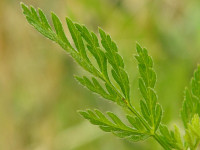
The leaves are arranged in a basal rosette and are bipinnate or 2-3 pinnatisect, with lanceolate segments and narrow lobes, 1 to 2 mm wide. The basal leaves form a rosette, while the cauline leaves are smaller or absent on the flowering axis, which is often scapose and leafless.
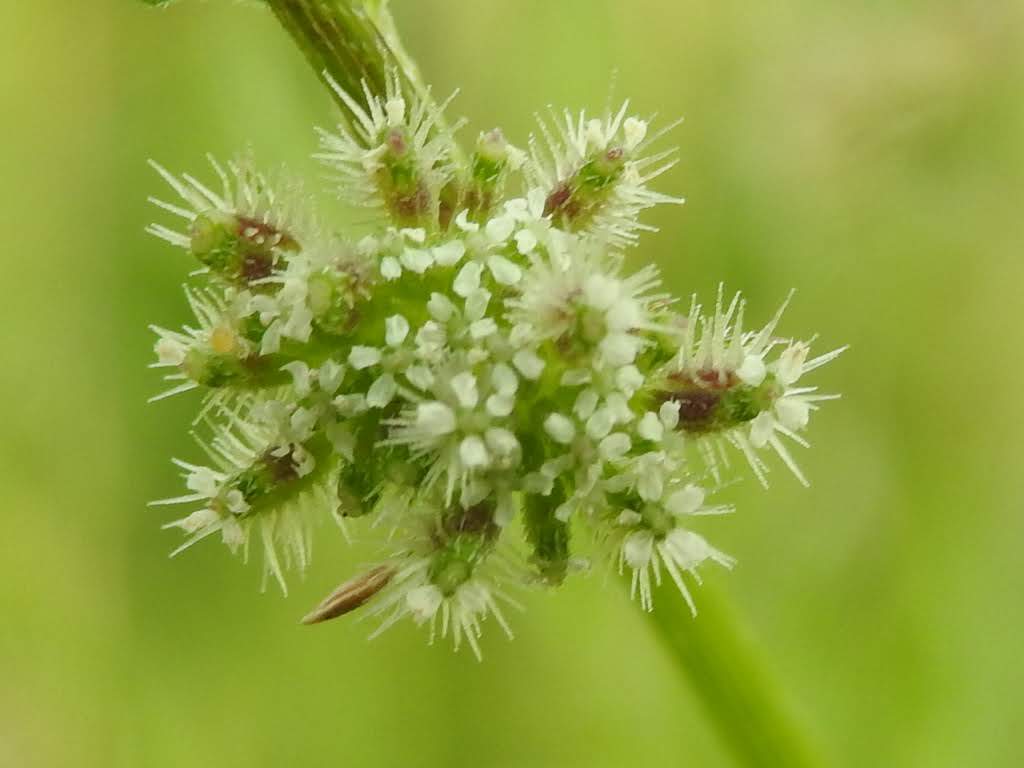
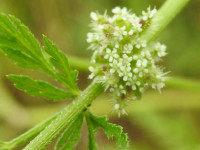
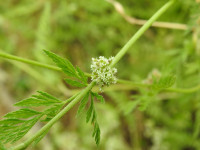
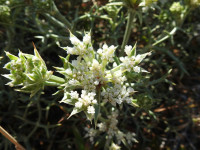
The inflorescence consists of capitate umbels, subsessile or sessile, opposite the leaves, with short rays (2-6 rays 1-2 cm long). The umbels appear contracted and compact. The flowers are small, white in color, with white petals and a calyx equipped with triangular teeth. The involucre bracts are absent, while the involucel is formed by linear bracteoles.
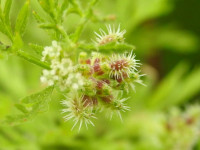
The fruit is an ovoid mericarp, 2 to 4 mm long, gray-green in color, covered with spines about 1 mm long ending with an arrow-shaped tip. The outer fruits have a spiny outer mericarp and a tuberculate inner one, while the inner fruits have both mericarps tuberculate, a characteristic that gives a heteromorphic shape to the fruits. The style is erect, as long as or slightly longer than the stylopodium. The chromosome number is 2n=24.
The root system is typical of annual herbaceous plants, with a taproot type that allows anchorage and absorption in often poor and uncultivated habitats.
Habitat and distribution
The species is present throughout the Italian territory, except for the Po Plain, with greater diffusion on calcareous soils in the hilly areas of the North and in mountainous regions. It is common in Liguria, the hills of Emilia, the Langhe, and the rest of the Peninsula up to the major islands.
At the Mediterranean and Eurasian level, it extends from the Mediterranean basin to Central Asia, particularly in areas with Mediterranean and Turanian climates, i.e., regions characterized by subdesert or desert climatic conditions.
It prefers open and disturbed habitats, such as ruins, uncultivated areas, roadsides, and railways, at altitudes ranging from the plains up to about 1100 meters. It grows on generally calcareous soils, with variable exposure, but prefers sunny or semi-shaded environments.
Flowering period
Flowering extends from spring to summer, generally from March to August. In some areas, especially those at higher altitudes or with cooler climates, flowering may be limited to the central months of spring and early summer.
Ecology and pollination
Flowering is accompanied by an effective entomogamous pollination strategy, favored by the presence of white flowers, visible and arranged in compact umbels that attract various pollinating insects, such as bees, wasps, and dipterans. The structure of the umbels and fruits is adapted to zoochorous dispersal, particularly through adhesion to the hair or fur of animals, thanks to the spines present on the outer fruits that facilitate dissemination away from the mother plant.
Curiosities and traditional uses
The common name "Knotted Hedge-parsley" derives from the particular spiny and knotted structure of the fruits, which resemble "burrs," adhesive structures used in the past as a natural remedy to catch or stop objects or animals.
No significant medicinal or food uses are known for this species, but the Apiaceae family is often associated with aromatic and medicinal plants, suggesting a potential ethnobotanical interest to be explored.
Etymology
The scientific name derives from the fusion of two Apiaceae genera, "Tordylium" and "Caucalis," from which the genus Torilis probably originates. The term "nodosa" refers to the knotted shape, i.e., characterized by nodes or protuberances, typical of the spiny fruits of the plant.
The common name "Knotted Hedge-parsley" recalls the resemblance of the fruits to burrs, plants known for their adhesive fruits, while "nodosa" emphasizes the presence of nodosities on the surface of the fruits, a distinctive characteristic of the species.
Sources
- Prof. S. Pignatti, "Flora d'Italia"
- Acta Plantarum - Flora delle regioni italiane (scheda di Gianluca Nicolella)
- World Flora Online (WFO)
Characteristics
Scheda botanica
| Famiglia | Apiaceae |
|---|---|
| Fioritura | marzo – agosto |
| Forma biologica | Scapose |
| Habitat | with white flowers, annual plant, plant with a prostrate-ascending habit |
Domande frequenti
- Quando fiorisce Knotted Hedge-parsley?
- Knotted Hedge-parsley fiorisce marzo – agosto.
- Che tipo di pianta è Knotted Hedge-parsley?
- Knotted Hedge-parsley è una Therophytes (Scapose) secondo la classificazione di Raunkiaer.
- A quale famiglia appartiene Knotted Hedge-parsley?
- Knotted Hedge-parsley appartiene alla famiglia botanica Apiaceae.
Where I found it (12 sightings)
Classification
- Kingdom
- Plantae
- Family
- Apiaceae
- Full name
- Torilis nodosa (L.) Gaertn.
- Life form
- Therophytes scapose
Similar species
Search for species with similar characteristicsNoticed an error in the identification? Write to me
Other species of the same family
Apiaceae
Explore
Other species of Apiaceae