Botanical species
Aegopodium podagraria
L.
Ground-Elder
Description
Morphological description
Perennial herbaceous plant that develops from a nodose, long and creeping rhizome, brown in color with white pulp, endowed with a characteristic smell reminiscent of parsley. The rhizome allows the plant to spread rapidly, forming extensive colonies that can be very invasive, especially in vegetable gardens and gardens.
The stem is erect, hollow, robust, angular and longitudinally striated, with a pubescent, papillose, hirsute, tomentose and slightly rough surface. The height generally varies between 30 and 80 cm, with simple stems or branched only in the upper part.
The leaves have a compound blade, bi- to triternate, with a triangular outline. The basal leaves are green-grayish in color, with a long keeled-grooved and trigonal petiole, 20-30 cm long, and equipped with a short sheath. The leaf segments, wide from 3 to 4 cm, are ovate-lanceolate, with an asymmetrical cordate base and acuminate apex. The margin is unevenly serrated. The cauline leaves are ternate, sessile, with the petiole reduced to a 2-3 cm sheath.
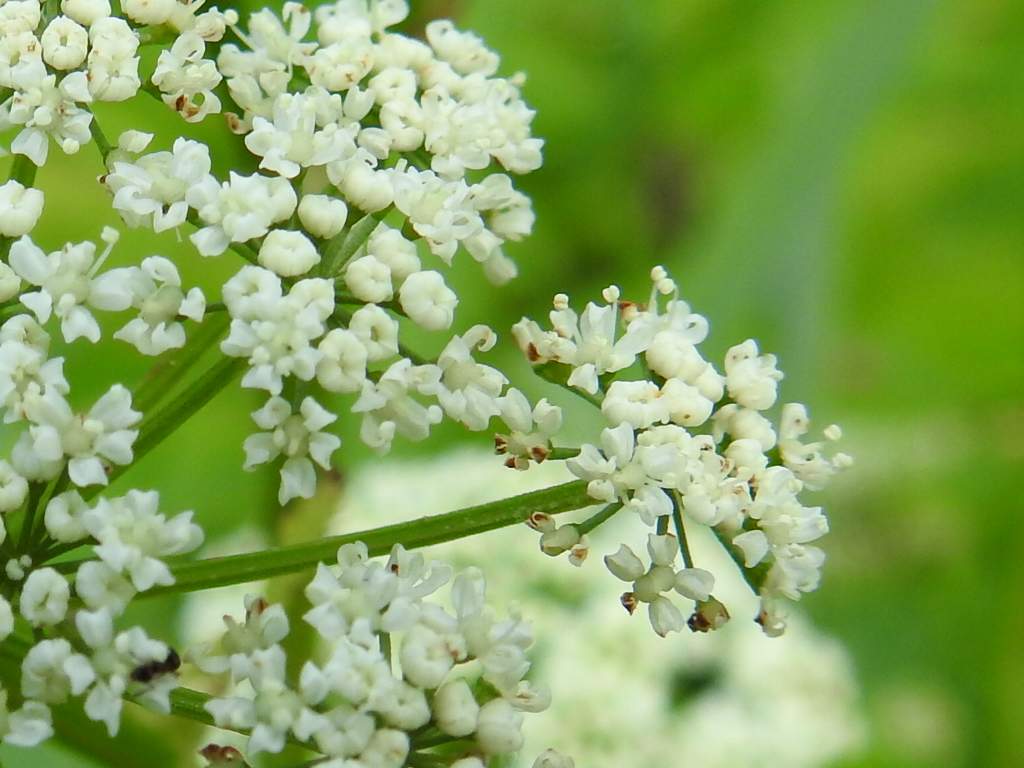
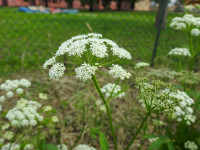
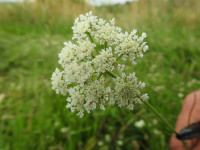
The inflorescence is a compound umbel, lacking involucres and umbels, with 10-25 thin rays 2-3 cm long, developing on peduncles 8-10 cm long, placed axillary. The flowers are small, with five petals of pure white or slightly pinkish color, obovate and bifid, characterized by a tongue curved at their extremity. The corolla is accompanied by five stamens. The ovary is inferior, formed by two monospermous carpels, with a subconical stylopodium and two long styles bent back during fruiting.
The fruit is a schizocarp (diaspore) composed of two oblong mericarps, glabrous, laterally compressed, about 3 mm long, with five filiform ribs of equal size. The surface is smooth, without bands of hairs along the valleculae.
Habitat and distribution
The species is native to the Eurosiberian area, widespread in the cold and temperate-cold zones of Eurasia. In Italy it is present throughout almost the entire territory, from sea level up to 1800 meters altitude, particularly common in broadleaf forest environments, forest edges, hedges, gorges and shady uncultivated places.
It prefers fresh, moist substrates rich in nitrogen nutrients, with a pH ranging from basic to slightly acidic. The plant is adapted to conditions of partial shade or shade, typical of forest environments or shady gardens. In some Mediterranean regions it is less common, while it is more frequent in temperate and mountainous areas.
Flowering period
Flowering extends from May to August, with slight geographical variations depending on altitude and local climate. The white flowers are visible throughout the first part of summer, contributing to the recognizability of the species in the growth areas.
Ecology and pollination
Pollination is entomogamous, mainly entrusted to pollinating insects that visit the umbels to collect nectar and pollen. The structure of the inflorescence, lacking involucres, facilitates access to small pollinating insects.
Seed dispersal occurs through the schizocarps, which, once mature, separate into two mericarps. The plant spreads mainly through the creeping rhizome, which allows rapid and invasive expansion of the plant group.
Curiosities and traditional uses
Also known as Ground-Elder, this species has historically been appreciated for its medicinal and food properties. The plant contains essential oils, carotene (especially in the roots), saponins in the fruits, vitamin C and calcium.
Folk medicine attributed diuretic, purifying and anti-gout properties to the root, so much so that in the 19th century it was recommended for the treatment of osteoarthritis, sciatica and gout. For external use, the fresh plant was used to soothe insect bites, small wounds and abrasions.
The young leaves are edible and were traditionally consumed raw, mixed in salads as a purifying agent, or cooked like spinach and seasoned with butter, considered a delicacy. The fruits also have diuretic properties.
In agronomic contexts, the long and creeping rhizome makes the plant very invasive, capable of suffocating other herbaceous species in cultivated areas or gardens. In Great Britain, where it is not native, it has naturalized following ancient cultivations and is described as a plant that "expelled from the kitchen, refused to leave the garden".
Etymology
The genus name derives from ancient Greek, combining "aix, aigós" (goat) and "poús, podós" (foot), referring to the shape of the leaves, which resemble the foot of ungulates. The specific epithet "podagraria" derives from the Greek "podagra" (literally "foot trap"), a term used to indicate gout, a disease against which the plant was traditionally considered effective.
In Italian, the common names castalda and girardina silvestre reflect the traditional use and spontaneous distribution of the species in woods and natural environments.
Sources
- Acta Plantarum - Flora delle regioni italiane (actaplantarum.org)
- Acta Plantarum - Flora delle regioni italiane (scheda di Anja Michelucci)
- Tela Botanica / H. Coste, "Flore descriptive et illustrée de la France"
- World Flora Online (WFO)
Characteristics
Scheda botanica
| Famiglia | Apiaceae |
|---|---|
| Fioritura | aprile – luglio |
| Forma biologica | Rhizomatous |
| Habitat | with white flowers, edible plant, creeping plant |
| Uso alimentare | Commestibile |
| Uso officinale | Pianta officinale |
Domande frequenti
- Quando fiorisce Ground-Elder?
- Ground-Elder fiorisce aprile – luglio.
- È commestibile Ground-Elder?
- Ground-Elder è considerata commestibile. Verifica sempre le parti eduli e la preparazione corretta prima del consumo.
- Che tipo di pianta è Ground-Elder?
- Ground-Elder è una Geophytes (Rhizomatous) secondo la classificazione di Raunkiaer.
- A quale famiglia appartiene Ground-Elder?
- Ground-Elder appartiene alla famiglia botanica Apiaceae.
Where I found it (2 sightings)
Classification
- Kingdom
- Plantae
- Family
- Apiaceae
- Full name
- Aegopodium podagraria L.
- Life form
- Geophytes rhizomatous
Similar species
Search for species with similar characteristicsFurther reading
Noticed an error in the identification? Write to me
Other species of the same family
Apiaceae
Explore
Other species of Apiaceae