Botanical species
Tragopogon pratensis
L.
Goat's-Beard
Description
Morphological description
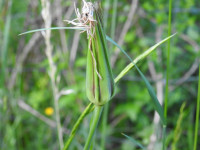
Perennial herbaceous plant, with a predominantly biennial cycle, generally 30 to 80 cm tall, characterized by an erect and scapose habit, with a sparsely branched, hollow, striated stem often reddish in color, swollen at the nodes. The stem is initially slightly hairy with a woolly tomentum that tends to fall off quickly, becoming glabrous in mature specimens.
The leaves are mainly arranged in a basal rosette, with a blade 5 to 20 cm long and about 4 mm wide, linear-lanceolate in shape with an acute apex. They are sessile and clasping, with a widened base that wraps around the stem, slightly channelled and with an entire and undulated margin. The central vein is well visible on the underside. Younger leaves may have slight hairiness that disappears with age.
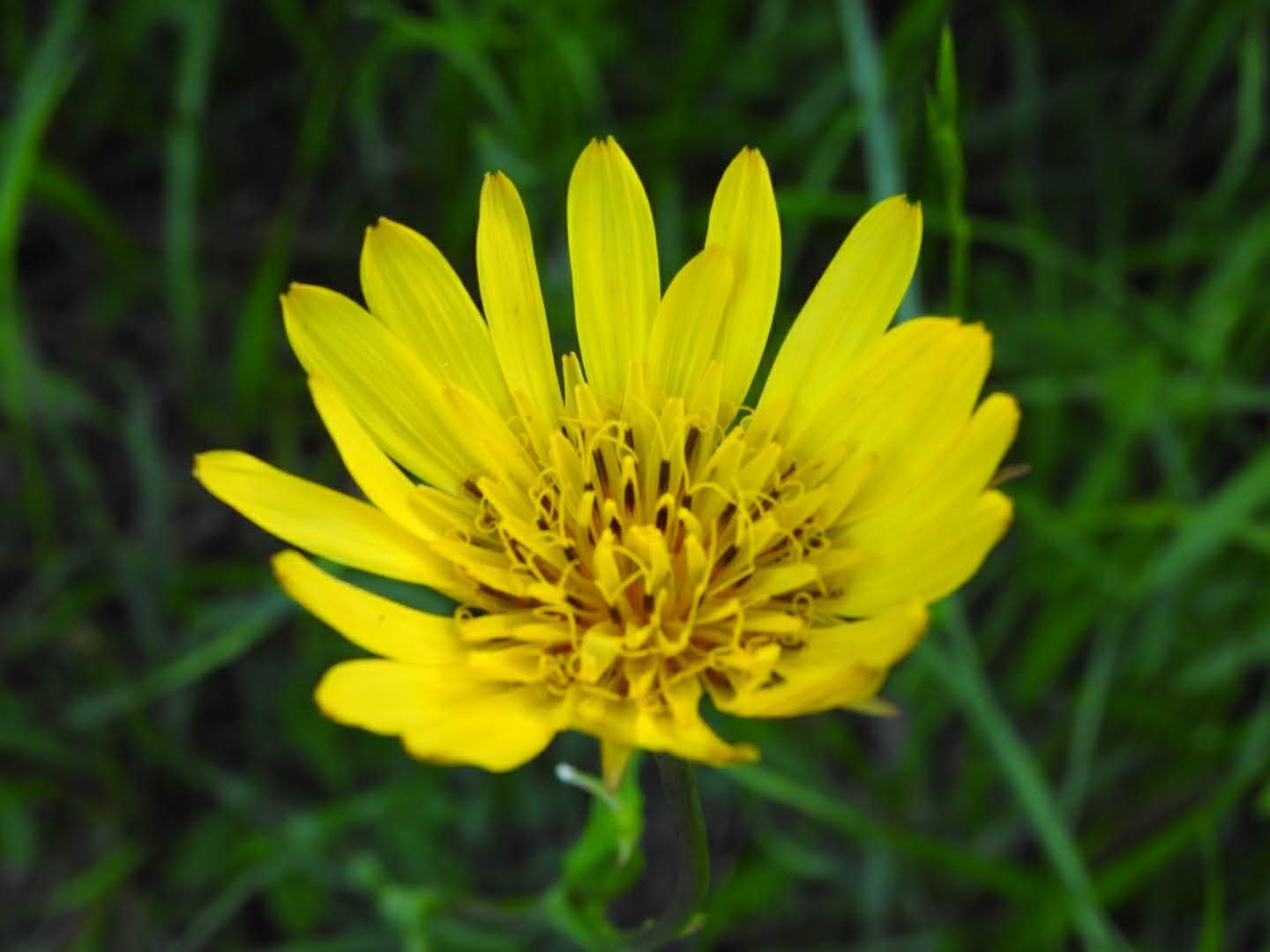
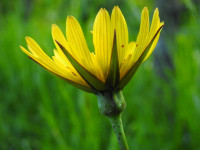
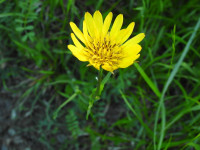
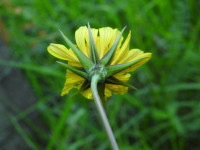
The flowers, grouped in solitary capitula placed at the apex of thin, scapose peduncles, are an intense golden yellow. The diameter of the capitula varies between 3 and 6 cm. The involucre is cylindrical, with lanceolate scales (7-8 in number), 18 to 33 mm long after fruiting, which bend backward. The ligules of the corollas, numerous and arranged radially, measure between 22 and 30 mm and have actinomorphic symmetry. The flowers are hermaphroditic and close during the central hours of the day or in overcast weather, assuming a conical shape.
The fruits are fusiform achenes, 15 to 25 mm long, with a slightly rough surface and equipped with a long thin beak, which sometimes reaches or exceeds the length of the achene body itself. The pappus is feathery, formed by intertwined bristles that create an umbrella-like structure, useful for anemochorous dispersal. The root system is taproot type, with a vertical root thickened to about 1 cm in diameter.
Habitat and distribution
This species is widespread throughout Italy and the Mediterranean regions, preferring mountainous and hilly environments, but is also found up to 2,100 meters altitude. It commonly grows in meadows, lush pastures, uncultivated lands, road edges, and fallow soils, favoring slightly moister soils compared to other related species of the same genus.
It tends to settle in open habitats, sunny or partially shaded, with predominantly full sun exposure. Its presence is frequent in anthropized and semi-natural environments, where it plays an important role in herbaceous biodiversity.
Flowering period
Flowering generally extends from May to August, with some variation related to altitude and latitude. At lower levels and in warmer regions, flowering may begin as early as May, while at higher altitudes it lasts longer towards the end of summer. The capitula open in the early morning hours, closing around noon or at most in the early afternoon, especially in adverse weather conditions.
Ecology and pollination
The species is pollinated by pollinating insects, mainly bees and other hymenopterans, attracted by the color and shape of the yellow ligulate flowers. The afternoon closing of the flowers is probably a strategy to protect the reproductive structures from unfavorable climatic conditions and to optimize pollination in the early hours of the day.
Seed dispersal occurs mainly through the feathery pappus which, thanks to its umbrella-like structure of intertwined bristles, promotes effective anemochorous dispersal, allowing colonization of new habitats even at considerable distances from the mother plant.
Curiosities and traditional uses
This plant is also known for its medicinal and food properties. The root, rich in inulin, is used in folk medicine as a depurative, diuretic, expectorant, sudorific, and astringent. It is particularly employed to soothe coughs and as an adjuvant in respiratory system ailments.
From a dietary point of view, the tender leaves can be eaten raw to flavor salads, while the roots and young shoots are suitable for cooking in soups, omelets, or boiled dishes. In some areas of Piedmont the plant is highly appreciated and called “barbabucco”: here it is traditionally sautéed in a pan with butter and local cheese such as mountain toma.
Moreover, the infusion of the petals is used to lighten the skin and freckles, while the distilled water obtained from the plant can be used for dry cleaning of leather. These uses stem from popular tradition and are not always supported by scientific evidence.
Etymology
The genus name derives from the Greek “trágos” (goat) and “pogón” (beard), referring to the feathery bristles of the pappus that resemble the beard of a goat. The specific name “pratensis” refers to the typical habitat of the species, namely meadows.
The Italian common name “barba di becco” seems to have Lombard origins: “bikk” indeed means beak, that is goat, symbolically recalling the shape of the feathery pappus that resembles the beard of an animal with a pointed snout.
Sources
- Prof. S. Pignatti, Flora d'Italia
- Acta Plantarum - Flora delle regioni italiane (scheda di Marinella Zepigi)
- World Flora Online (WFO)
Characteristics
Scheda botanica
| Famiglia | Asteraceae |
|---|---|
| Fioritura | maggio – agosto |
| Forma biologica | Scapose |
| Habitat | edible plant, with yellow flowers, Perennial plant |
| Uso alimentare | Commestibile |
| Uso officinale | Pianta officinale |
Domande frequenti
- Quando fiorisce Goat's-Beard?
- Goat's-Beard fiorisce maggio – agosto.
- È commestibile Goat's-Beard?
- Goat's-Beard è considerata commestibile. Verifica sempre le parti eduli e la preparazione corretta prima del consumo.
- Che tipo di pianta è Goat's-Beard?
- Goat's-Beard è una Hemicryptophytes (Scapose) secondo la classificazione di Raunkiaer.
- A quale famiglia appartiene Goat's-Beard?
- Goat's-Beard appartiene alla famiglia botanica Asteraceae.
Where I found it (9 sightings)
Classification
- Kingdom
- Plantae
- Family
- Asteraceae
- Full name
- Tragopogon pratensis L.
- Life form
- Hemicryptophytes scapose
Similar species
Search for species with similar characteristicsFurther reading
Noticed an error in the identification? Write to me
Other species of the same family
Asteraceae
Explore
Other species of Asteraceae