Botanical species
Hyoseris radiata
L.
Radicchio raggiato
Description
Morphological description
Perennial herbaceous plant belonging to the family Asteraceae, characterized by a compact habit and a height ranging between 10 and 40 cm. The root system is robust and thick, serving anchoring and storage functions, from which a basal rosette of leaves arranged in a radiating pattern develops at ground level.
The leaves are petiolate, pinnatipartite or runcinate in shape, with lateral segments varying from 7 to 8 per side, extending up to half of the leaf blade. These segments, arranged progressively wider from the base to the apex, are often directed downwards and partially overlapping. The texture is herbaceous, with serrated margins; the surface, especially on the lower side along the central vein, is generally covered with stiff and spreading hairs, although glabrous variants are present in coastal populations. Leaf dimensions vary approximately between 2-2.5 cm in width and 10-14 cm in length, while the petiole is about one eighth to one fifth the length of the blade.
The flowering scapes are erect, leafless (aphyllous) and generally undivided, with a more or less rough surface. On top of them develop the capitula, solitary and with a diameter between 4 and 4.5 cm. The involucre is cylindrical-campanulate, formed by 5-8 lanceolate scales arranged in two rows: the inner ones, larger (10-15 mm), are lanceolate, while the outer ones, smaller (4-5 mm), are ovate. The inner scales are reinforced by 3 smaller outer scales, about one third the length of the former.
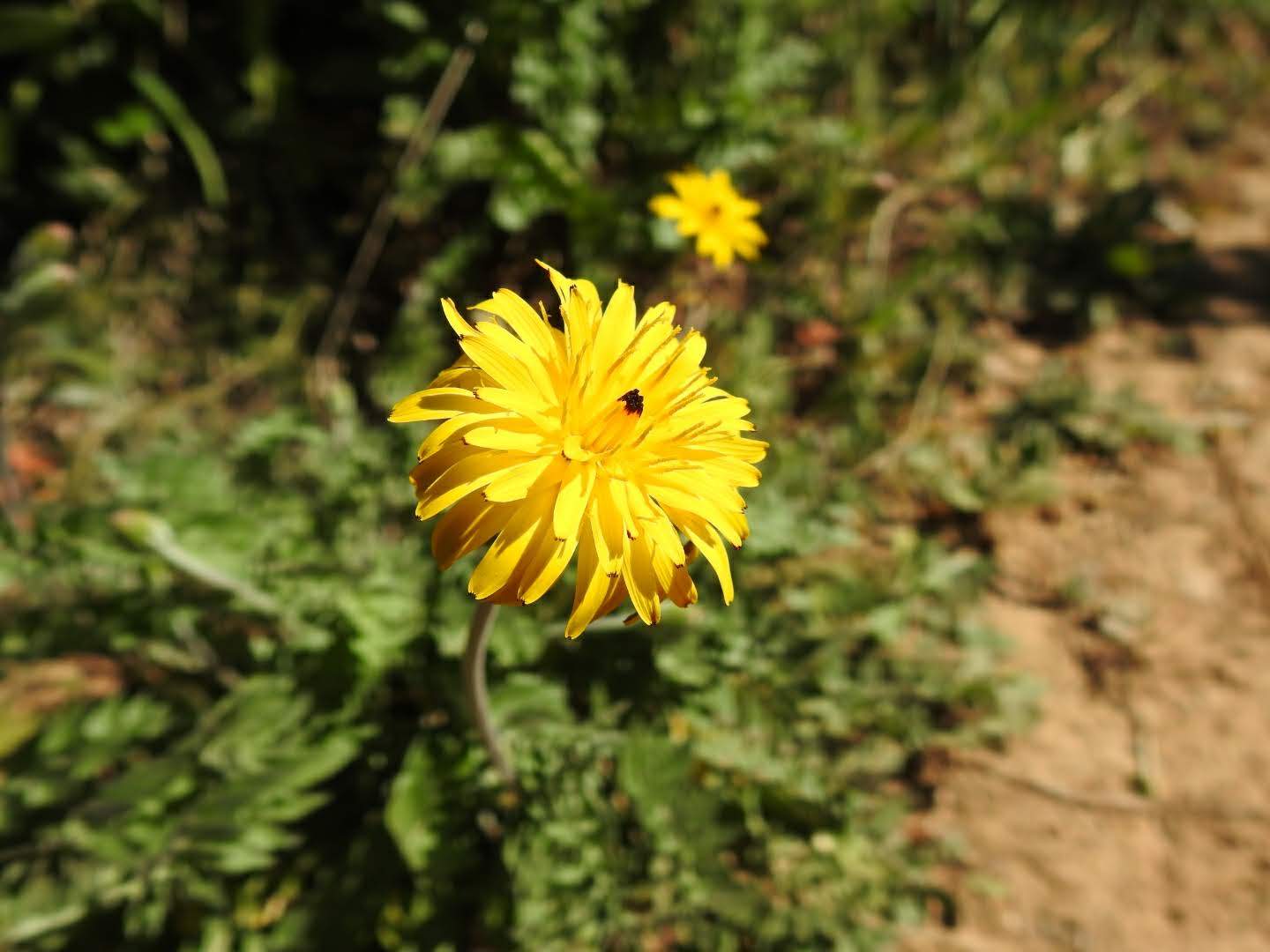
The flowers are ligulate, with numerous yellow petals arranged actinomorphically, i.e. symmetrically around the center, forming a radiating pattern that gave the plant its common name. The outer ligules are between 15 and 17 mm long, 3-4.5 mm wide, often greenish and reddened at the base, while the inner flowers are progressively smaller and completely yellow. The fruits are cylindrical-angular achenes, compressed, brown in color, 8 to 11 mm long, with a pappus of linear bristles (7-11 mm) that abundantly exceed the involucre of the capitulum. The central achenes are ciliate on the edge, while the peripheral ones are sterile and shorter.
The species shows significant morphological variability, especially regarding leaf pubescence, which can range from completely glabrous individuals to strongly hairy ones even within the same population. Some coastal populations, such as those of Sardinia and Pantelleria, present almost entirely glabrous leaves and entire lateral segments with rounded apex, characteristics that in the past suggested a taxonomic distinction.
Habitat and distribution
This species is widespread in Mediterranean areas, with a range known as the "olive area," which includes Mediterranean coasts and adjacent zones. In Italy it is mainly present in coastal and submontane regions, with a distribution extending from sea level up to about 1000 meters altitude. It typically grows in uncultivated grassy habitats, on walls, stony paths and soils with calcareous substrates, preferring sunny exposures and mountainous or hilly environments.
The plant is adapted to well-drained and calcareous-rich soils and is often found in anthropized or semi-natural environments, such as uncultivated lands and transition areas between cultivated and natural zones.
Flowering period
Flowering extends practically throughout the year, with a higher concentration from January to December, without significant seasonal interruptions in the milder Mediterranean environments. The long flowering phase allows a continuous presence of yellow flowers visible on the plant, facilitating reproduction and pollination.
Geographical variations may influence the intensity and duration of the flowering period, especially in areas with harsher or less favorable climates.
Ecology and pollination
The plant reproduces mainly sexually through seeds, which are dispersed by wind thanks to the feathery pappus that facilitates long-distance dispersal. Pollination is entomogamous, favored by pollinating insects attracted by the bright yellow flowers and their ligulate and radiating arrangement.
The main pollinators are insects belonging to groups such as bees, butterflies and other generalist pollinating insects frequenting Mediterranean grassy environments. The absence of foliar scales on the scapes and the solitary arrangement of the capitula make the flowers easily accessible to insects.
Curiosities and traditional uses
This species is recognized as edible and medicinal, with traditional use in food and folk medicine. Young leaves are used raw in mixed salads, often combined with aromatic plants such as pimpinella and wild fennel, or cooked in soups. They are also used as filling for tortelli, enhancing their slightly bitter flavor.
Historically, the plant is included in the list of “alimurgic” plants, i.e. spontaneous plants used as food in times of famine or war, testimony to its nutritional value and availability in the Italian countryside.
No specific pharmaceutical applications are known in depth but the species, like other Asteraceae, has traditionally been used for its medicinal properties in popular contexts. It is however important to underline that such uses are to be considered exclusively informative and do not replace medical or therapeutic advice.
Etymology
The scientific name derives from the Latin “hus” or “huios” meaning “pig” and “seris” or “seridos” indicating a “salad.” The term refers to the resemblance of the leaves or flowers to edible plants traditionally known as wild salads, to which a name related to food use for livestock or humans was also attributed.
The Italian common name “radicchio raggiato” alludes to the arrangement of the ligulate flowers arranged in a radiating pattern within the capitulum, highlighting the characteristic sunny and bright shape of the flower.
Sources
- Prof. S. Pignatti, Flora d'Italia
- Acta Plantarum - Flora delle regioni italiane (scheda di Nino Messina)
Characteristics
Scheda botanica
| Famiglia | Asteraceae |
|---|---|
| Fioritura | tutto l'anno |
| Forma biologica | Rosulate |
| Habitat | edible plant, with yellow flowers, Perennial plant |
| Uso alimentare | Commestibile |
Domande frequenti
- Quando fiorisce Radicchio raggiato?
- Radicchio raggiato fiorisce tutto l'anno.
- È commestibile Radicchio raggiato?
- Radicchio raggiato è considerata commestibile. Verifica sempre le parti eduli e la preparazione corretta prima del consumo.
- Che tipo di pianta è Radicchio raggiato?
- Radicchio raggiato è una Therophytes (Rosulate) secondo la classificazione di Raunkiaer.
- A quale famiglia appartiene Radicchio raggiato?
- Radicchio raggiato appartiene alla famiglia botanica Asteraceae.
Where I found it (3 sightings)
Classification
- Kingdom
- Plantae
- Family
- Asteraceae
- Full name
- Hyoseris radiata L.
- Synonyms
- Thlipsocarpus boeticus Kunze
- Life form
- Therophytes rosulate
Similar species
Search for species with similar characteristicsFurther reading
Noticed an error in the identification? Write to me
Other species of the same family
Asteraceae
Explore
Other species of Asteraceae