Botanical species
Urospermum dalechampii
(L.) F.W.Schmidt
Smooth golden fleece
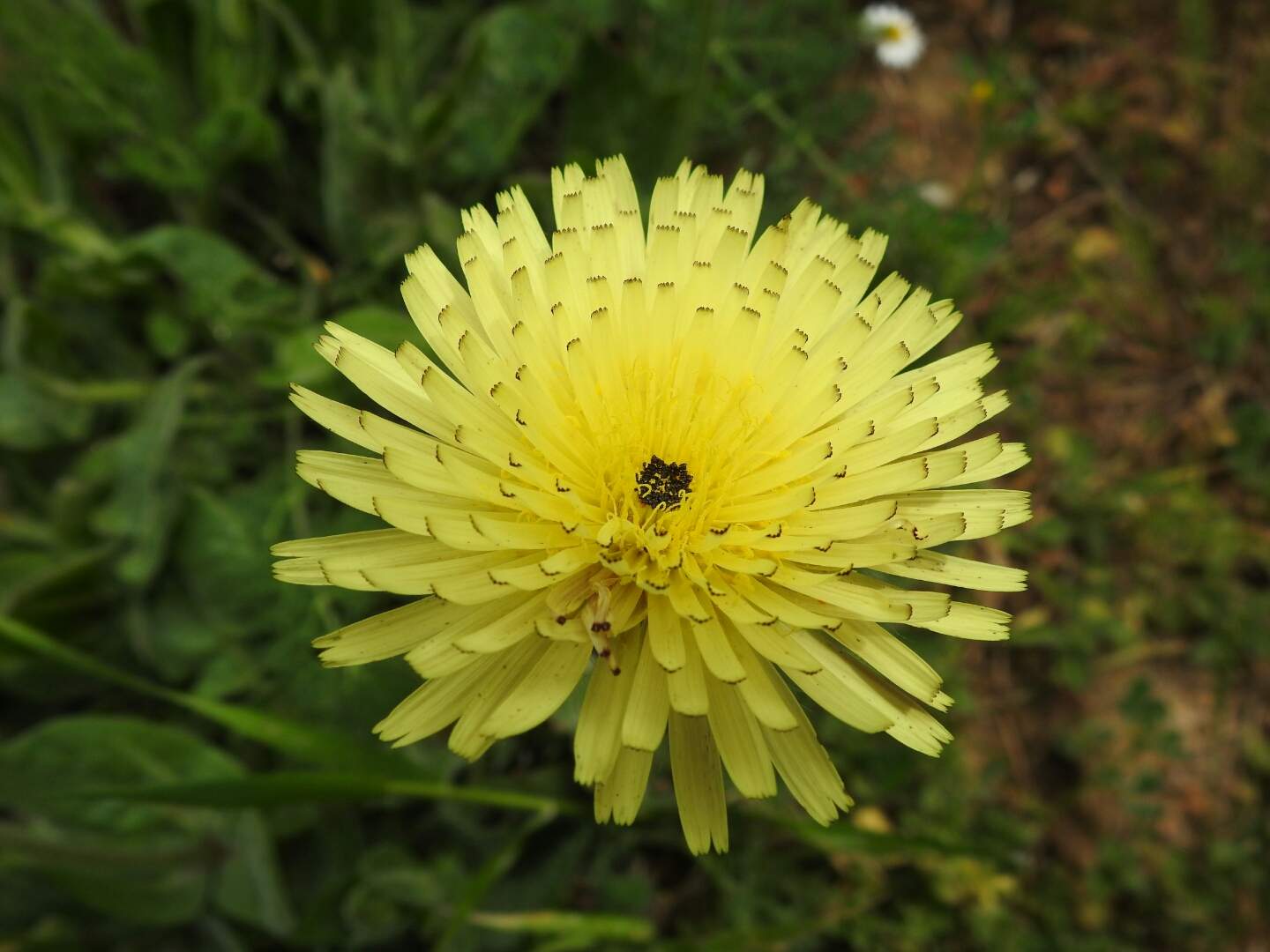
Description
Morphological description
Perennial herbaceous plant belonging to the family Asteraceae, with an erect or ascending herbaceous habit, reaching a height between 20 and 40 cm. The stem is simple or sometimes branched in the lower part, hollow in cross-section and covered by a dense pubescence formed by patent and bristly hairs, giving the plant a villous appearance. The surface of the stem therefore appears rough and slightly hairy.
The leaves are arranged alternately along the stem and show considerable morphological variability depending on their position. The basal leaves are pinnatifid or pinnatisect, about 5-6 cm long, with entire margin, petiole widened at the base and semi-clasping; these are broader and deeply divided. Moving upwards, the lower cauline leaves become progressively larger (up to 6-8 cm) and less deeply divided, while the upper leaves are lanceolate, subentire, often auriculate and clasping, smaller in size and, in some cases, arranged oppositely or in whorls of three. All leaves have a hairy surface.
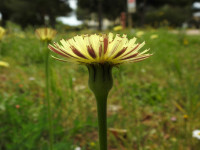
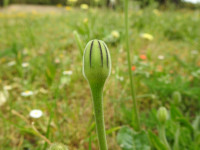
The capitulum is single, large (about 6 cm in diameter), borne on a long erect, naked and hollow peduncle, ending with an involucre composed of 7-8 uniseriate, lanceolate scales, with reddish margin and tomentose on the lower part. The flowers are all ligulate, with a ligule having five teeth, sulfur yellow in color with purple streaks at the base and apex, especially evident in the peripheral flowers which have a colorless tube about 12 mm long, with a ligule approximately 3 x 20 mm in size. The flower symmetry is actinomorphic and the capitulum has a scape-like habit (i.e. with flowers arranged on an elongated floral axis).
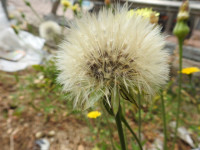
The fruit is an elongated achene (6-8 mm), wrinkled, equipped with a beak about twice the length of the achene body itself, hollow and rough. The pappus is plumose, dark, arranged in two series, and serves for seed dispersal by wind.
Habitat and distribution
Typically Mediterranean species, with distribution ranging from Liguria and western Italian regions to Spain and North Africa (Algeria). It is also present in some inland areas such as Drôme, Ardèche, Tarn, Lot, Aveyron, Lozère and Corsica. In Italy it is mainly found in coastal and submontane regions, up to an altitude of about 1200 meters above sea level.
It prefers open, sunny and dry habitats such as dry meadows, uncultivated areas, roadsides and poor soils, often calcareous or well-drained. The species is a scapose hemicryptophyte: it survives thanks to buds located at ground level and develops a bare and elongated floral axis. The plant is evergreen, retaining leaves even during the driest periods.
Flowering period
Flowering generally occurs from March to August, with a peak between May and June. In some Mediterranean areas flowering may be limited to the spring months, while in milder climatic conditions it can extend until late summer.
Ecology and pollination
The sulfur yellow flowers with purple streaks attract pollinating insects, particularly bees and butterflies, which act as pollinators. The ligulate structure and bright color favor entomophilous pollination. The plant, thanks to its long peduncle and large capitulum, is clearly visible in the open herbaceous landscape, facilitating insect attraction.
Seed dispersal occurs mainly by anemochory, thanks to the plumose and dark pappus which facilitates transport by the wind. The achene, equipped with a long hollow and rough beak, is adapted to this mode of dispersal, allowing the species to colonize new open and sunny habitats.
Curiosities and traditional uses
This species has a long history of use in food and medicinal traditions. The basal leaves were consumed cooked, seasoned like spinach, often mixed with other wild herbs such as Sonchus oleraceus, Tragopogon pratensis and Apium nodiflorum. The flower buds were instead preserved in brine like capers, representing a typical food of Mediterranean areas.
From a medicinal point of view, the plant was used to prepare infusions with digestive and anti-inflammatory properties, particularly against inflammation of the bile duct. In folk medicine it was also considered a galactagogue plant, probably due to the shape of the buds which resemble the nipple.
It is important to emphasize that traditional food and pharmaceutical uses are for informational purposes only and do not replace official medical advice.
Etymology
The scientific name derives from Greek: "oura" means "tail" or "beak", and "sperma" means "seed", referring to the long beak of the achene that characterizes the species. The specific epithet dalechampii is a tribute to the French botanist Jacques Dalechamp (1513-1588).
The Italian common name "Smooth golden fleece" refers precisely to the shape of the elongated and beaked fruit, distinguishing it from other similar species. Other common names are "Lattugaccio di Daléchamp" and "Amarago", which reflect the popular use and taste of the plant.
Sources
- Prof. S. Pignatti, "Flora d'Italia", Edagricole, Bologna 1982
- Acta Plantarum - Flora delle regioni italiane (scheda di Antonino Messina)
- Tela Botanica / H. Coste, "Flore descriptive et illustrée de la France"
Characteristics
Scheda botanica
| Famiglia | Asteraceae |
|---|---|
| Fioritura | marzo – agosto |
| Forma biologica | Scapose |
| Habitat | with yellow flowers, Perennial plant |
Domande frequenti
- Quando fiorisce Smooth golden fleece?
- Smooth golden fleece fiorisce marzo – agosto.
- Che tipo di pianta è Smooth golden fleece?
- Smooth golden fleece è una Hemicryptophytes (Scapose) secondo la classificazione di Raunkiaer.
- A quale famiglia appartiene Smooth golden fleece?
- Smooth golden fleece appartiene alla famiglia botanica Asteraceae.
Where I found it (1 sightings)
Classification
- Kingdom
- Plantae
- Family
- Asteraceae
- Full name
- Urospermum dalechampii (L.) F.W.Schmidt
- Synonyms
- Tragopogon dalechampii L
- Life form
- Hemicryptophytes scapose
Similar species
Search for species with similar characteristicsFurther reading
Noticed an error in the identification? Write to me
Other species of the same family
Asteraceae
Explore
Other species of Asteraceae