Botanical species
Carduus pycnocephalus
L.
Plymouth Thistle
Description
Morphological description
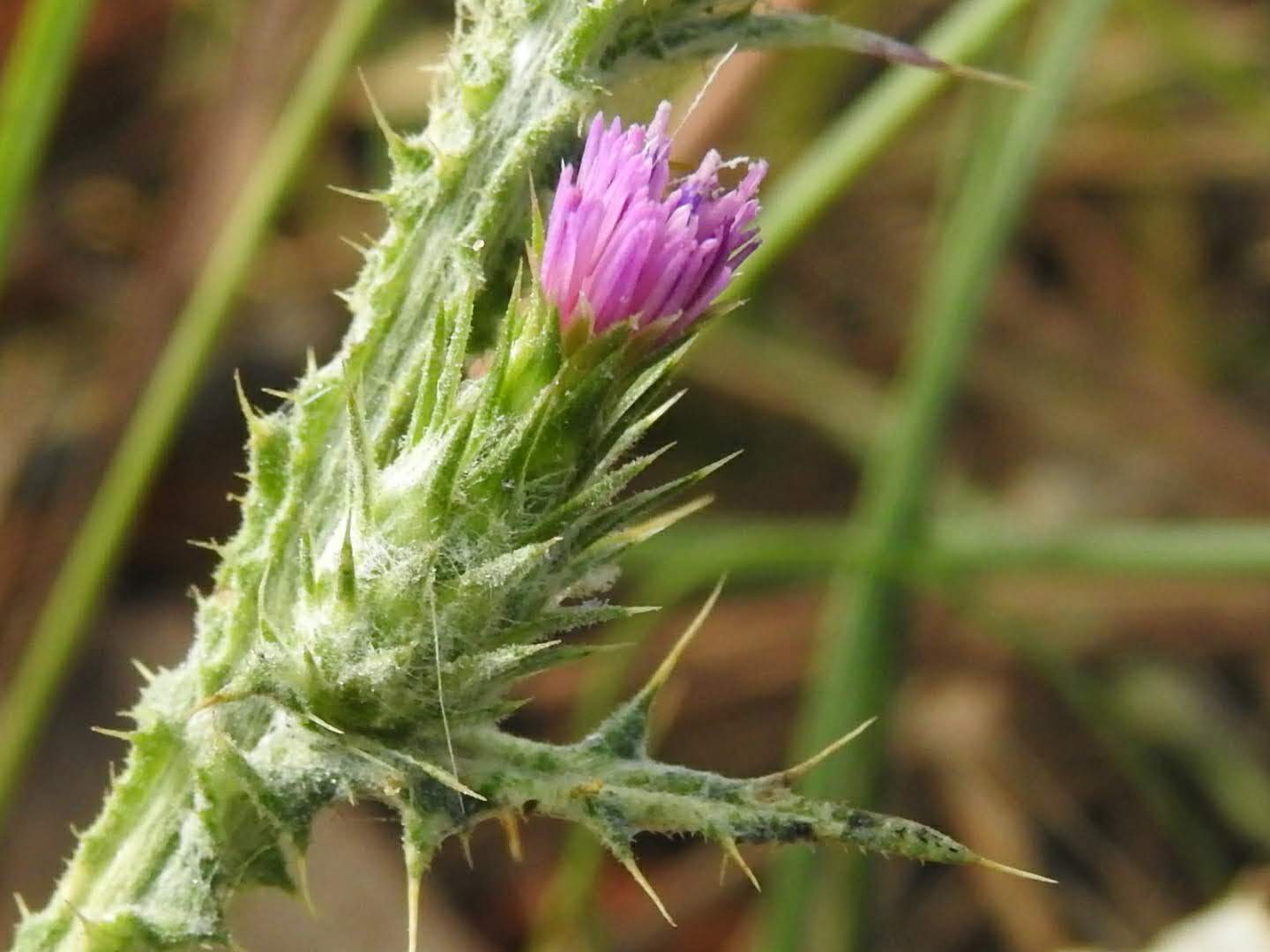
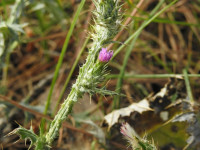
The Plymouth Thistle is an annual or biennial herbaceous plant belonging to the family Asteraceae, characterized by an erect habit and branched in the upper part. The stem, cylindrical in appearance, may have wings that sometimes reach the base of the flower heads; the surface is generally woolly, tomentose, and hirsute, with a rough texture and covered by robust spines 10 to 15 mm long.
The leaves, arranged along the stem, are generally 5 to 15 cm long, lanceolate in shape with strongly spiny margins, with spines 3 to 10 mm long. They are deeply segmented, with 3-5 angular segments per side, and have a white-woolly or cobwebby underside. The margin is bordered by numerous spines that can reach up to 1 cm in length. The cauline leaves may run along the stem and, when present, the floral leaves do not exceed the flower heads.
The inflorescence consists of cylindrical flower heads, longer than wide (about 1.5-2 cm in diameter), arranged in small groups of 2-3 (up to 5) or solitary. The involucre is cylindrical, about 1 cm long and 2 cm wide, with medium scales 14-16 mm long and with a short acuminate tip; the outer scales are scarious, cobwebby, and ciliate on the edge. The flowers are all tubular and hermaphroditic, pink-violet in color (rarely purple or whitish) and 15-17 mm long. The corolla is enveloped for about four-fifths by the pappus, which is feathery with simple bristles, facilitating seed dispersal.
The fruits are light achenes, ovoid and grooved, equipped with a feathery pappus that facilitates aerial transport.
The root system, as typical of biennial herbaceous plants, is well developed to allow anchorage and absorption in dry and uncultivated environments.
Habitat and distribution
The Plymouth Thistle is a species typical of Mediterranean regions and the Euro-Mediterranean area, also present in semi-desert Turano-Asian zones. In Italy it is mainly widespread in the regions of Lazio, the Peninsula, Sicily, Sardinia, Corsica, and other small minor islands. In the rest of northern Italy it is mainly present in drier areas, while in more humid areas it is rare, missing in some zones such as Trentino, Friuli, and much of the alluvial plains.
It prefers dry and uncultivated habitats, such as road edges, river and canal banks, dumps, and abandoned lands up to 1000 meters altitude. It grows on well-drained, often poor soils, and tolerates sunny exposures and drought conditions, adapting to stony or sandy soils typical of Mediterranean environments.
Flowering period
Flowering mainly occurs between April and July, with some possible geographic variation related to local climatic conditions. In Mediterranean regions flowering can start as early as April, while in more northern or mountainous areas it may shift to the warmer months of late spring and early summer.
Ecology and pollination
The Plymouth Thistle, like many Asteraceae, is pollinated by pollinating insects, particularly bees, bumblebees, and other pollinators attracted by the pink-violet color of the flowers and the presence of nectar. The tubular structure of the flowers, hermaphroditic and dense, favors entomogamous pollination.
Seed dispersal mainly occurs through the feathery pappus which allows the achene fruits to be carried by the wind, facilitating colonization of new environments, often disturbed or dry, where the species can behave as a weed.
Curiosities and traditional uses
There are no specific data available on traditional or medicinal uses of the Plymouth Thistle. However, like many Carduus species, it is possible that in the past it was used in phytotherapy for its bitter properties or for treatments related to the liver, but these informations are not confirmed by reliable sources in the provided material.
The species is mainly known for its potential as a weed in agricultural environments and uncultivated lands, where it can become a problem for soil management.
Etymology
The genus name Carduus derives from a Sanskrit root "kar" meaning "hard", combined with the Greek "árdis" meaning "sting", referring to the robust spines that characterize these plants.
The specific name pycnocephalus derives from the Greek "pyknós" (dense) and "kephalé" (head), recalling the presence of dense and compact flower heads.
The Italian common name "cardo saettone" probably refers to the pointed shape and the long, sharp spines that resemble "saette", i.e. arrows.
Sources
- Acta Plantarum - Flora delle regioni italiane (actaplantarum.org)
- Acta Plantarum - Flora delle regioni italiane (scheda di Mirna Medri)
- World Flora Online (WFO)
Characteristics
Scheda botanica
| Famiglia | Asteraceae |
|---|---|
| Fioritura | aprile – luglio |
| Forma biologica | Biennials |
| Habitat | spiny plant, with purple flowers, with pink flowers |
Domande frequenti
- Quando fiorisce Plymouth Thistle?
- Plymouth Thistle fiorisce aprile – luglio.
- Che tipo di pianta è Plymouth Thistle?
- Plymouth Thistle è una Hemicryptophytes (Biennials) secondo la classificazione di Raunkiaer.
- A quale famiglia appartiene Plymouth Thistle?
- Plymouth Thistle appartiene alla famiglia botanica Asteraceae.
Where I found it (13 sightings)
Classification
- Kingdom
- Plantae
- Family
- Asteraceae
- Full name
- Carduus pycnocephalus L.
- Life form
- Hemicryptophytes biennials
Similar species
Search for species with similar characteristicsFurther reading
Noticed an error in the identification? Write to me
Other species of the same family
Asteraceae
Explore
Other species of Asteraceae