Botanical species
Erigeron sumatrensis
Retz.
Guernsey Fleabane
Description
Morphological description
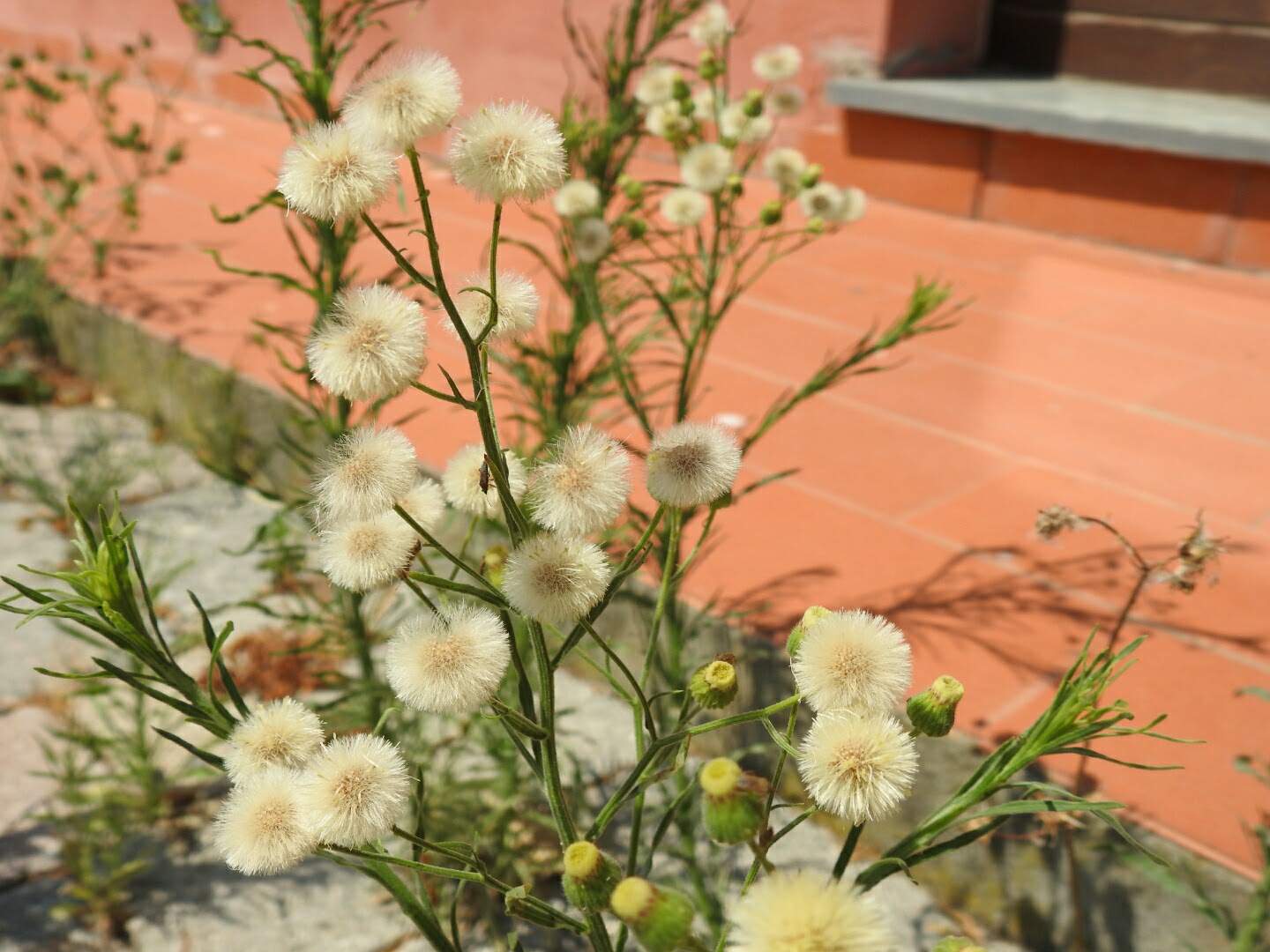
Annual or biennial herbaceous plant, Erigeron sumatrensis can reach a height between 50 and 200 cm, making it the tallest species of the genus present in Italy. The stem is erect, robust, grooved and often branched from the base, covered by a dense pubescence made up of hirsute and stellate hairs that give it a rough and bristly texture. The surface of the stem is also striated and wrinkled.
The basal leaves are arranged in rosettes and are oblanceolate or elliptical, with sizes that can reach up to 10 cm in length and 1.5 cm in width. They have an acute apex and an attenuated base; the margin is generally entire or slightly toothed or lobed towards the apex. The lateral veins are well visible and marked. The lower cauline leaves are similar to the basal ones but tend to wither during flowering while persisting; the upper cauline leaves are smaller, lanceolate or linear, alternate, with subentire margins and also covered by pubescence on both surfaces.
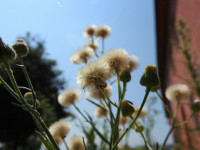
The flowers are gathered in numerous pedunculate heads, bell-shaped or urn-shaped, arranged in large corymbose or panicle-like inflorescences, with branches shorter than the main axis. The involucre is formed by linear-lanceolate bracts arranged in three series, acute and sparsely covered with hirsute hairs, with the outer bracts smaller than the inner ones. The flowers are all tubular and lack true ligules; the ray flowers are reduced to minute filiform ligules, pale yellow or white-yellowish in color, often with pinkish shades. The disc flowers have pentalobate tubular corollas, golden yellow in color. The diameter of the heads is less than 1 cm.
The fruits are oblanceolate oblong achenes, about 0.7-1.5 mm long, compressed and wrinkled, covered by a thin finely strigose pubescence. The pappus, whitish turning yellow-brown or reddish with age, is formed by thin and persistent bristles about 5 mm long, facilitating anemochorous dispersion.
The root system is taprooted with fusiform roots, firmly anchoring the plant to the soil.
Habitat and distribution
Native to South America, Erigeron sumatrensis has widely naturalized in Italy, where it is now present in all regions, being an invasive and weedy species. It commonly grows in anthropized environments such as uncultivated lands, edges of country roads, alluvial and sandy soils, including coastal environments like dunes, at altitudes between 0 and 600 meters.
In the Mediterranean in general, the species prefers disturbed places and poor or degraded soils, where it behaves as a weed. The plant is adapted to sunny exposures and well-drained soils, showing good tolerance to temporary drought conditions.
Flowering period
The flowering period extends from June to November, with a peak that may vary slightly depending on latitude and local climatic conditions. In Italy, flowering is more intense between July and September. The inflorescences persist for a long time, allowing effective seed production throughout the growing season.
Ecology and pollination
The flowering of Erigeron sumatrensis is characterized by tubular flowers adapted to attract generalist insect pollinators, particularly bees and flies, which feed on nectar and pollinate the flowers. The absence of showy ligules suggests a lower visual attraction compared to other Asteraceae, but the abundant flower production still favors entomophilous pollination.
Seed dispersal occurs mainly through the feathery pappus, which promotes anemochorous propagation over long distances. This mechanism contributes to the rapid spread of the species in new habitats, facilitating its invasive character.
Curiosities and traditional uses
No significant traditional medicinal or food uses are documented for this species in Italy or the Mediterranean. The common name "Guernsey Fleabane" and other synonyms derive from the presumed geographic origin, although the plant is native to the American continent. The genus Erigeron has phytotherapeutic uses in some cultures, but no relevant ethnobotanical uses are reported for E. sumatrensis.
The species is mainly known for its role as a weed in crops and anthropized environments, where it can compete with native flora and represent a problem for agriculture.
Etymology
The generic name Erigeron derives from Greek: "er" (early) and "geron" (old man), referring to the short flowering duration, which seems to "hasten" the end of the growing season. The specific name sumatrensis indicates a presumed origin or discovery linked to Sumatra, although the species is actually native to South America.
The synonym Conyza may derive from a plant emitting an odor similar to that of a stink bug or from the Greek kònopos, meaning "flea," probably referring to the weedy and annoying nature of the plant.
The Italian common name "Guernsey Fleabane" reflects the Latin specific name, used to indicate a tufted herb of exotic origin.
Sources
- Acta Plantarum - Flora delle regioni italiane (actaplantarum.org)
- Acta Plantarum - Flora delle regioni italiane (scheda di Giuliano Salvai)
- Tela Botanica / H. Coste, "Flore descriptive et illustrée de la France"
- World Flora Online (WFO)
Characteristics
Scheda botanica
| Famiglia | Asteraceae |
|---|---|
| Fioritura | giugno – novembre |
| Forma biologica | Scapose |
| Habitat | with white flowers, with yellow flowers |
Domande frequenti
- Quando fiorisce Guernsey Fleabane?
- Guernsey Fleabane fiorisce giugno – novembre.
- Che tipo di pianta è Guernsey Fleabane?
- Guernsey Fleabane è una Therophytes (Scapose) secondo la classificazione di Raunkiaer.
- A quale famiglia appartiene Guernsey Fleabane?
- Guernsey Fleabane appartiene alla famiglia botanica Asteraceae.
Where I found it (17 sightings)
Classification
- Kingdom
- Plantae
- Family
- Asteraceae
- Full name
- Erigeron sumatrensis Retz.
- Synonyms
- Conyza albida Willd. ex Spreng.
- Life form
- Therophytes scapose
Similar species
Search for species with similar characteristicsFurther reading
Noticed an error in the identification? Write to me
Other species of the same family
Asteraceae
Explore
Other species of Asteraceae