Botanical species
Tragopogon porrifolius
L.
Salsify
Description
Morphological description
Biennial plant generally 20 to 80 cm tall, with erect stems, simple or slightly branched, with a glabrous and glaucous surface, sometimes with sparse floccose hairiness. The root is a vertical, woody taproot of significant size, similar to that of wild leek, from which the specific name derives.
The basal leaves are linear, up to 10-15 cm long and about 0.5 cm wide, narrow and conduplicate (folded longitudinally), with slightly cobwebby margins on young leaves. The cauline leaves are clasping, with a sheath 2-3 cm wide and a shorter blade, 4-10 cm long, often canaliculate and glabrous. The leaves are alternately arranged along the stem and have entire margins.
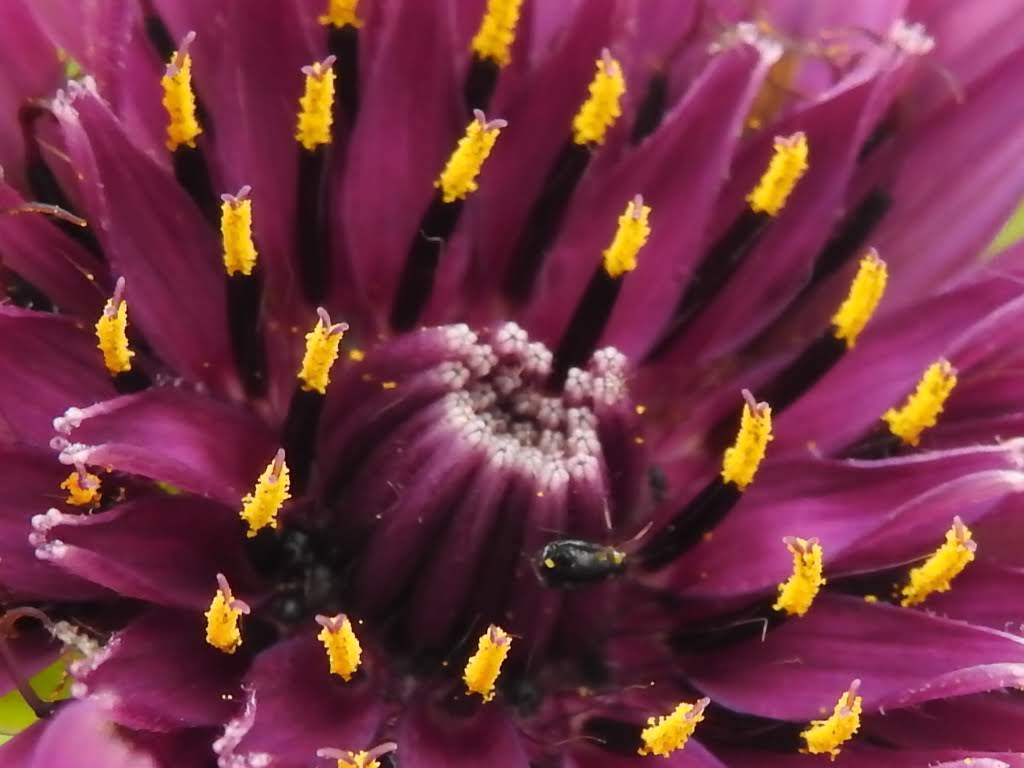
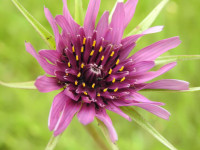
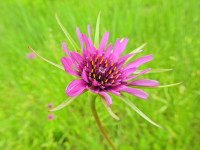
The inflorescence consists of a solitary capitulum, globose in shape and 6-7 cm in diameter, supported by a thickened and fistulous peduncle 4-5 cm long (up to 10 mm in diameter). The capitulum is composed of about 8 involucral bracts 2.5-4 cm long, which often exceed the corolla of the flowers. The flowers are ligulate, with a corolla of brown-violet or violet color, 23-26 mm long, and actinomorphic symmetry. The ligules, essentially monomorphic, tend to progressively increase in size from the center towards the periphery of the capitulum, with pigmentation variations from light reddish-brown to blackish-red, with a yellowish base in the lighter specimens.
The fruit is a fusiform achene, 6-8 cm long including the beak and pappus, with a thin and elongated beak about 1-1.3 mm long, brown in color and characterized by a polyhedral surface sometimes longitudinally grooved. The pappus consists of light brown feathery bristles, which facilitate anemochorous dispersal.
Habitat and distribution
The species is widespread throughout Italy and the Mediterranean basin, with a eurymediterranean range extending north and east, also covering some temperate European regions. It mainly grows in open environments such as dry meadows, uncultivated lands, rural road edges, and fields, from lowland areas up to about 1000 meters in altitude.
It prefers well-drained soils, often moderately moist, but it is a xerophilous plant adapted to seasonal drought conditions. It is not a typical species of the more anthropized roadside edges like other related species, but is more frequently found in semi-natural or agricultural marginal habitats.
Flowering period
Flowering mainly occurs between May and June, with possible local variations related to altitude and climate. In some Mediterranean areas, the period may start earlier or extend slightly, but generally flowering is concentrated in late spring and early summer.
The capitula open in the morning hours and tend to close in the early afternoon of the same day.
Ecology and pollination
The violet and brown ligulate flowers attract various pollinating insects, particularly bees and other pollinators that benefit from the nectar and pollen offered. The structure of the capitulum, with monomorphic ligules and a convex pompom arrangement, facilitates insect access.
Seed dispersal occurs through the feathery pappus that allows anemochorous dissemination, exploiting the wind to carry the achenes over distances. The long beak of the achene favors penetration into the soil or anchoring to surfaces to improve germination.
Curiosities and traditional uses
The common name "Barba di becco" refers to the characteristic shape of the fruit with the long feathery beak that resembles the "beard" of a goat, from which the genus name Tragopogon also derives (from Greek "tragòs" = goat and "pogòn" = beard).
This plant is edible and has always been used as a vegetable. The young basal rosette of the first year is consumed cooked or in salad, while the root, similar to a carrot or leek, is edible and suitable for preparations in pinzimonio or with béchamel sauce. The root is rich in inulin, a polysaccharide useful for producing sugars suitable for diabetics.
From a medicinal point of view, the plant has depurative, diuretic, sudorific, and expectorant properties, attributable to its main constituents such as glucids, proteins, and lipids. Historically, around the 16th century, Tragopogon porrifolius replaced Scorzonera hispanica in vegetable cultivation, another edible root.
An interesting phenomenon is the attack by the parasitic fungus Ustilago tragopogi, which transforms the inflorescence into a black powdery mass, altering its normal reproductive function.
Etymology
The genus Tragopogon derives from ancient Greek: "tragòs" means "goat" and "pogòn" means "beard", referring to the shape of the feathery fruit that resembles a goat's beard. The specific epithet "porrifolius" indicates the similarity of the leaves to those of leek (Allium porrum), i.e., long, linear, and clasping leaves.
The Italian common name "Barba di becco" precisely recalls the particular "beard" of the fruit, a very evident and distinctive characteristic of the species.
Sources
- Prof. P.V. Arrigoni, "Flora analitica della Toscana", "Flora dell'Isola di Sardegna"
- Acta Plantarum - Flora delle regioni italiane (scheda di Nino Messina)
- World Flora Online (WFO)
Characteristics
Where I found it (14 sightings)
Classification
- Kingdom
- Plantae
- Family
- Asteraceae
- Full name
- Tragopogon porrifolius L.
- Synonyms
- Tragopogon australis Jord.; Tragopogon porrifolius L. subsp. australis (Jord.) Nyman; Tragopogon sativus Gaterau, nom. illeg.
- Life form
- Emicriptofite bienni
Similar species
Search for species with similar characteristicsNoticed an error in the identification? Write to me
Other species of the same family
Asteraceae
Explore
Other species of Asteraceae