Botanical species
Bellis perennis
L.
Daisy
Description
Morphological description
Perennial herbaceous plant, slow growing, generally 5 to 15 cm tall, with simple, scapiform stems, generally leafless (aphyllous) and covered with a slight pubescence. The base of the stem may have some leaves on a few centimeters, sometimes more developed in some varieties. The root system is rhizomatous, which allows the plant to survive and regenerate even in adverse conditions, promoting the formation of extensive colonies.
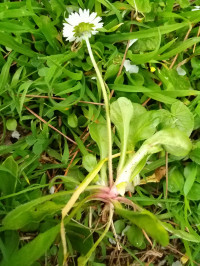
The leaves are all basal, arranged in a rosette close to the ground, with a spatulate blade (wider towards the apex and cuneate at the base) about 3.5-4 cm long and 1.4-1.6 cm wide. The leaf margin is generally denticulate or crenulate, rarely entire, and herbaceous in texture. The central vein is single and clearly visible. When young, the leaves are tomentose, then tend to become almost glabrous. The petiole is winged and well defined.
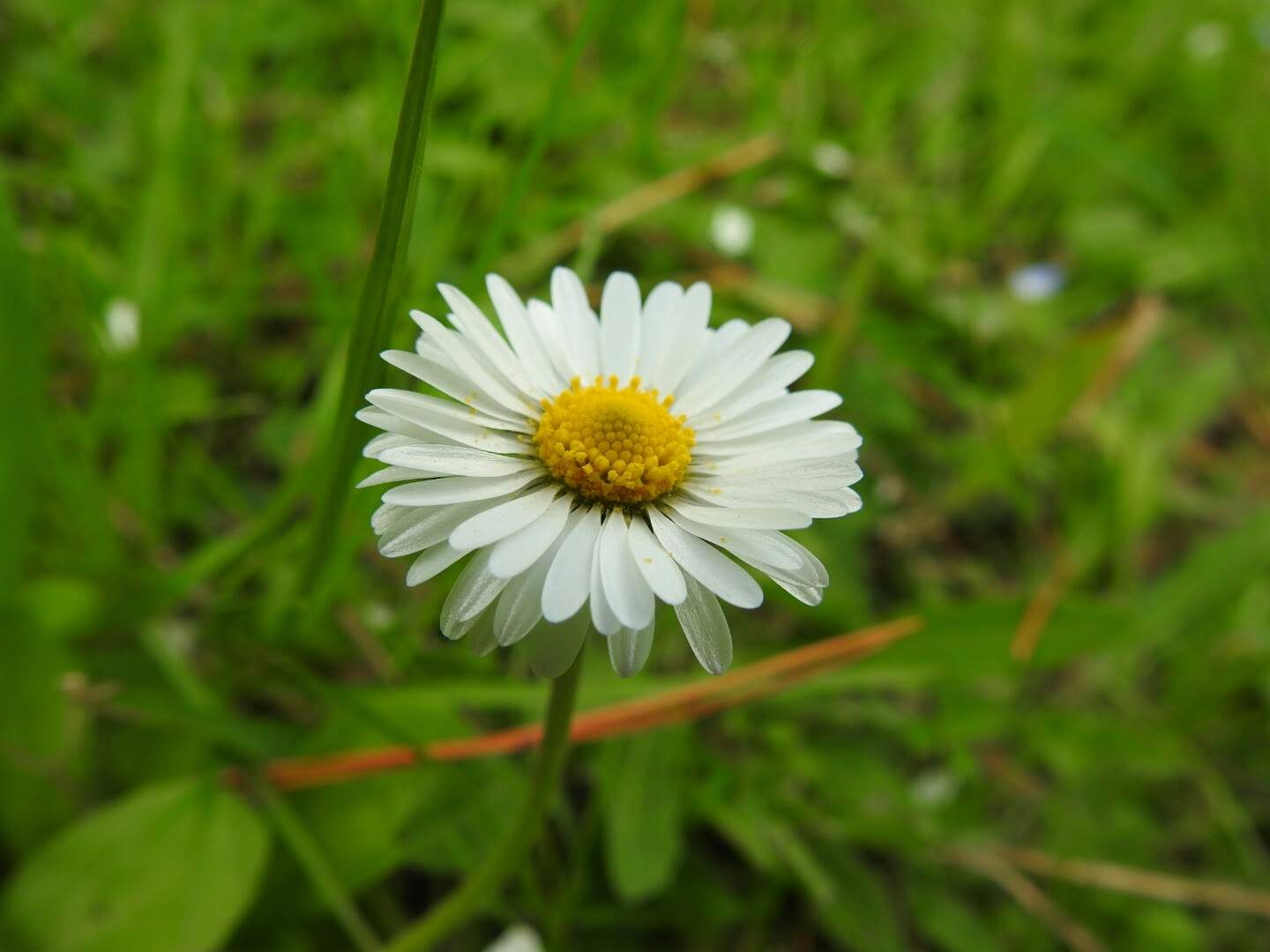
The inflorescence consists of a single terminal capitulum, about 2 cm in diameter, supported by a conical receptacle, about twice the length of the capitulum diameter itself. The involucre is composed of two series of linear-spatulate bracts, obtuse or rounded at the apex, 3-5 mm long, slightly pubescent.
The flowers are of two types: the peripheral, ligulate, with white corollas (sometimes tinged with pink or purplish red on the underside), 8-9 mm long and numerous; the central, tubular, yellow in color, about 1.5-1.7 mm long, hermaphroditic with anthers about 1 mm long. The peripheral flowers are actinomorphic, with radial symmetry, and incline closing at night or in cloudy weather, reopening with sunlight. The receptacle is convex and lacks chaff between the flowers.
The fruit is an oval achene about 1.5 mm long, provided with clavate hairs and lacking a pappus, a characteristic that limits long-distance dispersal by wind.
Several phenotypic variations are reported in Italy and the Mediterranean, with differences in capitulum size, organ hairiness, and leaf shape. Some varieties have smaller capitula or slightly leafy stems at the base.
Habitat and distribution
This is a species widely distributed throughout the Italian territory, including the islands, and in much of Europe and the Caucasus. It mainly grows in meadows, pastures, path edges, and dry or trampled places, showing remarkable tolerance to disturbed environments.
Growth altitude ranges from 0 up to about 2000 meters above sea level, with common presence also in mountainous environments. It prefers well-drained soils of variable type and adapts well to sunny or partially shaded exposures.
The arrangement of leaves in a rosette close to the ground, combined with rhizomatous growth, protects it from grazing and mowing, allowing the development of dense and uniform turf, often dominant over other herbaceous species.
Flowering period
Flowering extends from December to April in many areas, but the species can actually flower almost year-round under favorable conditions, with a higher concentration in spring and autumn months. In some Mediterranean and mountainous regions, flowering can last from March to November.
Ecology and pollination
The daisy is mainly pollinated by pollinating insects, including bees, flies, and butterflies, attracted by the colorful flowers and nectar produced by the central tubular flowers. The outer ligulate flowers serve a visual attraction function.
The closing of the peripheral flowers during the night and in low light conditions is a strategy to protect reproductive organs and optimize insect visitation frequency during daylight hours.
Seed dispersal mainly occurs by falling near the mother plant, due to the absence of pappus and the weight of the achenes, with limited capacity for long-distance movement.
Curiosities and traditional uses
This species has a long history of use in folk and medicinal contexts. Its leaves and flowers are edible and were traditionally used in cooking, both raw in salads and cooked in soups or preserved in vinegar.
From a medicinal point of view, the daisy is known for its vulnerary, emollient, diuretic, and astringent properties. In the past, an ointment based on the plant was used to treat trauma, bruises, wounds, and skin inflammations, while an infusion of the flowers was used to promote diuresis and sweating, acting as a detoxifier.
In folklore, the daisy symbolizes innocence, grace, and kindness, but also indecision and waiting, as suggested by the traditional love games “he loves me, he loves me not.” In the Middle Ages, it was even attributed prophetic powers in love matters.
The flowers are resistant to harsh temperatures down to -15 °C in dry air conditions, which contributes to the longevity of flowering and the spread of the species even in cold temperate climates.
Etymology
The genus name derives from the Latin "béllus," meaning "beautiful," referring to the grace and delicacy of the plant and its flowers. The specific name "perennis" indicates the perennial nature of the species and its long duration over time, often with flowering extending for much of the year.
The Italian common name "margheritina" or "pratolina comune" recalls the characteristic appearance similar to a small daisy and its typical habitat in meadows.
In English, the name "daisy" derives from the contraction of the old Anglo-Saxon term "days eye," referring to the flower's ability to open at sunrise and close at sunset.
Sources
- Prof. S. Pignatti, "Flora d'Italia"
- Acta Plantarum - Flora delle regioni italiane (sheet by Marinella Zepigi)
- Tela Botanica / H. Coste, "Flore descriptive et illustrée de la France"
- World Flora Online (WFO)
Characteristics
Where I found it (3 sightings)
Classification
- Kingdom
- Plantae
- Family
- Asteraceae
- Full name
- Bellis perennis L.
- Synonyms
- Bellis hybrida Ten.; Bellis pusilla (N.Terracc.) Pignatti
- Life form
- Emicriptofite rosulate
Similar species
Search for species with similar characteristicsFurther reading
Noticed an error in the identification? Write to me
Other species of the same family
Asteraceae
Explore
Other species of Asteraceae