Botanical species
Centaurea calcitrapa
L.
Red Star-thistle
Description
Morphological description
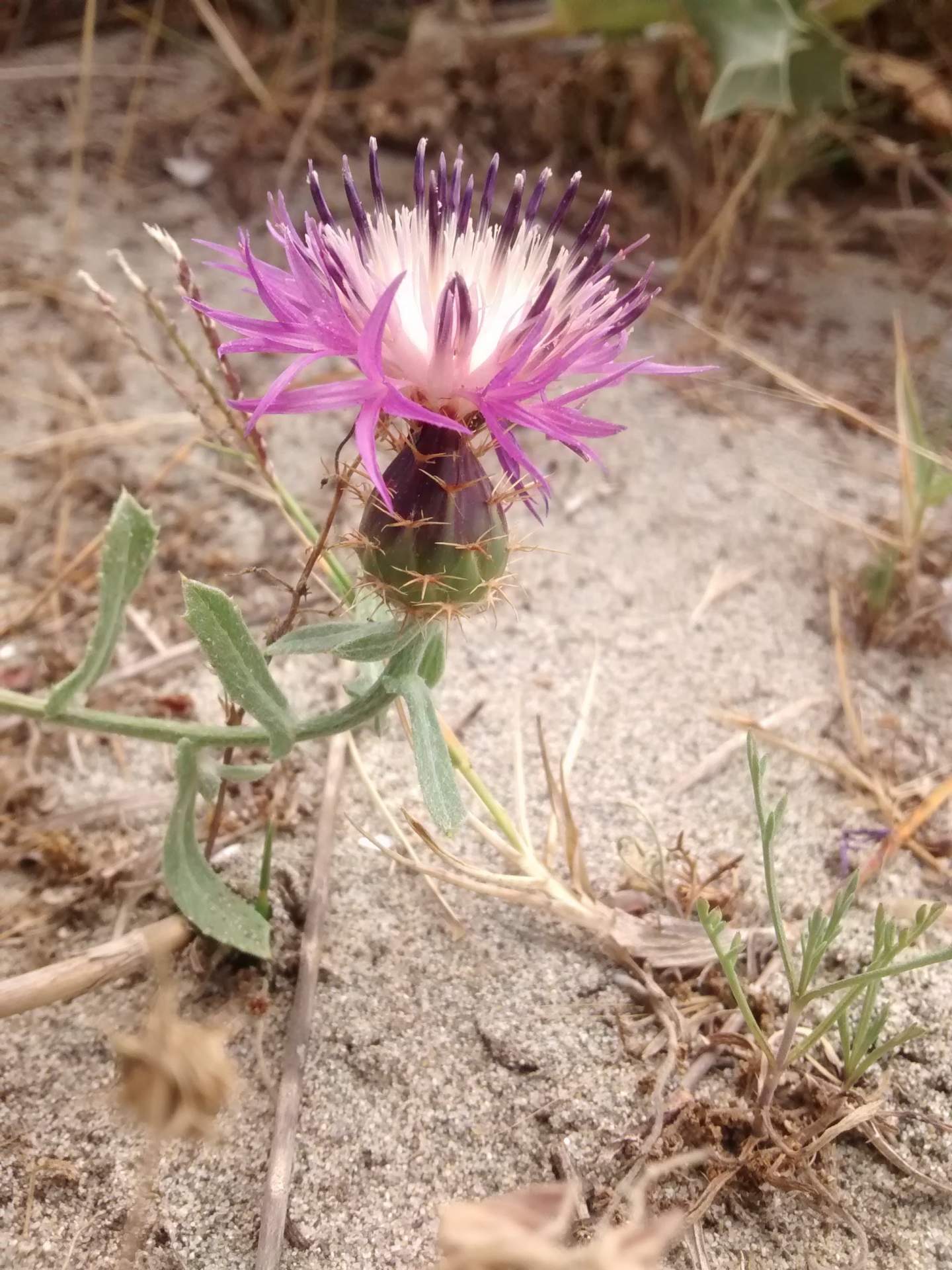
Biennial herbaceous plant, height variable between 15 and 50 cm, with a prostrate-ascending habit featuring numerous divaricate and slender branches, which may appear cobwebby or nearly glabrous. The stem is rough and angular in the upper part, with a surface initially puberulent or tomentose that tends to become more glabrous over time.
The basal leaves, often present in a rosette, are pinnatisect or pinnatipartite, petiolate, with linear segments about 18-25 mm long and 1-2 mm wide, denticulate and subspiny or rough to the touch. These basal leaves tend to disappear during flowering. The cauline leaves are alternate, sessile, variably shaped from pinnatifid to entire linear, with ± denticulate margins often equipped with spiny mucros, giving the plant a spiny appearance.
The capitula, numerous and placed axillary or apically, are subsessile or shortly pedunculate and surrounded by linear floral leaves. The involucre is pyriform or ovoid, measuring between 6 and 10 mm in diameter, formed by shiny green and coriaceous outer scales with a narrow and scarious margin. Each scale ends in a robust median spine, 14 to 25 mm long, yellowish and spreading, accompanied at the base by two pairs of shorter spines of 2-3 mm, forming a sort of "feathered spine". The inner scales have truncate appendages and are spineless.
The flowers, all tubular and actinomorphic, are pink-purple, rarely white. In the capitulum, the peripheral flowers are sterile and ray-like, while the central ones are hermaphroditic. The corollas vary in length between 15 and 24 mm and are composed of numerous tubular petals (25-40 per capitulum).
The fruit is an achene (cypsela) 2.5-4 mm long, glabrous, whitish with brown striations or lines, lacking a pappus or with a very reduced pappus (1-3 mm). The absence or small size of the pappus suggests that dispersal mainly occurs by falling and mechanical transport rather than by wind.
Habitat and distribution
The species is widespread throughout much of Italy and the Mediterranean basin, with confirmed presence in subcosmopolitan and xerothermophilous environments. It typically grows in dry uncultivated areas, road edges, ruins, cultivated fields, and vineyards, on well-drained and often calcareous soils, from flatland up to about 1400 meters above sea level.
It prefers sunny exposures and open environments, tolerating drought conditions and poor soils well. Its adaptability makes it common in anthropized and disturbed environments, where it can appear as a pioneer species.
Flowering period
Flowering mainly occurs in the summer months, from June to August, with some geographical variations where it can extend until September. The flowering phase coincides with the hottest and driest period of the year, during which the plant completes its biennial cycle producing numerous capitula.
Ecology and pollination
The plant adapts to a biennial cycle, with buds located at ground level (biennial hemicryptophyte), allowing survival during winter and vegetative regrowth in spring. Flowering attracts various pollinating insects, particularly bees and other hymenopterans, which are attracted by the pink-purple color and tubular shape of the flowers.
The sterile peripheral ray flowers are probably functional in attracting pollinators, while the central hermaphroditic flowers ensure seed production. Seed dispersal mainly occurs by falling (barochory), given the absence of a developed pappus, and can be facilitated by animals or human passage.
Curiosities and traditional uses
The common name "Red Star-thistle" refers to the particular spiny structure of the involucral bracts, which resemble Roman triboli, ancient four-pointed devices used to injure or cripple animals or enemies by stepping on them. This characteristic makes the plant rather troublesome in areas frequented by people or animals.
No widespread traditional food or medicinal uses are documented for this species, probably due to its spinosity and bitter taste. However, the genus Centaurea in general is known in phytotherapy for some species with anti-inflammatory or digestive properties. In local folklore, the plant is sometimes associated with symbols of protection and defense, due to its spiny armor.
Etymology
The genus name derives from Latin centaureum and Greek κενταυρίη (kentauríē), referring to the centaur Chiron of Greek mythology, who according to tradition discovered the medicinal virtues of these plants. The specific name calcitrapa is composed of calx (heel or foot) and trapa (tribulus or trap), a clear reference to the robust and sharp spines of the involucral bracts that can injure those who step on the plant.
The Italian common name "Calcatreppola" derives from the same idea, evoking the "trap" for the foot constituted by the spines so sharp and resistant.
Sources
- Prof. S. Pignatti, "Flora d'Italia"
- Acta Plantarum - Flora delle regioni italiane (sheet by Anja Michelucci)
- Tela Botanica / H. Coste, "Flore descriptive et illustrée de la France"
- World Flora Online (WFO)
Characteristics
Scheda botanica
| Famiglia | Asteraceae |
|---|---|
| Fioritura | giugno – agosto |
| Forma biologica | Biennials |
| Habitat | with fuchsia flowers, spiny plant, plant with leaves with irregularly toothed margin |
Domande frequenti
- Quando fiorisce Red Star-thistle?
- Red Star-thistle fiorisce giugno – agosto.
- Che tipo di pianta è Red Star-thistle?
- Red Star-thistle è una Hemicryptophytes (Biennials) secondo la classificazione di Raunkiaer.
- A quale famiglia appartiene Red Star-thistle?
- Red Star-thistle appartiene alla famiglia botanica Asteraceae.
Classification
- Kingdom
- Plantae
- Family
- Asteraceae
- Full name
- Centaurea calcitrapa L.
- Synonyms
- Centaurea calcitrapa L. subsp. torreana (Ten.) Nyman; Centaurea torreana Ten.
- Life form
- Hemicryptophytes biennials
Similar species
Search for species with similar characteristicsFurther reading
Noticed an error in the identification? Write to me
Other species of the same family
Asteraceae
Explore
Other species of Asteraceae