Botanical species
Spartium junceum
L.
Spanish Broom
Description
Morphological description
Spanish Broom is an erect shrub, which can reach a height between 1 and 3 meters, but sometimes up to 4 meters. The stem is cylindrical, fibrous, tough and hollow, glaucous green in color, with numerous thin, long and ascending branches that resemble the shape of a rush, from which the term "junceum" derives. The branches are smooth, spineless and often almost leafless, an adaptive characteristic of xerophilous plants to limit water loss.
The leaves are simple, sessile or with a short petiole, lanceolate or ovate-lanceolate in shape, 1-3 cm long and a few millimeters wide, with entire margins. They are dark green, glabrous on the upper surface and silky (covered with fine hairs) on the underside. The leaves appear early but fall quickly, so that at flowering they are almost absent.
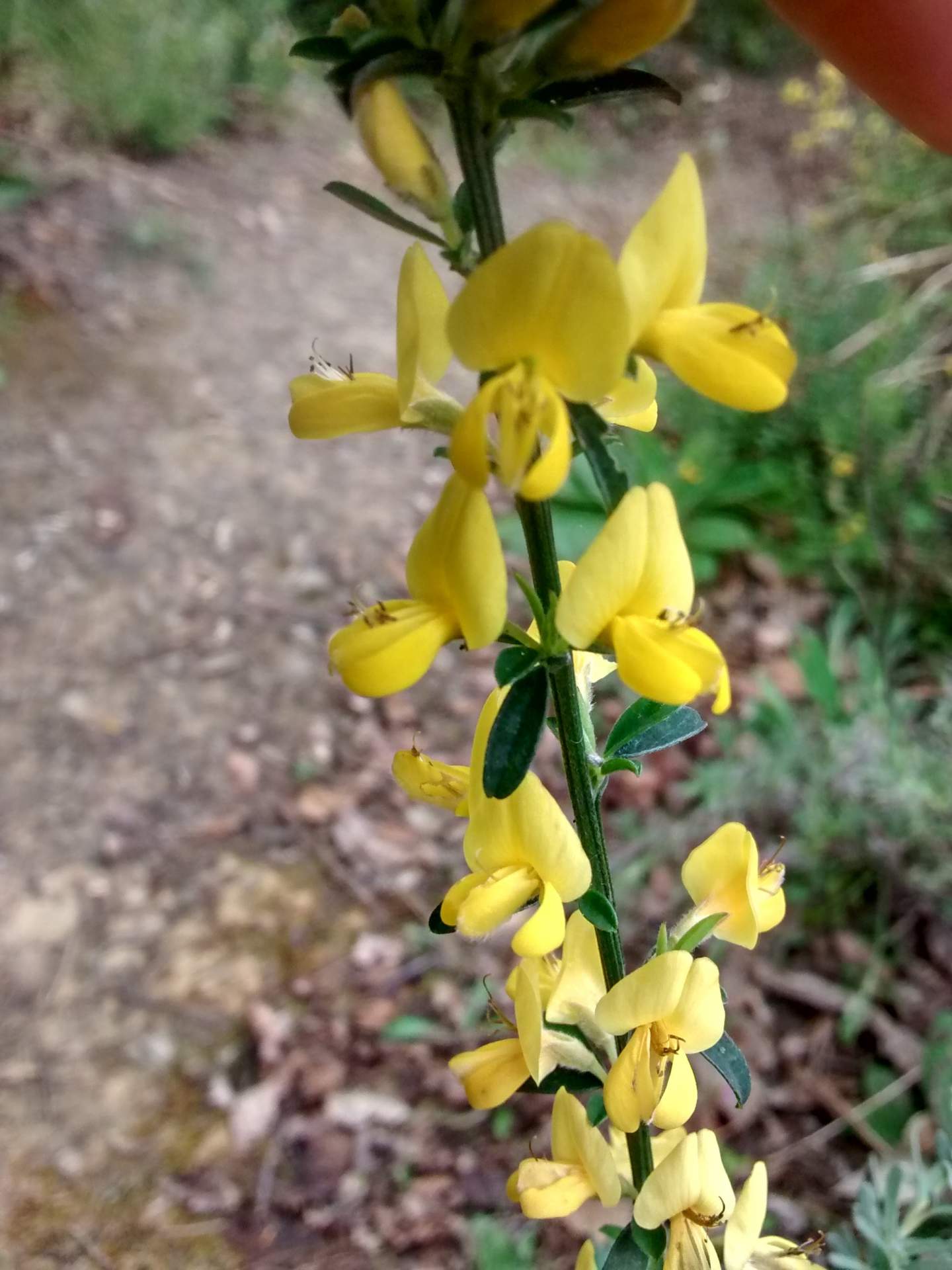
The flowers, very showy, are an intense and bright yellow, gathered in loose terminal racemes composed of 5-20 fragrant flowers. Each flower is papilionaceous, hermaphrodite, with a membranous calyx about 4-7.5 mm long, obliquely divided into a single lip ending with five small teeth. The corolla, 20-30 mm long, consists of an erect and rounded standard, ovate wings and a pointed keel with a recurved apex. The androecium is monadelphous, with alternately arranged anthers, and the style is curved and glabrous at the apex.
The fruit is a sickle-shaped, erect, oblong legume, 6 to 10 cm long and about 6-8 mm wide, initially green and velvety, then glabrescent and finally blackish at maturity. Dehiscence occurs with twisting of the legume, which ejects 10 to 18 shiny, brown, poisonous seeds. The root system is robust and deep, with anchoring and soil consolidation capacity.
Habitat and distribution
Spanish Broom has a Mediterranean range extending towards southwestern Europe, western Asia and North Africa up to the Canary Islands. In Italy it is common throughout the territory, from the plains up to about 600 meters in the Alps, 1400 meters in the Apennines and up to 2000 meters on Etna. It prefers dry and sunny places, clearings, forest edges and heavy soils, especially calcareous, but also adapts to clayey soils and marls. It is a pioneer species in disturbed environments, capable of colonizing poor and disrupted soils, such as embankments and landslide slopes, thanks to its resistant root system.
It grows preferentially in sub-Mediterranean and Mediterranean belts, including evergreen maquis, but requires a good availability of water in the soil, contrary to some beliefs that consider it exclusively xerophilous. It is a typical component of the Mediterranean and sub-Mediterranean landscape, often present in dense populations that do not form their own vegetation association, but are accompanied by ubiquitous species.
Flowering period
Flowering occurs from May to June (in some areas up to August), with possible geographical variations linked to climate and altitude. The flowers are very fragrant and attract numerous pollinating insects during this period.
Ecology and pollination
Spanish Broom is mainly pollinated by pollinating insects such as bees and bumblebees, attracted by the intense fragrance and bright yellow color of the flowers. The papilionaceous structure of the flower is adapted to the visit of these insects, which favor cross-fertilization.
The plant presents an adaptive strategy to drought, maintaining photosynthetic activity even after the early leaf fall thanks to the green and photosynthetic branches, thus reducing water loss. Seed dispersal occurs thanks to the twisting of the mature legume, which projects them far from the mother plant, facilitating colonization of new environments.
Curiosities and traditional uses
Spanish Broom is a toxic medicinal plant, containing alkaloids such as cytisine, present especially in the flowers and seeds. Cytisine has diuretic and purgative effects at low doses but is highly poisonous if ingested in larger quantities, therefore the plant is considered toxic and must not be consumed.
Historically, the flexible branches of Spanish Broom were used in agriculture to tie vine and tomato plants, thanks to their resistance and flexibility. From the stem a textile fiber is also obtained, used to produce ropes and fabrics, which was also employed during the Second World War for making garments.
The plant is appreciated as an ornamental in gardens for its showy and fragrant flowering, and is used for the consolidation of embankments and soils subject to erosion, especially along railways and highways, thanks to its robust and deep root system.
In beekeeping, Spanish Broom is a melliferous plant from which a fine honey is obtained, highly appreciated for its organoleptic characteristics.
Etymology
The genus name Spartium probably derives from the Greek "spartion", meaning small cord, or from the verb "speïro" meaning to bind, referring to the traditional use of its flexible branches as cords and ties in agriculture.
The specific name "junceum" derives from the Latin "juncus", rush, and the adjective "junceus" meaning rush-like, attributed for the similarity of the plant's thin and cylindrical stems to those of the rush, also used for binding and construction.
The Italian common name “ginestra” is shared with other related species, but for this plant it is often specified as “ginestra comune” or “ginestra odorosa” to distinguish it from other species of the genus Cytisus.
Sources
- Prof. S. Pignatti, "Flora d'Italia"
- Acta Plantarum - Flora delle regioni italiane (scheda di Giuliano Salvai)
- Tela Botanica / H. Coste, "Flore descriptive et illustrée de la France"
- World Flora Online (WFO)
Characteristics
Scheda botanica
| Famiglia | Fabaceae |
|---|---|
| Fioritura | maggio – giugno |
| Forma biologica | Shrubby |
| Habitat | with yellow flowers, toxic plant |
| Tossicità | Tossica — non consumare |
Domande frequenti
- Quando fiorisce Spanish Broom?
- Spanish Broom fiorisce maggio – giugno.
- È tossica Spanish Broom?
- Spanish Broom è una pianta tossica o velenosa. Non consumare nessuna sua parte senza aver consultato un esperto.
- Che tipo di pianta è Spanish Broom?
- Spanish Broom è una Phanerophytes (Shrubby) secondo la classificazione di Raunkiaer.
- A quale famiglia appartiene Spanish Broom?
- Spanish Broom appartiene alla famiglia botanica Fabaceae.
Where I found it (1 sightings)
Classification
- Kingdom
- Plantae
- Family
- Fabaceae
- Full name
- Spartium junceum L.
- Life form
- Phanerophytes shrubby
Similar species
Search for species with similar characteristicsFurther reading
Noticed an error in the identification? Write to me
Other species of the same family
Fabaceae
Explore
Other species of Fabaceae