Botanical species
Anthyllis vulneraria
L.
Kidney Vetch
Description
Morphological description
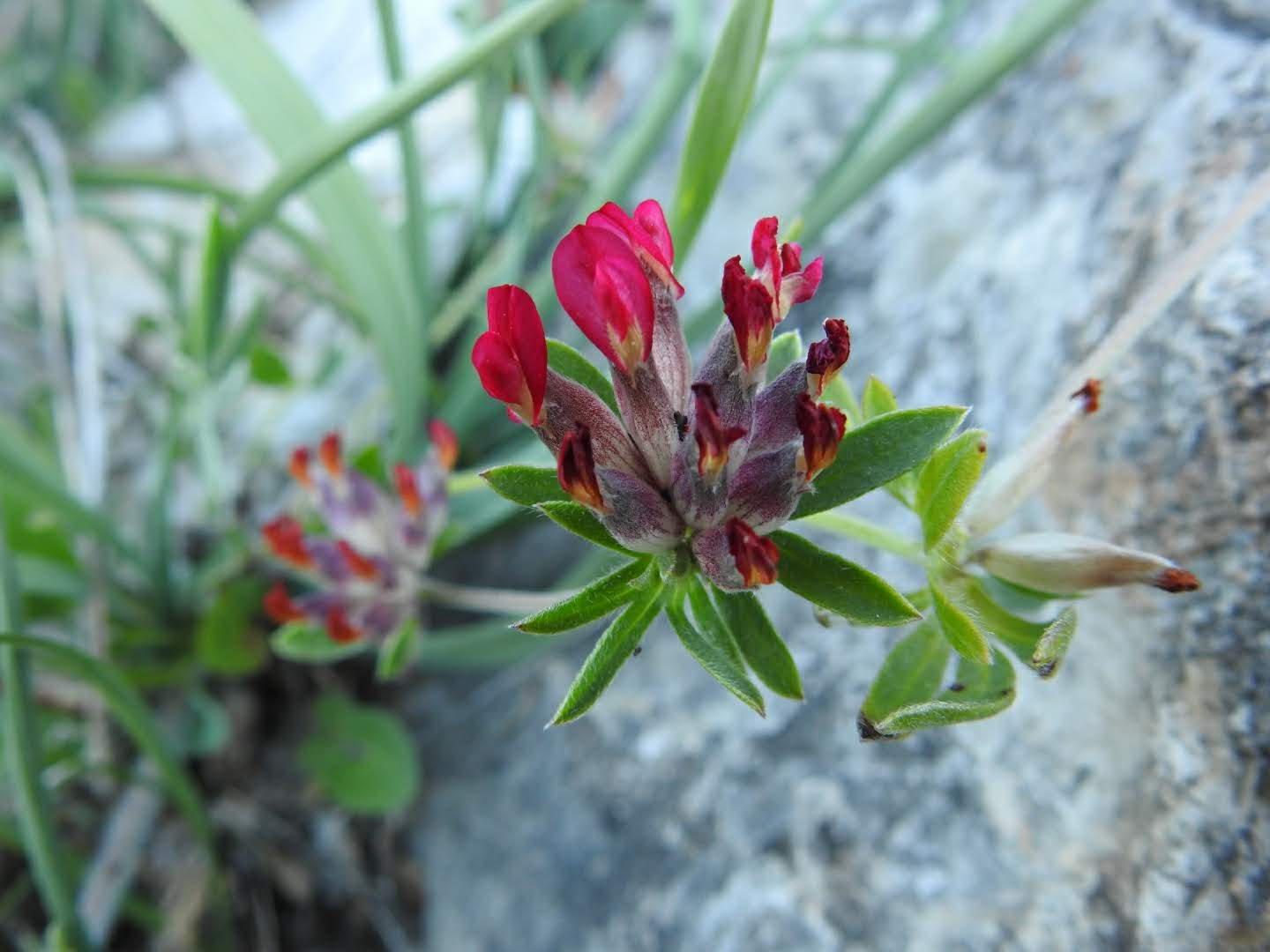
Perennial herbaceous plant, Kidney Vetch has a scapose habit, with generally prostrate or ascending-ascending stems reaching a height between 10 and 30 cm. The upper part of the stems is often leafless or has only one or two scattered small leaves. The stem is glabrescent or may have a slight sparse and appressed pubescence.
The lower leaves are arranged imparipinnately, with 1 to 5 pairs of small lateral leaflets and a larger terminal leaflet, oblong-linear or elliptical in shape, often broader and ovate at the end. The underside of the leaves is glabrescent, while the margins may be adorned with short hairs. The cauline leaves are few and smaller.
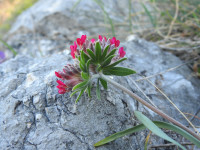
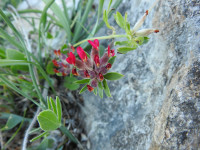
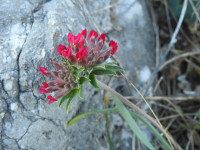
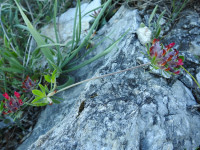
The inflorescence consists of dense clusters, single or paired, positioned at the apex of short peduncles. These are surrounded by large palmate leafy bracts, covered with soft pubescence, giving the inflorescences a woolly appearance. The flowers are papilionaceous, with a corolla 15-18 mm long of a characteristic blood red color, which may show tonal variations or slight variegated shades. The standard is curved and emarginate, with the margins of the wings and keel also red; the wings and keel are hooked together, exceeding the length of the calyx. The calyx, 11-14 mm long, is swollen, with a vesicular and striated structure, with color varying from red to reddish-brown; it has teeth much shorter than the tube and uniformly covered with appressed hairs.
The fruits are small elliptical legumes, about 3.5-7 mm long and 2-4 mm wide, indehiscent and membranous, containing a single ovoid seed. The root system, typical of Fabaceae, consists of deep roots with possible presence of rhizobial nodules for nitrogen fixation.
Habitat and distribution
Kidney Vetch is a species with a eurymediterranean distribution, predominant along the Mediterranean coasts but extending north and east, also including continental areas such as the Vite region. In Italy, it is present throughout the territory, from sea level up to about 1000 meters altitude.
It prefers open environments such as grassy lands, uncultivated areas, garrigues and Mediterranean scrub, often on well-drained, sandy or calcareous soils, with sunny or semi-shaded exposure. Its presence is typical of mountainous and submontane environments, but it is also adaptable to drier and rocky arid conditions, where it is often associated with xerophilous Mediterranean vegetation.
Flowering period
Flowering mainly occurs between April and June. Geographic variations may slightly influence the start or duration of flowering, with specimens in warmer or lower areas possibly flowering earlier or longer.
Ecology and pollination
Kidney Vetch is pollinated by pollinating insects, particularly bees and other hymenopterans, attracted by the bright red color of the flowers and the presence of nectar. The papilionaceous structure of the corolla favors entomogamous pollination, ensuring effective pollen transfer.
Seed dispersal mainly occurs by falling near the mother plant, given the indehiscent nature of the legumes; however, environmental factors such as wind or the action of small animals may contribute to their spread over limited distances.
Curiosities and traditional uses
The specific name vulneraria derives from the Latin vulnus, meaning "wound," referring to the traditionally attributed healing properties of plants of this genus. Historically, Kidney Vetch has been used in folk medicine for the treatment of wounds and sores, exploiting its presumed hemostatic and healing properties.
No significant food uses are documented, but the plant has some importance as a habitat indicator and as an element of the spontaneous Mediterranean flora.
Etymology
The genus name Anthyllis comes from the Greek anthos (flower) and -yllis or -illos (down), recalling the woolly appearance of the inflorescences typical of many species of the genus. The specific name vulneraria derives from the Latin vulnus (wound), emphasizing the traditional medicinal use of the plant for treating wounds.
The Italian common name, "vulneraria," directly reflects this Latin root, maintaining the reference to the plant's healing capabilities.
Sources
- Acta Plantarum - Flora delle regioni italiane (actaplantarum.org)
- Acta Plantarum - Flora delle regioni italiane (scheda di Mirna Medri)
- World Flora Online (WFO)
Characteristics
Scheda botanica
| Famiglia | Fabaceae |
|---|---|
| Fioritura | aprile – giugno |
| Forma biologica | Scapose |
| Habitat | with red flowers, plant with a prostrate-ascending habit, plant with a scapose habit |
Domande frequenti
- Quando fiorisce Kidney Vetch?
- Kidney Vetch fiorisce aprile – giugno.
- Che tipo di pianta è Kidney Vetch?
- Kidney Vetch è una Hemicryptophytes (Scapose) secondo la classificazione di Raunkiaer.
- A quale famiglia appartiene Kidney Vetch?
- Kidney Vetch appartiene alla famiglia botanica Fabaceae.
Where I found it (5 sightings)
Classification
- Kingdom
- Plantae
- Family
- Fabaceae
- Full name
- Anthyllis vulneraria L.
- Synonyms
- Anthyllis vulneraria L. subsp. praepropera (A.Kern.) Bornm.; Anthyllis vulneraria L. var. rubriflora DC.; Vulneraria heterophylla Moench var. parvula Lojac.
- Life form
- Hemicryptophytes scapose
Similar species
Search for species with similar characteristicsFurther reading
Noticed an error in the identification? Write to me
Other species of the same family
Fabaceae
Explore
Other species of Fabaceae