Botanical species
Trifolium angustifolium
L.
Narrow Clover
Description
Morphological description
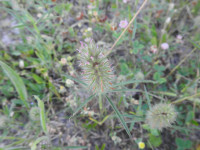
It is an annual herbaceous plant between 10 and 50 cm tall, with an erect habit and a simple or branched stem in the lower part. The stems are rigid, erect, often with longer lower internodes, covered by a rather dense appressed pubescence, which gives a velvety surface. The leaves are trifoliate, alternate and petiolate, with segments of linear-lanceolate shape, 20 to 80 mm long and 2-4 mm wide, mostly erect and acute. The leaflets are hairy on both surfaces and have an almost parallel venation, a characteristic that distinguishes them from other similar species. The stipules are linear, membranous, with well-visible veins; at the terminal part they are free, tapered and setaceous (shaped like a stiff thread).
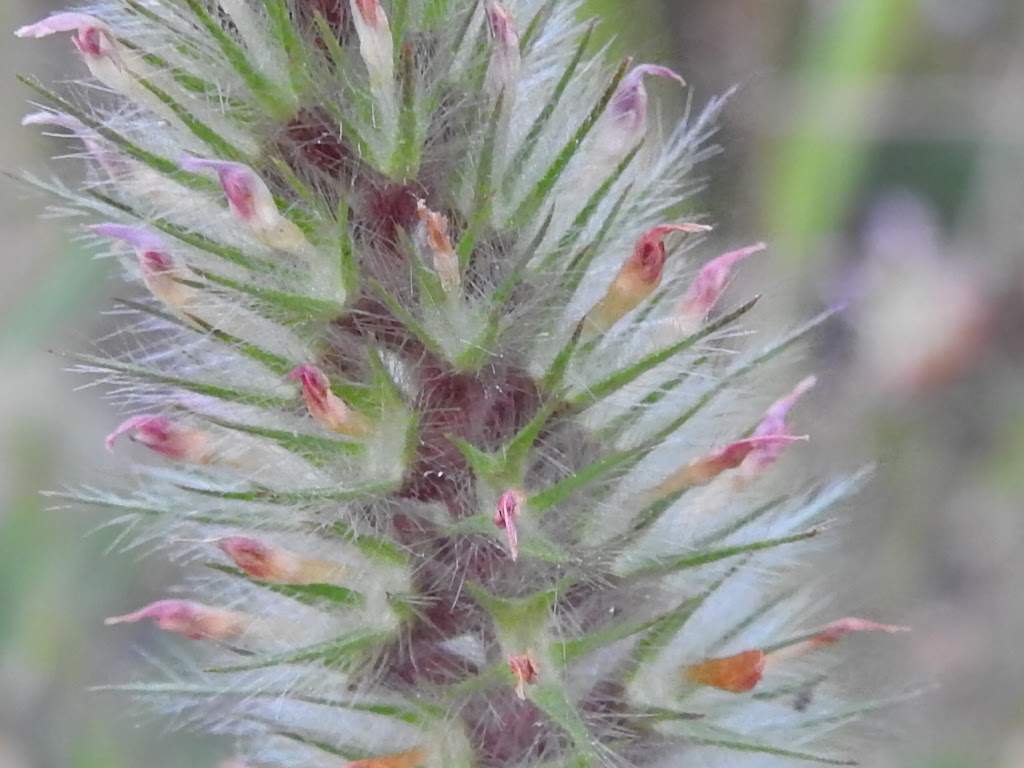
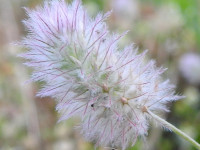
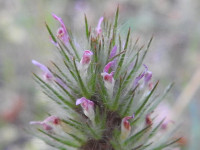
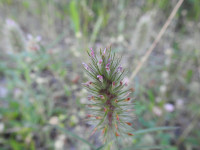
The inflorescence is terminal, solitary, spike-shaped or elongated head (spicate), with a length ranging from 2 to 8 cm and a diameter that tends to become cylindrical during fruiting. The inflorescence is supported by a peduncle 1 to 5 cm long. The flowers, without basal bracteoles, open almost simultaneously and are pink, purplish or white-pink in color, with a papilionaceous corolla about 10-12 mm long, more or less equal to or slightly longer than the calyx, which tends to fall off quickly after opening.
The calyx is campanulate, with a tube of 3-5.2 mm, hirsute-hairy and provided with 5 subulate, unequal and hairy teeth, longer than the calyx tube. During fruiting, the teeth open radially almost like a star and have a bilabiate callosity briefly ciliate closing the throat. The fruit is a small monosperm legume (camara) indehiscent, included in the calyx, with a membranous pericarp and containing a single yellowish seed 1.5-2.4 mm long.
The root system is not specifically described in the sources, but as for other Trifolium it is presumably composed of fibrous roots that favor the fixation of atmospheric nitrogen in symbiosis with rhizobial bacteria, typical of the Fabaceae family.
Habitat and distribution
Narrow Clover is a typically Mediterranean species, widespread along the coasts and arid and semi-arid inland regions of the Mediterranean basin, with a range that includes southern Europe, western Asia and North Africa. In Italy it grows mainly in arid environments, on sandy or clay soils, often near marine and coastal environments, but also up to 1300 meters of altitude.
It prefers sunny exposures and hot, dry places, typical of xerothermophilous zones. In Italy it is mainly found in the Central-South and the major islands, including Mediterranean habitats with sparse vegetation and on poor and well-drained soils.
Flowering period
Flowering generally occurs between April and July, with a peak in May and June. The duration and intensity of flowering can vary depending on altitude and latitude, with earlier flowering in coastal areas and later flowering in inland or mountainous areas.
Ecology and pollination
The species is adapted to xerothermic conditions and plays an important role in Mediterranean ecosystems, contributing to nitrogen fixation in the soil. Pollination is entomogamous, mainly entrusted to pollinating insects such as bees and bumblebees that visit the papilionaceous flowers, attracted by the pink color and the availability of nectar. The almost simultaneous flowering of the flowers in the inflorescence favors rapid pollination.
Seed dispersal occurs mainly by falling into the surrounding soil, since the fruit is indehiscent and remains protected in the calyx. No particularly specialized dispersal mechanisms such as anemochory or zoochory are reported.
Curiosities and traditional uses
No significant traditional medicinal or food uses are documented for this species, nor particular references in local folklore. Given its aptitude for nitrogen fixation and colonization of arid environments, this plant may have a secondary ecological and agronomic role in improving soil fertility, but it is not normally cultivated or directly used by humans.
Etymology
The genus name, Trifolium, derives from the Latin "tri" (three) and "folium" (leaf), referring to the characteristic trifoliate leaf. The specific epithet "angustifolium" literally means "with narrow leaves", describing the shape of the linear-lanceolate leaflets that distinguish this species from others in the genus.
The Italian common name "trifoglio a foglie strette" is a direct translation of the scientific name and reflects the peculiar morphology of the leaves, narrower and more elongated compared to more common clovers.
Sources
- Prof. S. Pignatti, "Flora d'Italia"
- Acta Plantarum - Flora delle regioni italiane (scheda di Anja Michelucci)
- Tela Botanica / H. Coste, "Flore descriptive et illustrée de la France"
Characteristics
Scheda botanica
| Famiglia | Fabaceae |
|---|---|
| Fioritura | aprile – luglio |
| Forma biologica | Scapose |
| Habitat | with purple flowers, with pink flowers, Perennial plant |
Domande frequenti
- Quando fiorisce Narrow Clover?
- Narrow Clover fiorisce aprile – luglio.
- Che tipo di pianta è Narrow Clover?
- Narrow Clover è una Therophytes (Scapose) secondo la classificazione di Raunkiaer.
- A quale famiglia appartiene Narrow Clover?
- Narrow Clover appartiene alla famiglia botanica Fabaceae.
Where I found it (9 sightings)
Classification
- Kingdom
- Plantae
- Family
- Fabaceae
- Full name
- Trifolium angustifolium L.
- Life form
- Therophytes scapose
Similar species
Search for species with similar characteristicsFurther reading
Noticed an error in the identification? Write to me
Other species of the same family
Fabaceae
Explore
Other species of Fabaceae