Botanical species
Medicago arabica
(L.) Huds.
Spotted Medick
Description
Morphological description
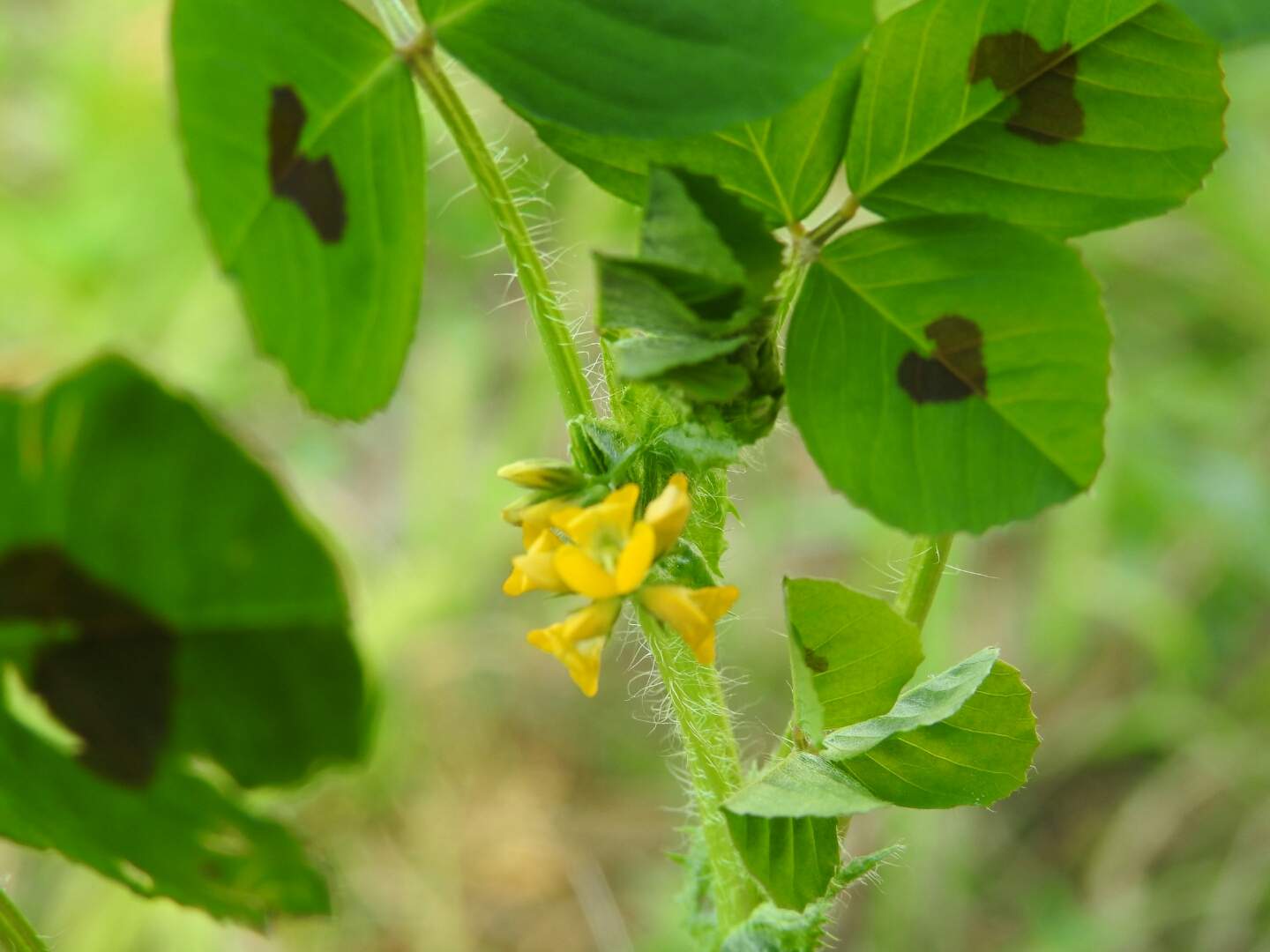
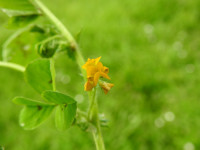
Annual herbaceous plant, Spotted Medick generally has a creeping or decumbent habit, with stems ranging from 20 to 60 cm long that can also be ascending or leaning on other plants to reach the light. The stems are angular, often with a sub-quadrangular cross-section, covered with spreading, non-glandular hairs, giving them a slightly hairy surface.
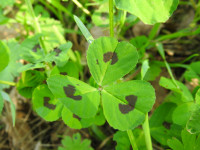
The leaves are composed of three leaflets (trifoliate), with ovate-lanceolate stipules 4-5 mm long, equipped with deep teeth and often pubescent. The leaflets are obcordate or obovate in shape, with entire or slightly toothed margins and herbaceous texture; they are about 15-25 mm long and 12-32 mm wide. A distinctive feature is the presence, at the center of the leaflets, of a dark spot in the shape of an inverted V or of a brown-violet color, which facilitates identification.
The flowers, bright yellow in color, are gathered in axillary raceme inflorescences composed of 2 to 5 flowers, each with five petals (corolla 4.5-7.5 mm long). The calyx is campanulate, 2.5-4 mm long, green with sometimes purple shades, pubescent and with teeth of similar size to the calyx tube. The corolla has a banner wider and larger than the keel, while the wings are intermediate in size. The flower peduncles are awned and shorter than the petiole of the adjacent leaf.
The fruit is a indehiscent legume, subglobose, with a diameter between 4 and 7 mm, characterized by a spiral structure composed of 3-7 loose coils that twist counterclockwise. The surface of the legume is glabrous and adorned with distichous spines 2-4 mm long, curved and divergent, but not hooked. Inside are 2 oblong, reniform seeds, orange or yellow-brown in color, about 2.5-3.5 mm long and smooth.
The root system is not described in particular detail in the sources, but, as typical of Fabaceae, the presence of rhizobial nodules for nitrogen fixation can be assumed.
Habitat and distribution
Spotted Medick grows in open and anthropized habitats such as cultivated fields, uncultivated lands, ruins, roadsides, and disturbed areas. It is a species typical of xerothermic environments, preferring sunny exposures and well-drained soils.
In Italy, the species is mainly widespread along the coasts and in hilly areas up to about 600 meters altitude, with more frequent reports in the Mediterranean basin. Its range extends throughout southern and western Europe, western Asia, and North Africa, with some presence also in medium-altitude mountainous regions.
Flowering period
Flowering occurs in spring, generally between April and June, with some variations depending on latitude and local environmental conditions. In Italy and much of the Mediterranean, flowering is concentrated in April and May.
Ecology and pollination
Spotted Medick is mainly pollinated by pollinating insects, particularly bees and hymenopterans, attracted by the yellow color of the flowers and nectar production. The corolla structure is typical of Fabaceae, favoring entomophilous pollination.
Seed dispersal occurs through the spiral legume that detaches from the plant at maturity. The spines present on the fruit can facilitate anchoring to the soil or transport by animals, although they are not hooked.
Like many legumes, this species contributes to soil fertility thanks to its ability to fix atmospheric nitrogen, promoting the restoration of organic matter in poor soils.
Curiosities and traditional uses
Spotted Medick is recognized as a good forage plant, mainly used for livestock feeding. Its ability to fix nitrogen also makes it valuable for enriching agricultural soils, improving their biological fertility.
The common name "Calvary clover" is linked to a popular legend according to which the dark spots on the leaves would be the result of drops of Christ's blood fallen at the foot of the cross. This gives the plant symbolic value in some local traditions.
Etymology
The genus name Medicago derives from the historical region of Media, in ancient Persia, from which the plant was thought to originate. The specific epithet arabica refers to its presumed geographic origin or to its spread in the Arab area.
The Italian common name “Spotted Medick” recalls both the belonging to the genus Medicago and the Mediterranean origin or distribution of the species.
Sources
- Prof. S. Pignatti, "Flora d'Italia"
- Acta Plantarum - Flora delle regioni italiane (scheda di Giuliano Salvai)
- Tela Botanica / H. Coste, "Flore descriptive et illustrée de la France"
- World Flora Online (WFO)
Characteristics
Where I found it (8 sightings)
Classification
- Kingdom
- Plantae
- Family
- Fabaceae
- Full name
- Medicago arabica (L.) Huds.
- Synonyms
- Medicago polymorfa L. var. arabica L.
- Life form
- Terofite scapose
Similar species
Search for species with similar characteristicsFurther reading
Noticed an error in the identification? Write to me
Other species of the same family
Fabaceae
Explore
Other species of Fabaceae