Botanical species
Anthyllis montana
L.
Mountain Kidney-vetch
Description
Morphological description
Small perennial plant, with a tufted habit and woody stems at the base that appear branched and twisted. The height generally varies between 10 and 30 cm, with erect or ascending herbaceous stems that can reach a diameter of about 2 cm. These stems are hairy or covered with silky hairs, leafless (aphyllous) in the upper part.
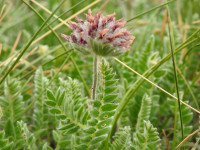
The leaves are mostly basal, arranged imparipinnate, with a variable number between 15 and 31 leaf segments of elliptical, lanceolate or more or less linear shape. The leaflets are alternate, pubescent on both sides, especially along the margin, with the terminal leaflet from oblanceolate to obovate. All leaflets are connected to the rachis by a striated, sheathing and persistent petiole. Usually only one cauline leaf is observed, inserted towards the base or in the middle of the scape.
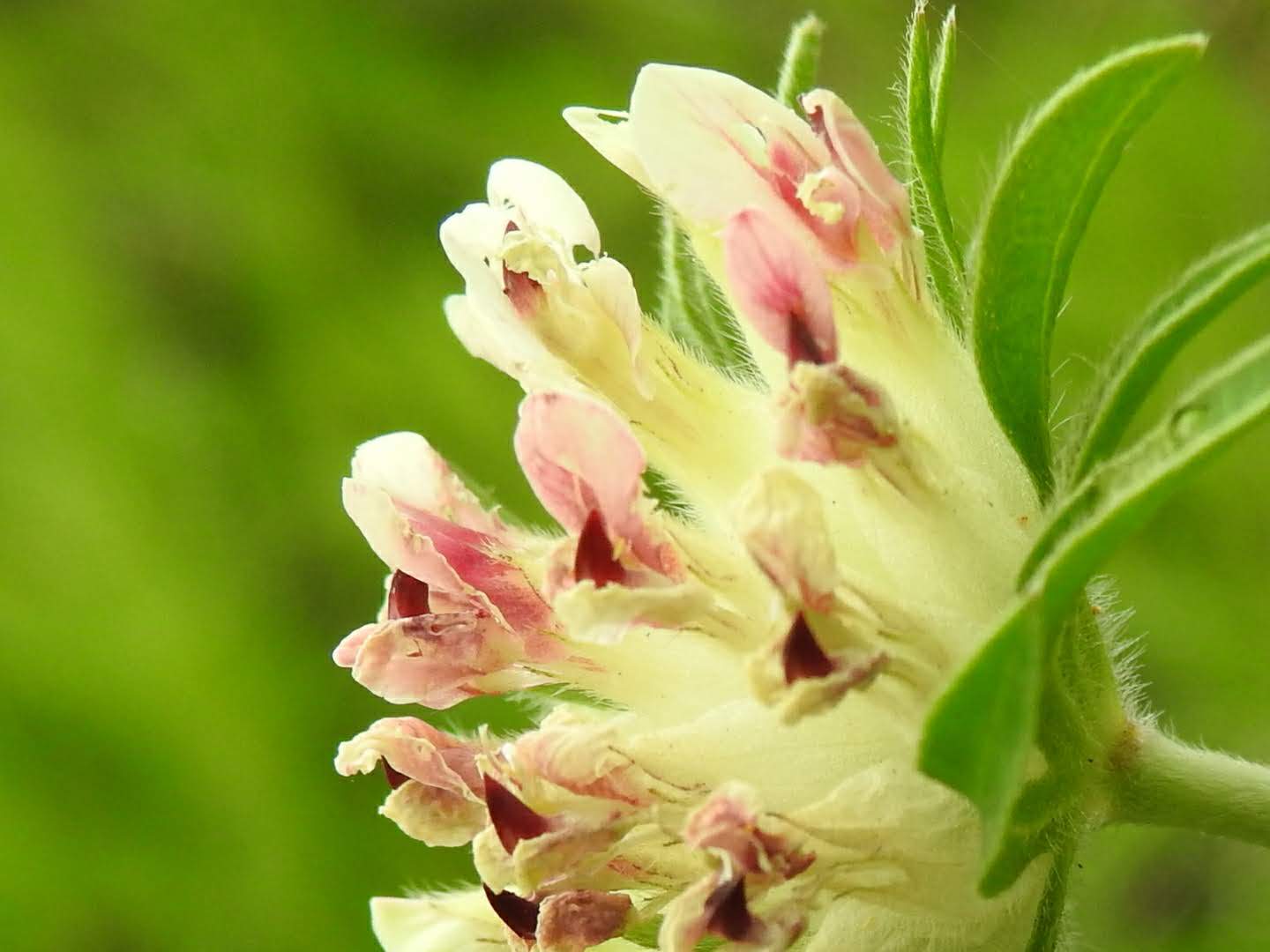
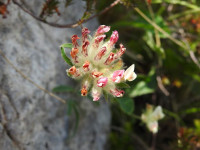
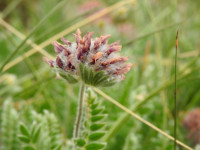
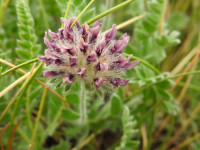
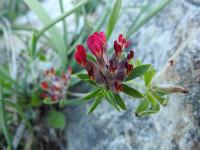
The inflorescence consists of a single hemispherical, globose head, about 2.5 cm in diameter, placed at the apex of the scapes. The head is long-petioled and surrounded by two sessile, palmatipartite, jagged leafy bracts generally shorter than the flowers. The flowers are numerous, about 9-12 mm long, with a tubular villous calyx, equipped with feathery teeth as long as the tube itself (4-5 mm). The corolla varies in color from pink to deep purple, often with violet shades, and tends to darken upon drying. The standard is oblong-campanulate and protrudes beyond the bracts; the wings are larger than the keel, which is slightly curved and obtuse.
The fruit is an ellipsoid, oblong and acuminate legume, glabrous, with a wrinkled or reticulated surface. It contains smooth, subreniform seeds, about 2-3 mm. The root system is not described in detail in the available sources but, as typical of montane Fabaceae, it is presumably well developed to anchor in rocky soils.
Habitat and distribution
This species is typical of montane environments of the Mediterranean area and southern Europe, with widespread presence in Italy especially in the mountainous range. It grows mainly in grassy and rocky places, preferably on calcareous substrates, at altitudes between 300 and over 1,600 meters. It is present in environments with sunny or semi-shaded exposure, in well-drained soil conditions.
The chorological range is defined as Mediterranean-montane, with distribution overlapping that of other steno- and euri-Mediterranean species adapted to mountain areas. In Italy some subspecies are recognized, with morphological variants linked to specific areas or altitudes, such as subsp. atropurpurea with shorter stems and dark violet corolla.
Flowering period
Flowering mainly extends from May to July, with possible variations related to altitude and latitude. In higher mountain ranges flowering may start later, while at lower altitudes it may begin slightly earlier. The flowers develop in terminal heads, clearly visible for their bright color and globose structure.
Ecology and pollination
The plant presents a reproductive strategy typical of Fabaceae, with flowers particularly suited to entomophilous pollination. The main pollinating insects are bees and bumblebees, attracted by the colorful corolla and the availability of nectar. The flower structure, with hairy calyces and prominent corollas, facilitates visits by pollinating insects.
Seed dispersal probably occurs through autochthonous mechanisms, with direct release from the mature legume; no particular forms of long-distance dispersal, such as animal transport or anemochory, are known. The presence of hairs and the shape of the seeds suggest an adaptation to survival in montane environments rather than dispersal over long distances.
Curiosities and traditional uses
The common name "Mountain Kidney-vetch" recalls the traditional uses attributed to this plant, related to the ability to promote wound healing, similarly to other species of the genus Anthyllis (from Greek, “hairy flower”). Although there are no specific in-depth data on the ethnobotany of this montane species, the genus Anthyllis is known in some traditions for medicinal properties, particularly as a cicatrizant and anti-inflammatory.
There are no direct references to food uses or a significant role in popular folklore in the consulted sources, but its presence in montane environments has often favored its local use as a medicinal plant or for decorative purposes.
Etymology
The genus name "Anthyllis" derives from the union of the Greek words “anthòs” (flower) and “iulus” (hair), referring to the characteristic hairy calyces of the flowers. The specific epithet "montana" clearly indicates the preferred habitat of the species, i.e., mountain areas.
The Italian common name "Mountain Kidney-vetch" is linked to popular tradition that attributes healing properties to this plant, especially for wounds (from Latin "vulnerare" = to wound, to heal wounds).
Sources
- Prof. S. Pignatti, Flora d'Italia
- Acta Plantarum - Flora delle regioni italiane (scheda di Giuliano Salvai)
- World Flora Online (WFO)
Characteristics
Scheda botanica
| Famiglia | Fabaceae |
|---|---|
| Fioritura | maggio – luglio |
| Forma biologica | Suffruticose |
| Habitat | with white flowers, with purple flowers, Perennial plant |
Domande frequenti
- Quando fiorisce Mountain Kidney-vetch?
- Mountain Kidney-vetch fiorisce maggio – luglio.
- Che tipo di pianta è Mountain Kidney-vetch?
- Mountain Kidney-vetch è una Chamaephyte (Suffruticose) secondo la classificazione di Raunkiaer.
- A quale famiglia appartiene Mountain Kidney-vetch?
- Mountain Kidney-vetch appartiene alla famiglia botanica Fabaceae.
Classification
- Kingdom
- Plantae
- Family
- Fabaceae
- Full name
- Anthyllis montana L.
- Life form
- Chamaephyte suffruticose
Similar species
Search for species with similar characteristicsNoticed an error in the identification? Write to me
Other species of the same family
Fabaceae
Explore
Other species of Fabaceae