Botanical species
Securigera varia
(L.) Lassen
Crown Vetch
Description
Morphological description
Perennial herbaceous plant belonging to the Fabaceae family, it has a scapose habit with branched and prostrate-ascending stems, often climbing, which can reach a height between 30 and 120 cm. The root system consists of a large branched rhizome, which allows the plant's perennation and propagation.
The leaves are imparipinnate, shortly petiolate, composed of 6-12 pairs of elliptical, mucronate leaflets, varying in size between 0.5 and 2 cm. The lower surface of the leaflets appears glaucous. Like many legumes, the leaves exhibit nyctinastic behavior: in the evening they close and fold into a resting position, reopening the following morning.
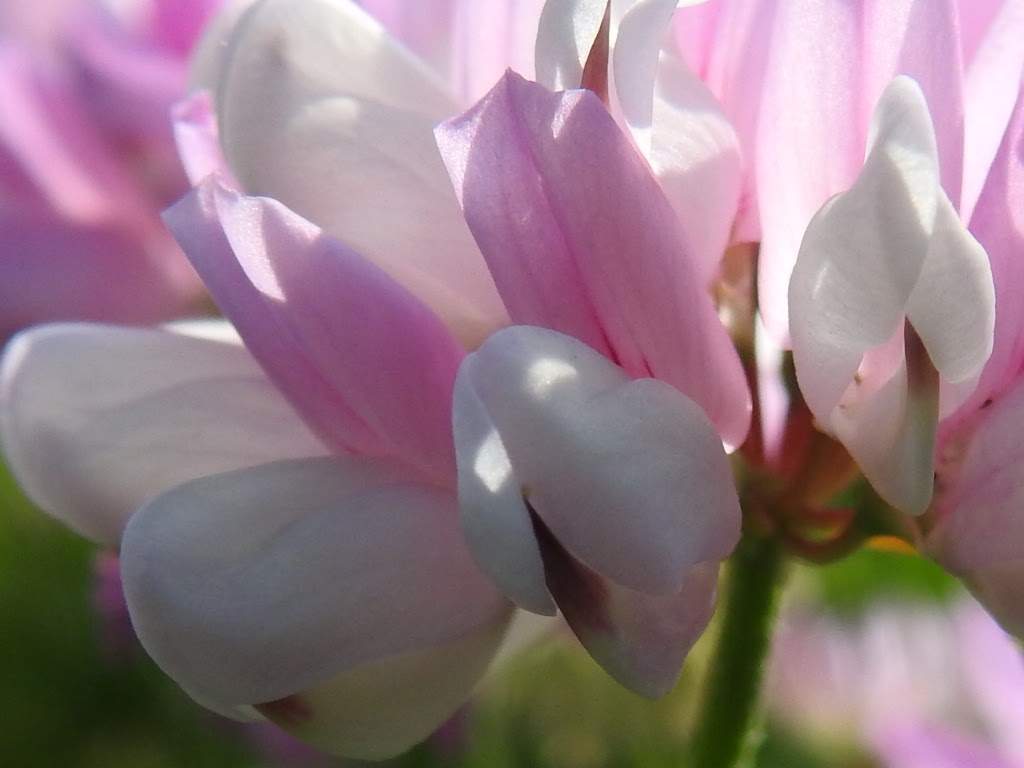
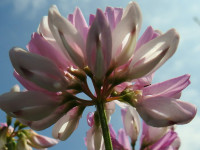
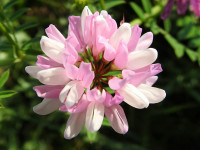
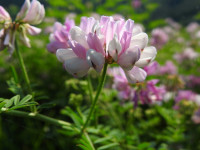
The flowers are papilionaceous, grouped in globose umbel inflorescences containing from 5 to 20 flowers, supported by long axillary peduncles. The pedicel of each flower can be up to three times longer than the calyx. The corolla is characterized by a variegated coloration: the standard (banner) is dark pink or violet, the wings are white, while the keel has a white base with a dark violet apex. The flowers, initially inclined, stand erect during flowering and fruiting.
The fruits are quadrangular loments, narrow and linear, erect, between 2 and 8 cm long, with slightly marked and slightly constricted joints. Each monospermous segment contains a subcylindrical seed of brown-reddish color. The shape of the fruits resembles a saber, from which the genus name also derives.
Habitat and distribution
The species is widespread throughout the Eurasian area, ranging from Europe to Japan. In Italy it commonly grows both in plains and mountainous environments, generally up to 1,200 m altitude, but can also exceed 1,600 m a.s.l. It prefers habitats such as slopes, stable meadows, screes, cliffs, and paths, showing a particular preference for calcareous and well-drained soils. It favors sunny exposures and thermophilic environments, typical of hilly and mountainous areas.
Flowering period
Flowering mainly occurs in the summer months, from June to August. In some areas with favorable climatic conditions it can slightly extend beyond this period, but generally it is limited to the central months of summer.
Ecology and pollination
The flowering of this species attracts numerous pollinating insects, particularly bees and butterflies, which are drawn by the scent and bright colors of the flowers. The plant reproduces sexually through seeds contained in the loments, whose dispersal mainly occurs by falling near the mother plant. The branched rhizome also allows vegetative multiplication.
Among the insects associated with the plant is the caterpillar of Zygaena ephialtes, a moth whose larval stages develop on this species, highlighting a close ecological link.
Curiosities and traditional uses
This species is toxic due to the presence of coronillin, a glycoside with cardiotonic action similar to that of digitalis. In the past, the leaves were used in the preparation of cardiotonic remedies to treat mild forms of cardiac weakness, although today such uses are discouraged due to the plant's toxicity.
Besides medicinal uses, Crown Vetch is sometimes cultivated as forage and used to stabilize slopes and prevent soil erosion thanks to its rapid ground cover. It is also appreciated as an ornamental plant for the beauty of its pink and fragrant flowers.
Etymology
The genus name derives from the Latin “securis” (axe or hatchet) combined with the suffix “-ger, -gera, -gerum”, meaning “bearing”, referring to the characteristic shape of the fruits which resemble a saber or an axe. The specific name “varia” highlights the high morphological variability of the species, especially in the shape and size of the leaves.
The Italian common name “erba ginestrina” probably refers to the similarity of the flowers with those of the broom, although they are not related species.
Sources
- Acta Plantarum - Flora delle regioni italiane (scheda di Marinella Zepigi)
- Tela Botanica / H. Coste, "Flore descriptive et illustrée de la France"
- World Flora Online (WFO)
Characteristics
Scheda botanica
| Famiglia | Fabaceae |
|---|---|
| Fioritura | giugno – agosto |
| Forma biologica | Scapose |
| Habitat | toxic plant, with pink flowers, with fragrant flowers |
| Tossicità | Tossica — non consumare |
Domande frequenti
- Quando fiorisce Crown Vetch?
- Crown Vetch fiorisce giugno – agosto.
- È tossica Crown Vetch?
- Crown Vetch è una pianta tossica o velenosa. Non consumare nessuna sua parte senza aver consultato un esperto.
- Che tipo di pianta è Crown Vetch?
- Crown Vetch è una Hemicryptophytes (Scapose) secondo la classificazione di Raunkiaer.
- A quale famiglia appartiene Crown Vetch?
- Crown Vetch appartiene alla famiglia botanica Fabaceae.
Where I found it (10 sightings)
Classification
- Kingdom
- Plantae
- Family
- Fabaceae
- Full name
- Securigera varia (L.) Lassen
- Synonyms
- Coronilla varia L.
- Life form
- Hemicryptophytes scapose
Similar species
Search for species with similar characteristicsFurther reading
Noticed an error in the identification? Write to me
Other species of the same family
Fabaceae
Explore
Other species of Fabaceae