Botanical species
Medicago sativa
L.
Alfalfa
Description
Morphological description
Perennial herbaceous plant, Alfalfa has an erect habit with stems ranging from 30 to 80 cm long, often branched and scapose. The stem develops from a robust underground rhizome, woody and very deep, which allows the plant to easily regenerate after cutting. The roots extend up to 3-6 meters deep, a characteristic that favors its drought resistance.
The leaves are alternate, trifoliate, with oblanceolate or obovate-oblong segments, of variable size, equipped with a denticulate margin in the distal part and a truncate-mucronate apex. The stipules, linear or ovate-lanceolate, are long and with denticulate margins, often pointed.
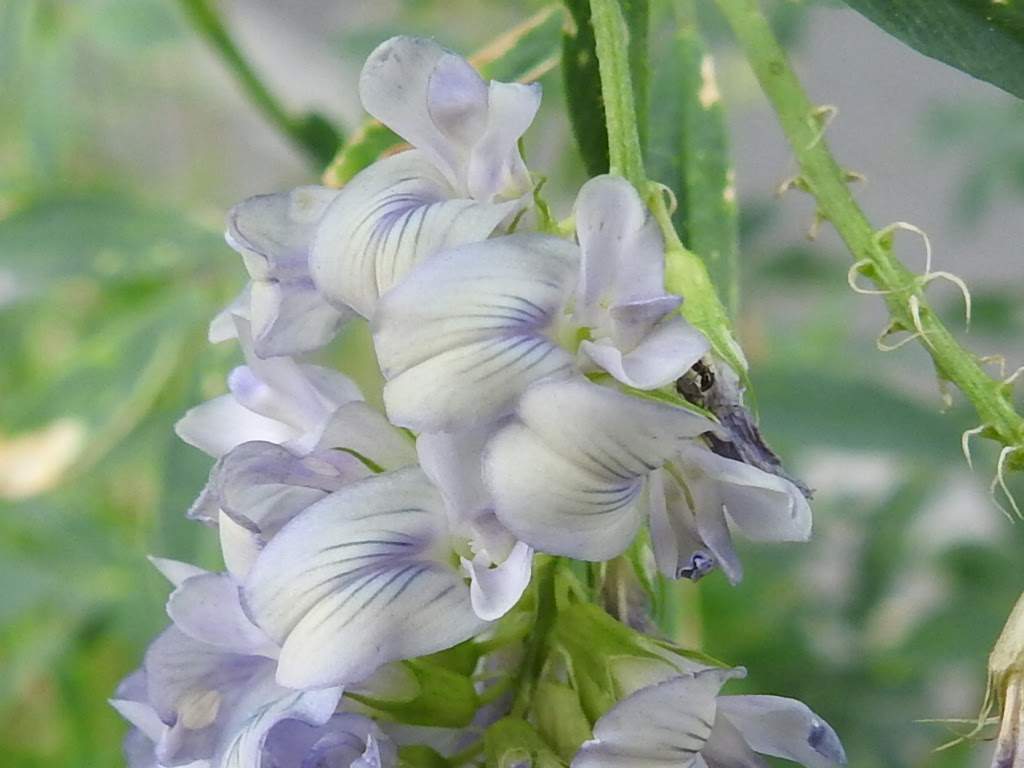
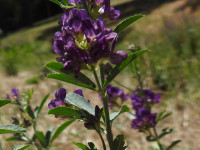
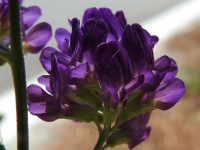
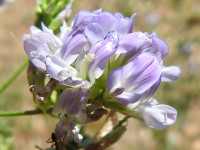
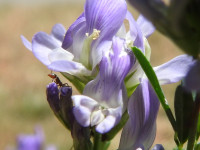
The flowers are gathered in dense racemes, in the leaf axils, with peduncles longer than the leaves themselves (3-5 cm). The corolla, pentapetalous in shape, varies from violet-blue to dark violet, rarely whitish. The upper petal, called the banner or standard, is oblong and has a darker vein, while the two lower petals, partially fused, form the keel.
The fruits are spiraled legumes, about 5-9 mm long, wrapped in 2-4 coils. They are glabrous or slightly pubescent, with a reticulated surface and without spines. Each legume contains from 10 to 20 ovoid seeds, yellow-brown in color, smooth and shiny.
Habitat and distribution
Probably native to the Media region (ancient Persia), Alfalfa is now widespread throughout the Mediterranean basin and Europe, from the Eurasian area to Japan. In Italy it is mainly found in mountainous and hilly environments, from sea level up to about 1,900 m altitude, but more commonly between 0 and 1,200 m. It prefers calcareous or clayey soils, often cultivated or disturbed, such as dry meadows, uncultivated lands, field margins, and roadside edges.
The species is widely cultivated as a forage plant and can also be found in a subspontaneous form in many Italian regions, especially in the Po Valley and areas with a temperate climate. Its ability to fix nitrogen makes it valuable also for improving soil fertility.
Flowering period
Flowering mainly occurs between April and July, with possible geographic and climatic variations. In some areas it extends until September. The flowers are clearly visible throughout the flowering period, gathered in racemes that facilitate pollination.
Ecology and pollination
Alfalfa is a scapose hemicryptophyte perennial plant, reproducing both vegetatively through the rhizome and sexually through seeds. The ability of self-pollination is present, but the species is also pollinated by pollinating insects, particularly bees and other hymenoptera, attracted by the colorful corolla and abundant nectar production.
Seed dispersal mainly occurs by falling near the mother plant, but also through insects or animals that can transport seeds over longer distances.
Curiosities and traditional uses
Alfalfa is one of the most important forage species worldwide, mainly used for the production of hay, silage, and dehydrated meal intended for animal feed. Its protein and vitamin value is high, and the forage is highly appreciated for its high content of vitamins A, C, E, K and various minerals such as calcium, potassium, and iron.
In phytotherapy, Alfalfa is recognized as a medicinal species with multiple properties: it acts as a depurative, refreshing, astringent, and diuretic remedy; stimulates appetite, lowers cholesterol, and has beneficial effects on the circulatory and urinary systems. It is also used to treat anemia, osteoporosis, hormonal disorders related to menopause, and as a general tonic that promotes blood detoxification.
In cooking, the leaves can be consumed raw or cooked as a vegetable, while the sprouted seeds are used to flavor salads or prepare tea. Historically, the name “alfa-alfa” derives from the Arabic “Al-Fal-Fa” meaning “father of all foods,” emphasizing the nutritional value of the plant.
The cultivation of Alfalfa has a long history: probably introduced to Europe by Alexander the Great’s soldiers around the 5th century BC, it was appreciated by the ancient Romans and later spread in Spain by the Arabs. In Italy, it was almost abandoned during the Middle Ages and reintroduced only in the Renaissance.
Etymology
The scientific name of the genus derives from the Media region, an ancient area of Persia, from which the plant is believed to have originated. From ancient Greek “medikai” and Latin “herba medica” come the terms indicating this species.
The Italian common name “Alfalfa” reflects this geographic origin. The name “Erba Spagna,” used in some regions, indicates its reintroduction in Italy via Spain, where the crop had been spread by the Arabs. The term “alfa-alfa” derives from the Arabic “Al-Fal-Fa,” meaning “father of all foods,” highlighting the nutritional value of the plant.
Sources
- Prof. S. Pignatti, Flora d'Italia
- Acta Plantarum - Flora delle regioni italiane (scheda di Marinella Zepigi)
- Tela Botanica / H. Coste, Flore descriptive et illustrée de la France
- World Flora Online (WFO)
Characteristics
Scheda botanica
| Famiglia | Fabaceae |
|---|---|
| Fioritura | aprile – luglio |
| Forma biologica | Scapose |
| Habitat | edible plant, with lilac flowers, with purple flowers |
| Uso alimentare | Commestibile |
| Uso officinale | Pianta officinale |
Domande frequenti
- Quando fiorisce Alfalfa?
- Alfalfa fiorisce aprile – luglio.
- È commestibile Alfalfa?
- Alfalfa è considerata commestibile. Verifica sempre le parti eduli e la preparazione corretta prima del consumo.
- Che tipo di pianta è Alfalfa?
- Alfalfa è una Hemicryptophytes (Scapose) secondo la classificazione di Raunkiaer.
- A quale famiglia appartiene Alfalfa?
- Alfalfa appartiene alla famiglia botanica Fabaceae.
Where I found it (15 sightings)
Classification
- Kingdom
- Plantae
- Family
- Fabaceae
- Full name
- Medicago sativa L.
- Life form
- Hemicryptophytes scapose
Similar species
Search for species with similar characteristicsFurther reading
Noticed an error in the identification? Write to me
Other species of the same family
Fabaceae
Explore
Other species of Fabaceae