Botanical species
Trifolium hybridum
L.
Alsike Clover
Description
Morphological description
Perennial herbaceous plant, Alsike Clover presents erect or ascending stems reaching a height between 15 and 60 cm. The stems are few or numerous, with a glabrous or nearly glabrous surface and show a characteristic vertical groove. The leaves are palmately trifoliate, with segments broadly elliptical, ovate-elliptical or obovate, varying in size from 1 to 3 cm in length and 1-2 cm in width. The leaf margins are entire or finely denticulate, with a broadly cuneate base and an obtuse apex, sometimes slightly emarginate. The stipules, ovate or ovate-lanceolate in shape, have the base fused for about one third of their length and end with an acuminate subulate point, giving the leaves a soft and not very rigid appearance. The lower leaves have very long petioles that progressively shorten towards the upper ones.
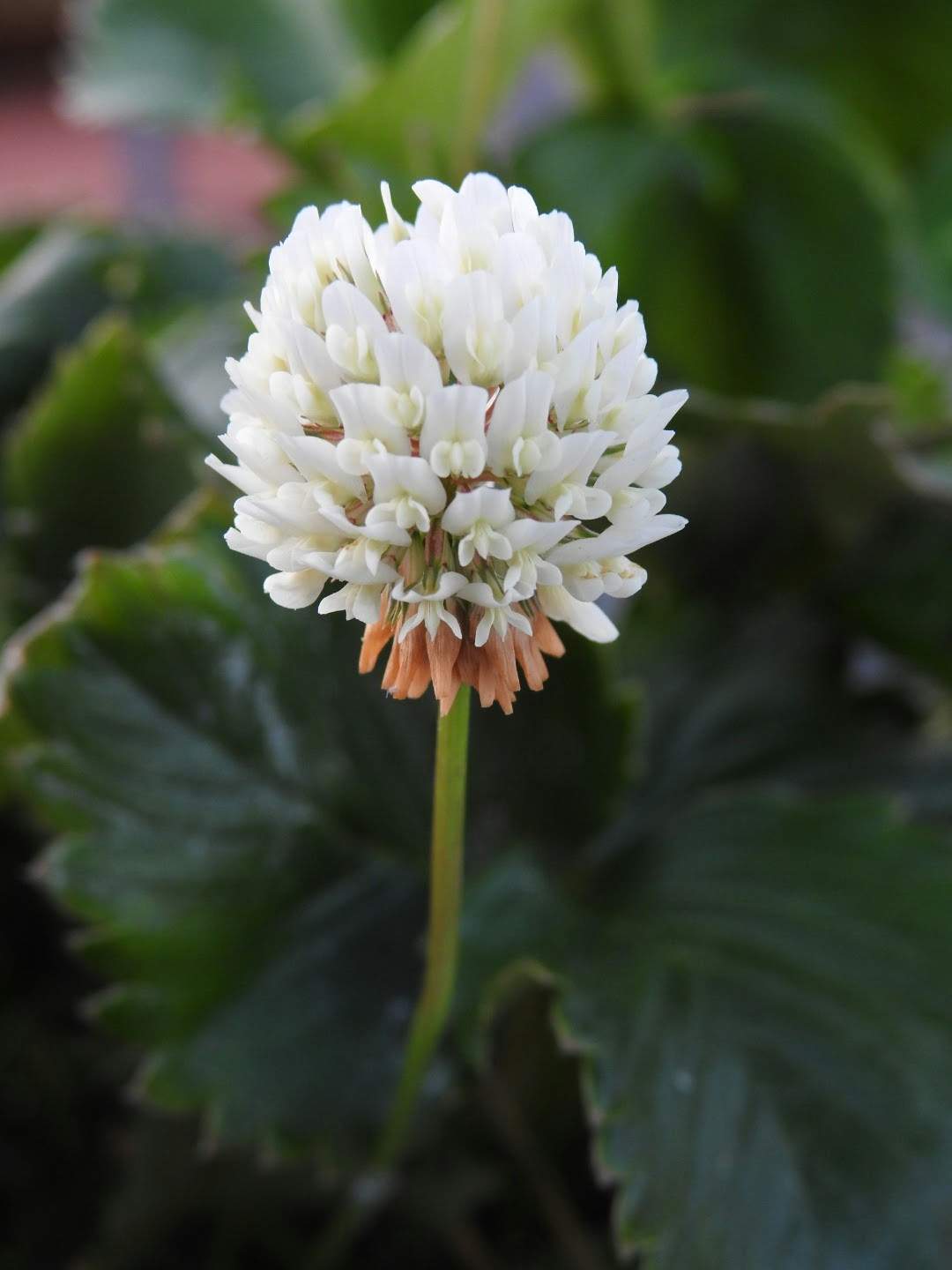
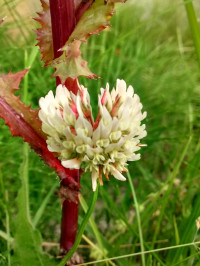
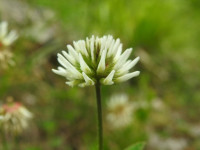
The flowers, from 10 to 50 per inflorescence, are gathered in hemispherical or globose heads 1-3 cm in diameter, placed in the leaf axils or at the apex of the stems on peduncles longer than the leaves themselves. The pedicels of individual flowers, 3-5 mm long, are generally longer than the calyx tube and tend to fold back after flowering. The calyx has five main and five secondary veins, with subulate teeth 1-2 times the length of the calyx tube. The corolla varies from white to white-pinkish, with a length of 7-10 mm; the standard petal is elliptical and longer than the wings and keel. The ovary is linear, with two ovules, while the fruit is an elliptical legume containing two ovoid seeds, with color ranging from brown to reddish, with a tuberculate surface.
The root system, typical of Fabaceae, is rhizomatous with nodulose roots that promote atmospheric nitrogen fixation, contributing to soil fertility.
Habitat and distribution
Alsike Clover is widespread in Italy and the Mediterranean area, preferring montane and subalpine environments, generally at altitudes between 600 and 1800 meters. It commonly grows in moist meadows, road edges, fields and pastures, favoring fresh and well-drained soils, often in sunny or partially shaded positions. The plant develops on substrates of variable origin, often with good water availability, characteristic of hilly and mountainous environments.
Flowering period
Flowering extends from May to August, corresponding to late spring and summer. In some higher areas or with cooler climates, flowering may start later and continue until September-October, thus adapting to local climatic conditions.
Ecology and pollination
The plant reproduces mainly sexually through seed production, but it is also able to propagate vegetatively via rhizomes. The abundant flowering and showy flowers attract numerous pollinating insects, particularly bees and bumblebees, which facilitate cross-pollination, essential for genetic diversity and species adaptation. After flowering, the pedicels fold back facilitating seed dispersal, which mainly occurs by direct fall near the mother plant, but also with the help of small animals and water.
Curiosities and traditional uses
Alsike Clover, like many other clover species, is known for its edibility and forage value. Traditionally, it has been used as forage for livestock, thanks to its ability to enrich the soil with nitrogen and improve pasture quality. Also, in some local traditions, parts of the plant have been used in cooking, especially the young leaves, which can be eaten raw or cooked.
From an ethnobotanical point of view, no specific medicinal uses of Alsike Clover are known, but clovers in general have been used for their anti-inflammatory and purifying properties. The presence of this plant in mountain meadows also contributes to biodiversity and the stability of alpine ecosystems.
Etymology
The scientific name derives from Latin Trifolium, meaning "three leaves," referring to the typical trifoliate arrangement of the plant's leaves. The epithet hybridum indicates the intermediate or hybrid nature of the species compared to other related ones in the genus. The Italian common name "trifoglio ibrido" reflects this characteristic, emphasizing the similarity and differences compared to other clover species.
Sources
- Prof. S. Pignatti, Flora d'Italia
- Tela Botanica / H. Coste, Flore descriptive et illustrée de la France
- World Flora Online (WFO)
Characteristics
Scheda botanica
| Famiglia | Fabaceae |
|---|---|
| Fioritura | maggio – agosto |
| Forma biologica | Tufted |
| Habitat | with white flowers, edible plant, Perennial plant |
| Uso alimentare | Commestibile |
Domande frequenti
- Quando fiorisce Alsike Clover?
- Alsike Clover fiorisce maggio – agosto.
- È commestibile Alsike Clover?
- Alsike Clover è considerata commestibile. Verifica sempre le parti eduli e la preparazione corretta prima del consumo.
- Che tipo di pianta è Alsike Clover?
- Alsike Clover è una Hemicryptophytes (Tufted) secondo la classificazione di Raunkiaer.
- A quale famiglia appartiene Alsike Clover?
- Alsike Clover appartiene alla famiglia botanica Fabaceae.
Where I found it (2 sightings)
Classification
- Kingdom
- Plantae
- Family
- Fabaceae
- Full name
- Trifolium hybridum L.
- Life form
- Hemicryptophytes tufted
Similar species
Search for species with similar characteristicsNoticed an error in the identification? Write to me
Other species of the same family
Fabaceae
Explore
Other species of Fabaceae