Botanical species
Astragalus monspessulanus
L.
Montpelier Milk-vetch
Description
Morphological description
Perennial herbaceous plant, of small size, with height varying between 10 and 25 cm, characterized by short and ascending stems, woody at the base and generally almost leafless (acaulescent or with very short stems). The stem surface is finely pubescent, covered with medifixed hairs, giving a slight downy appearance.
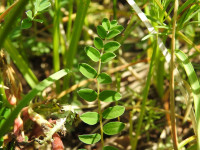
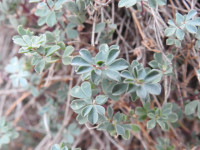
The leaves are imparipinnate, 10 to 15 cm long, composed of 21 up to 41 elliptical leaflets, initially oval and pointed, then more elliptical and without an acuminate tip. The upper surface of the leaves is green and glabrous or nearly so, with a well-marked central vein. The leaflets have average dimensions of about 5-12 mm. The leaf arrangement is mainly basal, arising from the base of the plant in a rosette form.
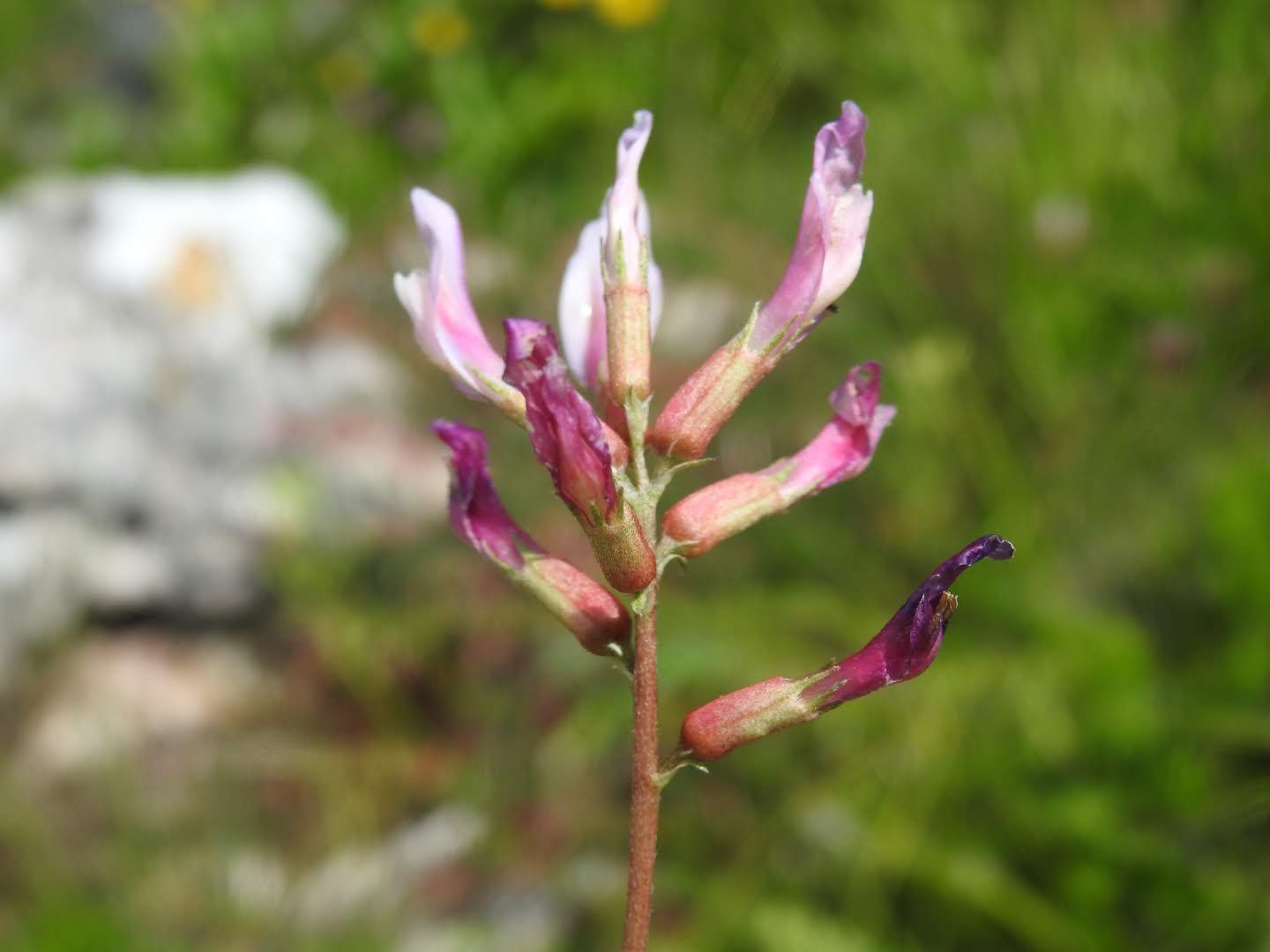
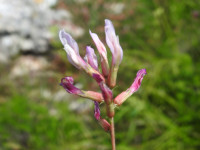
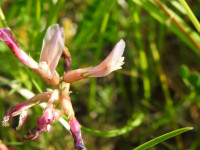
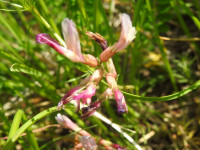
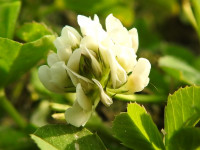
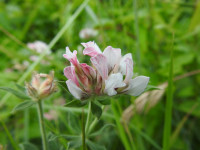
The flowers are gathered in multiflorous racemes borne on axillary peduncles that clearly exceed the leaves in length, with a ratio from 1 to 2 times the length of the leaf itself. The calyx is tubular, glabrescent or slightly pubescent, reddish or wine-colored, with acute teeth ranging from one-third up to two-thirds of the calyx tube, 9-15 mm long. The corolla is in shades of red-wine or light purple, with the standard (the upper petal) about 20-26 mm long and clearly longer than the wings and the keel, the latter with an obtuse apex. The flowers are erect, 2-3 cm long, arranged in clusters of 8-10 units that often exceed the leaves in height. The androecium is diadelphous (stamens united in two groups).
The fruit is a subglabrous legume, cylindrical and linear in shape, pointed at the apex and curved, 25 to 40 mm long. The surface is almost smooth, with angular seeds inside, hence the generic name.
The root system is not described in detail in the sources, but the species, adapted to arid and calcareous environments, probably has well-developed roots for absorption in poor and dry soils.
Habitat and distribution
The range of this species extends in western Mediterranean Europe, with a distribution center between Liguria, Spain, and Algeria. In Italy it is mainly present in the northern and central regions, with populations found from sea level up to mountain altitudes of 2300 m.
It prefers dry meadow environments, exposed slopes, pastures, cliffs, and rocky areas with predominantly calcareous and heavy soils. It is typical of mountainous and hilly environments, with sunny exposure and often marked aridity conditions. It also frequents pine forest formations and gravelly soils, adapting to poor and well-drained substrates.
The species is commonly found in hilly and mountainous biotopes, with a preference for temperate and dry climates, typical of the western eurymediterranean belt.
Flowering period
Flowering generally extends from April to June, with possible local variations related to altitude and specific climatic conditions. In more southern territories and at lower altitudes, flowering can begin as early as April, while in cooler or mountainous areas it can extend until June, sometimes slightly beyond.
Ecology and pollination
The flowering of this species is characterized by showy flowers of red-wine or light purple color, which attract specialized pollinating insects. The main pollinators are probably hymenopterans (bees and bumblebees), attracted by the color and flower structure that facilitates entomogamous pollination.
The plant is perennial and evergreen, with buds located at ground level from which it regenerates every year, adapting to conditions of aridity and grazing. The production of curved leguminous fruits favors seed dispersal, which mainly occurs by falling near the mother plant, but can also be facilitated by external agents such as wind or small animals.
Curiosities and traditional uses
The name astragalus derives from Greek and indicates a legume whose seeds resemble in shape the “angular little bones” (astragali). The specific name “monspessulanus” refers to Montpellier, a French locality from which it is presumed to have originated or been described for the first time.
No specific food or medicinal uses of this species are documented in the consulted sources. However, like many legumes, it could play an important role in soil improvement thanks to atmospheric nitrogen fixation. The presence of this species in natural arid and calcareous environments makes it an ecological indicator of well-preserved habitats.
Etymology
The scientific name is composed of Astragalus, a Greek term indicating a genus of legumes and literally meaning “little bones” or “small bone pieces,” referring to the angular shape of the seeds. The specific name monspessulanus refers to the city of Montpellier, France, where the species was probably described or studied for the first time.
The Italian common name, “Montpelier Milk-vetch,” derives directly from the scientific name, maintaining the French geographic reference and the botanical genus allusion.
Sources
- Prof. S. Pignatti, "Flora d'Italia"
- Acta Plantarum - Flora delle regioni italiane (scheda di Giuliano Salvai)
- World Flora Online (WFO)
Characteristics
Where I found it (5 sightings)
Classification
- Kingdom
- Plantae
- Family
- Fabaceae
- Full name
- Astragalus monspessulanus L.
- Life form
- Emicriptofite rosulate
Similar species
Search for species with similar characteristicsFurther reading
Noticed an error in the identification? Write to me
Other species of the same family
Fabaceae
Explore
Other species of Fabaceae