Botanical species
Trigonella officinalis
(L.) Coulot & Rabaute
Ribbed Melilot
Description
Morphological description
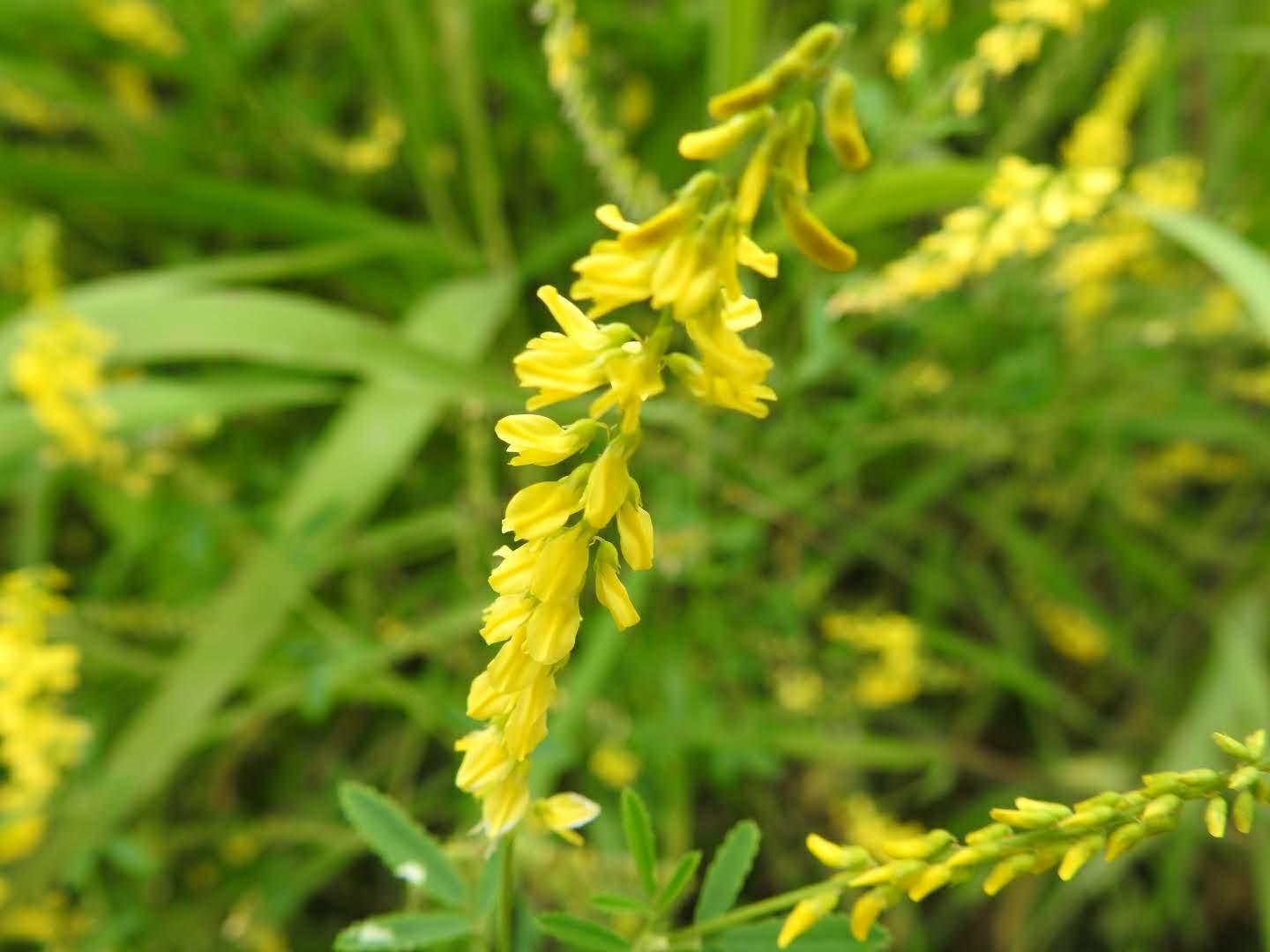
Biennial herbaceous plant belonging to the Fabaceae family, Ribbed Melilot presents a habit that can vary from prostrate-ascending to erect and branched, reaching a height between 50 and 150 cm. The stems are numerous, branched, grooved, and often hollow, giving the plant a robust but flexible structure.
The root system is characterized by a taproot, deep and sometimes tuberous, which allows good anchorage and effective absorption of water and nutrients even in poor or rocky soils.
The leaves are alternate, petiolate, and trifoliate, with elliptic-elongated segments that can reach 10-25 mm in the upper leaves. The leaflet margins are irregularly serrated, while the central leaflet is longer and equipped with an elongated rachis. The stipules are strap-shaped and entire, contributing to easy identification of the species.
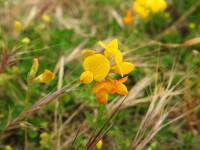
The inflorescence is a pedunculated raceme 4 to 10 cm long, positioned above the axillary leaf. It contains 30 to 70 small pendulous flowers, bright yellow in color and endowed with a pleasant scent that attracts numerous pollinating insects. The flowers are papilionaceous, with a zygomorphic corolla 4.5 to 7 mm long; the standard is similar in size to the wings, which in turn are longer than the keel. The calyx is bell-shaped with five linear and subequal teeth, shorter than half of the corolla.
The fruit is a small indehiscent legume called camara, oval and pendulous, 2.5 to 3.5 mm long, glabrous and light brown at maturity. It features a transversely reticulated and sinuous ribbing, containing one or two ovoid and smooth seeds.
Habitat and distribution
Ribbed Melilot is widely distributed in Italy and the Mediterranean basin. It prefers open environments such as rubble, uncultivated fields, roadsides, and disturbed areas, demonstrating excellent adaptability to poor and often calcareous soils. The species generally grows from 0 up to about 1500 meters in altitude, finding favorable conditions in mountainous and hilly areas.
In Italy it is present throughout most of the territory, while in the Mediterranean its distribution is subcosmopolitan, being present in almost all temperate regions of the world, albeit with some geographical gaps.
Flowering period
Flowering occurs mainly between May and August, with possible local variations related to altitude and climatic conditions. In warmer climates, flowering can begin as early as May, while at higher altitudes it tends to concentrate in the summer months.
Ecology and pollination
The yellow and fragrant flowers of Ribbed Melilot are very attractive to pollinating insects, particularly bees and other hymenopterans, which play a crucial role in the species' pollination. The plant produces a significant amount of nectar and pollen, making it a valuable source for pollinators and thus contributing to the biodiversity of the ecosystems where it is found.
Seed dispersal occurs mainly by natural fall, thanks to the pendulous structure of the fruit which facilitates deposition near the mother plant, but it can also be aided by animals or humans, especially in cultivated or disturbed areas.
Curiosities and traditional uses
Ribbed Melilot contains coumarin derivatives, aromatic substances that develop especially during drying and give the plant a characteristic hay-like scent. These compounds are responsible for the sedative and antispasmodic properties recognized in the plant, which has traditionally been used to promote sleep, soothe nervous irritations, neuralgia, headaches, and digestive disorders.
In folk medicine, Ribbed Melilot has also been used as a diuretic and as a balsamic expectorant. For external use, infusions of the plant have been used in decongestant washes for eyelids, mouth, throat, and small wounds, thanks to its astringent and mild sedative properties.
It should be noted, however, that coumarin, while beneficial in moderate amounts, can be slightly toxic if taken in excess; therefore, therapeutic uses should be carried out with caution.
Besides medicinal uses, the young leaves of Ribbed Melilot are consumed in salads, while the plant is also appreciated in beekeeping as a melliferous plant, contributing to honey production. In agriculture, it is used as forage and for soil improvement, thanks to its ability to fix nitrogen.
Etymology
The genus name "Trigonella" derives from the Greek τρίγωνος (trígonos) meaning "triangular," referring to the shape of the leaves composed of three leaflets. The specific epithet "officinalis" indicates the medicinal use of the plant, traditionally employed in herbal medicine and pharmacopoeia.
The Italian common name "Meliloto" recalls the characteristic sweet aroma of the plant, derived from coumarin compounds that resemble the smell of honey ("meli-") and sweetness ("-loto"), also highlighting its value as a melliferous plant.
Sources
- Acta Plantarum - Flora delle regioni italiane (scheda di Anja Michelucci)
Characteristics
Scheda botanica
| Famiglia | Fabaceae |
|---|---|
| Fioritura | maggio – agosto |
| Forma biologica | Biennials |
| Habitat | with yellow flowers, plant with a prostrate-ascending habit |
| Uso officinale | Pianta officinale |
Domande frequenti
- Quando fiorisce Ribbed Melilot?
- Ribbed Melilot fiorisce maggio – agosto.
- Che tipo di pianta è Ribbed Melilot?
- Ribbed Melilot è una Hemicryptophytes (Biennials) secondo la classificazione di Raunkiaer.
- A quale famiglia appartiene Ribbed Melilot?
- Ribbed Melilot appartiene alla famiglia botanica Fabaceae.
Where I found it (3 sightings)
Classification
- Kingdom
- Plantae
- Family
- Fabaceae
- Full name
- Trigonella officinalis (L.) Coulot & Rabaute
- Synonyms
- Melilotus officinalis (L.) Lam.; Trifolium officinale L.
- Life form
- Hemicryptophytes biennials
Similar species
Search for species with similar characteristicsNoticed an error in the identification? Write to me
Other species of the same family
Fabaceae



Explore
Other species of Fabaceae