Botanical species
Matricaria chamomilla
L.
Scented Mayweed
Description
Morphological description
Annual herbaceous plant, Scented Mayweed has an erect and scapose habit, with a height ranging between 10 and 50 cm. The stem is thin, glabrous, often highly branched in the upper part, and hollow inside. The leaves are alternate, sessile, light green in color, with a lanceolate outline; they are bi- or tripinnatisect, with segments reduced to thin, short, pointed linear lobes, less than 0.5 mm wide.
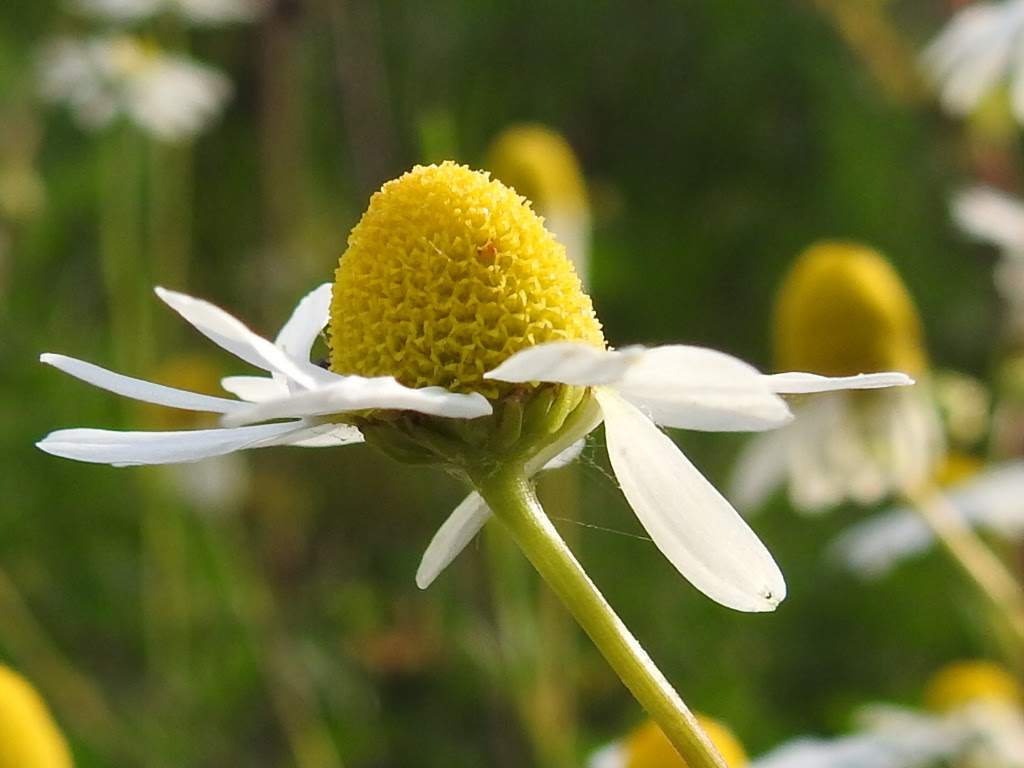
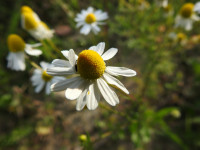
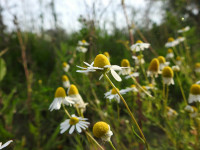
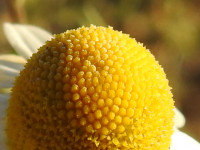
The flowers are gathered in solitary capitula measuring between 1.5 and 2.5 cm in diameter, supported by peduncles averaging 2-6 cm in length. The involucre consists of 12-17 membranous bracts, green-brown with eroded margins, arranged in 1-3 rows. The receptacle is conical, glabrous and hollow inside, giving the inner disc a convex shape, particularly visible when the white ligules of the ray flowers bend downward during senescence.
The capitula are heterogamous, with peripheral ligulate flowers, white, female, of elongated oval shape (5-10 mm in length), equipped with 3 terminal teeth on the ligules. The disc flowers are tubular, yellow, hermaphroditic, and contain five stamens fused to form a tube around the bifid pistil. Both the calyx scales and the flowers have multicellular hairs visible only under the microscope. The fruits are small ovoid achenes, 1-2 mm long, smooth on the back, with 3-5 more or less evident ribs on the concave side; the pappus is absent or reduced to a short fringed membranous crown.
The roots are tapered and thin, anchoring the plant to the soil.
Habitat and distribution
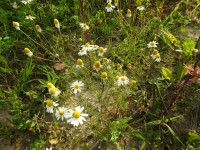
Scented Mayweed is an archaeophyte species naturalized in Italy and the Mediterranean area, probably native to Eurasia and introduced in pre-Roman times. It is widespread throughout the Italian territory and much of the Mediterranean, present in anthropized environments such as cereal crops (especially wheat), uncultivated lands, gardens, roadside edges, dumps, and near dwellings.
It grows mainly from 0 up to 800 m altitude, with sporadic occurrences up to 1,500 m a.s.l. It prefers well-drained soils, often poor and disturbed, with sunny or semi-shaded exposure.
Flowering period
The flowering extends from May to August, with variations linked to altitude and latitude. In warmer climates and lower elevations, flowering can start as early as May, while in cooler or mountainous areas it lasts until August.
Ecology and pollination
Scented Mayweed is an aromatic and strongly scented plant that attracts numerous pollinating insects, including bees, hymenopterans, and other pollinators, promoting cross-fertilization. The yellow tubular flowers are hermaphroditic, while the white ligulate ones are female, a common arrangement in Asteraceae that facilitates pollination.
Seed dispersal occurs mainly by gravity and through accidental transport by animals or human activities. The achenes, lacking pappus or with a very reduced pappus, are not particularly adapted to aerial transport, but the presence of the membranous crown can favor limited displacement.
Curiosities and traditional uses
Scented Mayweed is one of the most well-known and used medicinal plants in Italy and worldwide. Historically, it has been valued for its aromatic, medicinal, and cosmetic properties since antiquity. The essential oil, rich in bisabolol and chamazulene (responsible for the characteristic blue color), flavonoids, hydroxycoumarins, mucilages, and tannins, gives the plant anti-inflammatory, sedative, antispasmodic, analgesic, and digestive actions.
Traditionally, the infusion of Scented Mayweed is used to relieve nervous digestive disorders, insomnia, infant colic, toothache, and to stimulate the immune system, thanks to its ability to activate white blood cells. External use is indicated for the treatment of wounds, sunburns, hemorrhoids, and skin inflammations.
Besides medicinal use, Scented Mayweed is used in cosmetics as an anti-allergenic and hair lightener, and in cooking as a flavoring for wines, liquors (e.g., vermouth), jams, candies, and chewing gum. In the past, dried flowers were used as pipe tobacco or as a moth repellent in drawers.
Scented Mayweed is also appreciated in organic farming as a natural soil amendment, promoting the decomposition of organic residues.
It is important to distinguish common or German Scented Mayweed (Matricaria chamomilla) from Roman Scented Mayweed (Chamaemelum nobile), which, although having similar properties, presents slightly different botanical and therapeutic characteristics.
Etymology
The genus name "Matricaria" derives from the Latin "matrix" or "mater," referring to emmenagogue properties and the traditional link with maternity and childbirth. The specific name "chamomilla" comes from classical Greek, composed of "chamai" (on the ground, small or low) and "melon" (apple), indicating the low plant with an odor similar to that of an apple, an olfactory reference already known to Dioscorides and Pliny the Elder.
In Italian, the term "camomilla" derives directly from the Latin and Greek name, maintaining the reference to the fruity aroma and the medicinal properties of the plant.
Sources
- Prof. S. Pignatti, "Flora d'Italia"
- Acta Plantarum - Flora delle regioni italiane (scheda di Marinella Zepigi)
- Tela Botanica / H. Coste, "Flore descriptive et illustrée de la France"
- World Flora Online (WFO)
Characteristics
Scheda botanica
| Famiglia | Asteraceae |
|---|---|
| Fioritura | maggio – agosto |
| Forma biologica | Scapose |
| Habitat | with white flowers, edible plant, annual plant |
| Uso alimentare | Commestibile |
Domande frequenti
- Quando fiorisce Scented Mayweed?
- Scented Mayweed fiorisce maggio – agosto.
- È commestibile Scented Mayweed?
- Scented Mayweed è considerata commestibile. Verifica sempre le parti eduli e la preparazione corretta prima del consumo.
- Che tipo di pianta è Scented Mayweed?
- Scented Mayweed è una Therophytes (Scapose) secondo la classificazione di Raunkiaer.
- A quale famiglia appartiene Scented Mayweed?
- Scented Mayweed appartiene alla famiglia botanica Asteraceae.
Where I found it (9 sightings)
Classification
- Kingdom
- Plantae
- Family
- Asteraceae
- Full name
- Matricaria chamomilla L.
- Synonyms
- Chamomilla recutita (L.) Rauschert; Matricaria recutita L.
- Life form
- Therophytes scapose
Similar species
Search for species with similar characteristicsFurther reading
Noticed an error in the identification? Write to me
Other species of the same family
Asteraceae
Explore
Other species of Asteraceae