Botanical species
Leontodon anomalus
Ball
Dente di leone delle Apuane




Description
Morphological description
Perennial herbaceous plant, with an erect habit and height varying between 20 and 45 cm. The floral scape, leafless but equipped with some scales, is generally simple and monocephalous, meaning it bears a single capitulum at the apex, although it can rarely be forked with two capitula. The surface of the scape is covered with hirsute hairs.
The leaves are all arranged in a basal rosette, dark green in color and herbaceous in texture. They are lanceolate, linear or lanceolate-linear, with weakly dentate or sinuous margins, sometimes almost entire. The leaf surface is rough due to the presence of stalked hairs 0.2 to 0.8 mm long, with (2)3(4) rays curved downward. The leaves are longer than the scape and have a rough texture due to simple and forked hairs.
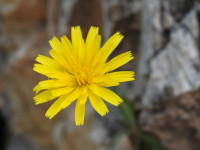
The floral capitulum is initially pendulous before anthesis, with a cylindrical involucre formed by marginal scales with dense simple hairs and scattered hairs – also forked – on the back. The flowers are hermaphroditic, all ligulate, of a bright and vivid yellow very similar to that of the common dandelion (Taraxacum). The anthers have acute apices, while the stigmas are filiform and hairy.
The fruit is a cypsela (achene) of brownish color, with a pappus initially plumose of light brown color that then loses the secondary hairs, appearing to be equipped with simple white bristles about one and a half times the length of the achene. The root system consists of a taproot, tuberous and vertical, supporting numerous leaf rosettes.
Habitat and distribution
It is an Italian endemic species, present exclusively in the Apuan Alps, in the Modenese and Pistoiese Apennines, in Western Liguria and in the northeastern sector of the Voltri Group in Piedmont. Its distribution is disjunct in two main areas: the western Ligurian and the Tuscan-Emilian.
It prefers mountain environments up to about 1800 meters altitude, frequenting carbonate substrates in the Apuan Alps and in the Finalese, while in the western Ligurian Apennines it is also found on ultramafic rocks belonging to the alpine serpentinite series. It grows on lithosols, often on exposed rocky slopes.
Flowering period
Flowering mainly extends during the summer months, from June to August. No significant variations in the flowering period are reported in the different distribution areas.
Ecology and pollination
The species has hermaphroditic ligulate flowers of bright yellow color, which favor the attraction of pollinating insects, particularly bees and other generalist pollinators, attracted by the color and shape of the flowers. The presence of pendulous capitula before anthesis may help protect immature flowers from weather or predators.
Seed dispersal occurs through the plumose pappus, which allows the fruit to be carried by the wind. The loss of secondary hairs in the pappus represents a functional adaptation for more effective aerial dispersal.
Curiosities and traditional uses
No documented information is available regarding traditional uses, folk medicines, or food uses of the species. Being a rare and endemic plant with limited distribution, it is likely that its collection has been and still is little widespread. The common name “dente di leone delle Apuane” (Apuan dandelion) recalls the similarity to the well-known Taraxacum, often used in herbal medicine and food, but Leontodon anomalus is not known for similar uses.
Etymology
The genus name derives from the Greek "leon" (lion) and "odontos" (tooth), clearly referring to the dentate leaf margin, which resembles the shape of lion’s teeth. The specific epithet "anomalus" indicates the peculiarity or anomaly compared to other species of the genus, probably referring to distinctive morphological characteristics or limited geographic distribution.
The Italian common name “dente di leone delle Apuane” emphasizes both the similarity to the common dandelion and the restricted range to the Apuan Alps.
Sources
- Prof. S. Pignatti, Flora d'Italia
- Acta Plantarum - Flora delle regioni italiane (scheda di Giuliano Salvai)
Characteristics
Scheda botanica
| Famiglia | Asteraceae |
|---|---|
| Fioritura | giugno – agosto |
| Forma biologica | Rosulate |
| Habitat | with yellow flowers, endemic plant |
Domande frequenti
- Quando fiorisce Dente di leone delle Apuane?
- Dente di leone delle Apuane fiorisce giugno – agosto.
- Che tipo di pianta è Dente di leone delle Apuane?
- Dente di leone delle Apuane è una Hemicryptophytes (Rosulate) secondo la classificazione di Raunkiaer.
- A quale famiglia appartiene Dente di leone delle Apuane?
- Dente di leone delle Apuane appartiene alla famiglia botanica Asteraceae.
Classification
- Kingdom
- Plantae
- Family
- Asteraceae
- Full name
- Leontodon anomalus Ball
- Synonyms
- Leontodon incanus (L.) Schrank var. anomalus (Ball) Fiori
- Life form
- Hemicryptophytes rosulate
Similar species
Search for species with similar characteristicsNoticed an error in the identification? Write to me
Other species of the same family
Asteraceae

Explore
Other species of Asteraceae