Botanical species
Erigeron karvinskianus
DC.
Mexican Fleabane
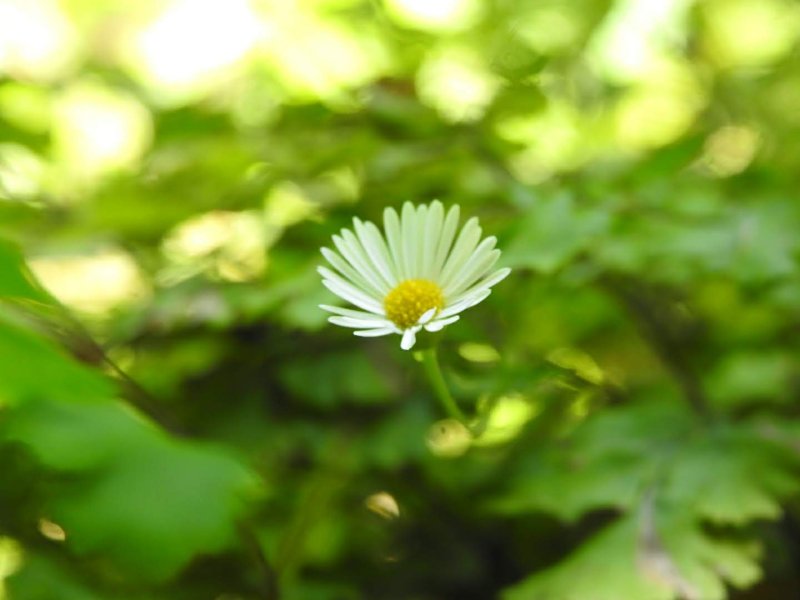
Description
Morphological description
Perennial herbaceous plant, of modest size, with a height generally ranging between 10 and 30 cm, but can also reach up to 40 cm. The habit is characterized by thin stems, prostrate or decumbent, with slender and flexible ascending branches, slightly angular and covered by a light whitish pubescence, which with age assume a subcortical texture with evident leaf bases. The stem is often irregular and has a slightly hairy surface.
The leaves are mainly arranged in a basal rosette and along the stem. Basal leaves are sessile or with a short petiole, ovate-lanceolate in shape, up to 3 cm long and about 5 mm wide. Some may be entire, others trilobed with lateral spinules and a mucronate tip. Cauline leaves are narrower, spatulate-linear in shape, acute and one-nerved, 13 to 22 mm long and 2-3 mm wide. These often have slightly revolute margins and are sparsely hairy on both surfaces.
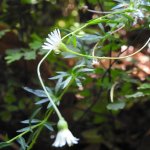
The inflorescence consists of solitary heads, about 1.5 cm in diameter, borne at the apex of the branches or on longer axillary peduncles emerging above the foliage. The involucre is cylindrical, about 4 mm long, with 2-3 series of lanceolate bracts, slightly pubescent and with membranous and finely denticulate margins; the outermost bracts may show purplish hues.
The peripheral flowers are ligulate, female, in about two series, with ligules 5-6 mm long, white inside and pink or rosy outside, sometimes both colors present on the same plant. The corolla of the ligules is linear-oblong or oblanceolate, with an entire or slightly bifid apex. The disc flowers are hermaphroditic, tubular, yellow in color, with a narrowly funnel-shaped corolla 2.5-3 mm long, hairless, and anthers about 1 mm. The receptacle is flat, slightly convex, without chaff, smooth or alveolate.
The fruits are ellipsoid or obovoid achenes, 1-1.5 mm long, laterally compressed and covered by a light whitish pubescence. The pappus consists of numerous fine, barbellate bristles about 2.5 mm long, which facilitate wind dispersal.
The root system is not described in detail in the sources consulted, but as with many Mediterranean perennial herbaceous species, it is presumed to consist of fibrous and superficial roots, suitable for colonizing rocky substrates and walls.
Habitat and distribution
Native to Central and subtropical America, this species is currently naturalized in several temperate-warm areas, including vast regions of the Mediterranean. In Italy it is mainly found in urban and peri-urban environments, often on walls, rocky cliffs, building cracks, and other stony substrates, even under variable but generally moderate moisture conditions. The species prefers sunny or semi-shaded exposures.
Growth altitude ranges from sea level up to about 600 meters, with a greater presence in coastal and hilly areas. The ability to adapt to poor and shallow substrates, along with some drought tolerance, makes this plant suitable for Mediterranean climates.
Flowering period
Flowering extends from April to October, with possible extension into the warmer and more humid months, depending on local climatic conditions. This long flowering window allows the plant to reproduce effectively and rapidly colonize new habitats. No significant variations in the flowering period related to geographic distribution within the Mediterranean area have been reported.
Ecology and pollination
The flowers, with their typical radiate structure (outer ligulate flowers and central tubular flowers), attract numerous pollinating insects, including bees, bumblebees, butterflies, and other pollinators that visit both the ligulate flowers, which often serve as a visual attractant, and the disc flowers, richer in pollen and nectar.
The reproductive strategy is predominantly entomogamous, with cross-fertilization favored by the simultaneous presence of female ligulate flowers and hermaphroditic tubular flowers. The abundant production of achenes equipped with barbellate pappus allows efficient wind dispersal, promoting colonization of new sites, especially in open environments such as walls and rocks.
Stoloniferous growth and the ability to produce buds at ground level also contribute to the species' perenniality and vegetative spread.
Curiosities and traditional uses
Erigeron karvinskianus is appreciated for its ornamental value, thanks to its long flowering period and delicate flower colors, ranging from white to pink. It is frequently cultivated in rock gardens, balconies, and green walls, and has given rise to highly valued ornamental hybrids.
From an ethnobotanical perspective, a related species of the genus Erigeron (Erigeron canadensis) has been used in folk medicine for the treatment of diarrhea, dysentery, as a hemostatic, and for conditions such as gonorrhea. However, no specific medicinal uses are documented for Erigeron karvinskianus in Italy or the Mediterranean basin.
The plant is also reported as one of the Erigeron species that have naturalized outside their original range, escaping cultivation and establishing spontaneously in urban and rural environments.
Etymology
The generic name Erigeron derives from the Greek "eri" (early) and "geron" (old man), probably referring to the short duration of individual flowers that quickly produce the white pappi of the achenes, or to the presence of hairs characterizing some species of the genus. In ancient times, this name was used to indicate plants similar to senecio.
The specific epithet karvinskianus honors the German explorer and botanist Karwinski von Karwin (1780-1855), known for his studies on the tropical flora of Central America and author of the "Icones Plantarum," a significant botanical work.
The Italian common name "Cespica di von Karwinski" refers precisely to this dedication.
Sources
- Acta Plantarum - Flora delle regioni italiane (actaplantarum.org)
- Acta Plantarum - Scheda di Antonino Messina
- World Flora Online (WFO)
Characteristics
Scheda botanica
| Famiglia | Asteraceae |
|---|---|
| Fioritura | giugno – ottobre |
| Forma biologica | Scapose |
| Habitat | with white flowers, with pink flowers, plant with a prostrate-ascending habit |
Domande frequenti
- Quando fiorisce Mexican Fleabane?
- Mexican Fleabane fiorisce giugno – ottobre.
- Che tipo di pianta è Mexican Fleabane?
- Mexican Fleabane è una Hemicryptophytes (Scapose) secondo la classificazione di Raunkiaer.
- A quale famiglia appartiene Mexican Fleabane?
- Mexican Fleabane appartiene alla famiglia botanica Asteraceae.
Where I found it (7 sightings)
Classification
- Kingdom
- Plantae
- Family
- Asteraceae
- Full name
- Erigeron karvinskianus DC.
- Synonyms
- Erigeron karvinskianus DC. var. mucronatus (DC.) Asch.; Erigeron karvinskianus DC. var. mucronatus (DC.) Hieron., isonym; Erigeron mucronatus DC.; Vittadinia triloba hort., non DC.
- Life form
- Hemicryptophytes scapose
Similar species
Search for species with similar characteristicsFurther reading
Noticed an error in the identification? Write to me
Other species of the same family
Asteraceae
Explore
Other species of Asteraceae