Botanical species
Scolymus hispanicus
L.
Golden Thistle
Description
Morphological description
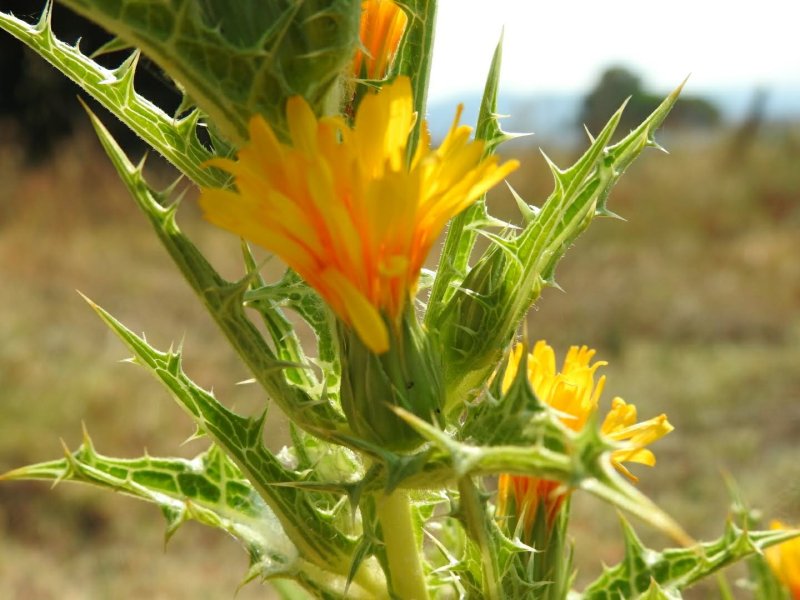
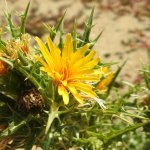
Biennial herbaceous plant, sometimes perennial, with an erect habit and variable height between 30 and 120 cm. The stem is branched and has short, interrupted, and spiny lateral wings, not cartilaginous, with a generally pubescent surface. The stem wings are characteristic and help distinguish the species, being discontinuous and with spiny but thin margins.
The leaves are of two types: basal leaves are pinnatifid or pinnatipartite, 5 to 15 cm long, with deep teeth and robust spines, green in color and slightly coriaceous; the upper leaves are broad, broadly clasping, more or less coriaceous, and with spiny margins. The leaf veins are well visible, whitish in color, and the cauline leaves are often decurrent along the stem.
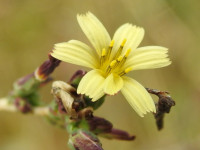
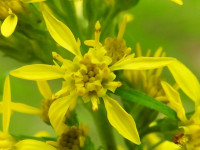
The inflorescence consists of sessile heads, both terminal and axillary, arranged in corymbs or branched clusters. Each head is surrounded by 3 spiny bracts, about as wide as the undivided central area, with lanceolate, glabrous scales, progressively tapering to an acute and cuspidate tip. The flowers are all ligulate, hermaphroditic, of a bright vivid yellow color, about 16-17 mm long (sometimes smaller in the central flowers). The anthers are yellow.
The fruit is an ovoid-compressed achene, about 3-5 mm long, grayish in color, lacking a pappus but with 2-4 deciduous and fragile bristles at the top. The root is fleshy and taprooted, suitable for food purposes.
Habitat and distribution
This species is typical of Mediterranean regions, with a range extending along the entire European Mediterranean coast, including the major Italian islands, and reaching northwards to regions such as Liguria and the Adriatic coast up to Calabria. Its presence in Piedmont is uncertain.
It prefers sandy coastal habitats, dry soils, uncultivated lands, banks of large rivers, and marine environments with sunny exposure. It generally grows from 0 up to 800 meters in altitude. It is particularly adapted to sandy and well-drained soils, often in disturbed or anthropized contexts.
Flowering period
Flowering mainly occurs between June and August, with possible geographic variations shifting it from July to September in some Mediterranean areas. The long flowering season allows good reproductive success under Mediterranean climatic conditions.
Ecology and pollination
The species reproduces through entomophilous pollination, mainly thanks to pollinating insects attracted by the intense yellow color of the ligulate flowers. The hermaphroditic flower structure promotes cross-fertilization. Seed dispersal occurs via achenes, which lack a pappus but have fragile and deciduous bristles that facilitate temporary anchorage to the substrate or passing animals.
The plant behaves as a biennial hemicryptophyte: buds overwinter at ground level, allowing annual or biennial survival and regeneration.
Curiosities and traditional uses
The Golden Thistle is known for its fleshy, edible roots, appreciated in some Italian culinary traditions, especially in the Marche region, where they are harvested and used in typical dishes, such as accompaniments to stockfish in festive preparations. The roots can be boiled, stewed, or toasted (the latter used as a coffee substitute). The ribs, properly stripped of spines and leaves, are consumed both boiled and fried, with a stronger flavor compared to artichoke.
Dried flowers have been used to color foods, sometimes as a substitute for saffron, although they only impart color without the characteristic aroma.
From an ethnobotanical point of view, the presence of rough spines has historically limited large-scale wild harvesting, but food and medicinal use is nonetheless documented.
Warning: medicinal and food uses are reported for informational purposes and do not replace professional medical or nutritional advice.
Etymology
The generic name “Scolymus” derives from ancient Greek and means “sting” or “spine,” referring to the characteristic spines of the plant and its similarities with other thistles. The specific name “hispanicus” alludes to the Spanish geographic origin attributed to the species, although its distribution is wider in the Mediterranean basin.
The Italian common name “cardo scolimo” recalls the spiny appearance similar to that of thistles and its belonging to the genus Scolymus.
Sources
- Prof. S. Pignatti, "Flora d'Italia"
- Acta Plantarum - Flora delle regioni italiane (scheda di Mirna Medri)
- Tela Botanica / H. Coste, "Flore descriptive et illustrée de la France"
- World Flora Online (WFO)
Characteristics
Scheda botanica
| Famiglia | Asteraceae |
|---|---|
| Fioritura | giugno – agosto |
| Forma biologica | Biennials |
| Habitat | with yellow flowers, spiny plant, psammophilous plant |
Domande frequenti
- Quando fiorisce Golden Thistle?
- Golden Thistle fiorisce giugno – agosto.
- Che tipo di pianta è Golden Thistle?
- Golden Thistle è una Hemicryptophytes (Biennials) secondo la classificazione di Raunkiaer.
- A quale famiglia appartiene Golden Thistle?
- Golden Thistle appartiene alla famiglia botanica Asteraceae.
Where I found it (4 sightings)
Classification
- Kingdom
- Plantae
- Family
- Asteraceae
- Full name
- Scolymus hispanicus L.
- Life form
- Hemicryptophytes biennials
Similar species
Search for species with similar characteristicsFurther reading
Noticed an error in the identification? Write to me
Other species of the same family
Asteraceae
Explore
Other species of Asteraceae