Botanical species
Mycelis muralis
(L.) Dumort. subsp. muralis
Wall Lettuce
Description
Morphological description
The plant is a perennial herbaceous species, 30 to 100 cm tall, with an erect habit and a glabrous, smooth stem branched in the upper part. The stem is generally hairless and may have a waxy coating that is easily removable, giving it a glaucous appearance.
The leaves are green-glaucous in color, pinnatifid in shape with deeply incised divisions into broad, angular, and toothed lobes. The terminal lobe is triangular or pentagonal, larger than the lateral lobes, which often point towards the base of the leaf. The lower leaves are borne on a winged petiole, while the upper ones are lyrate and clasp the stem with two small rounded auricles at the base.
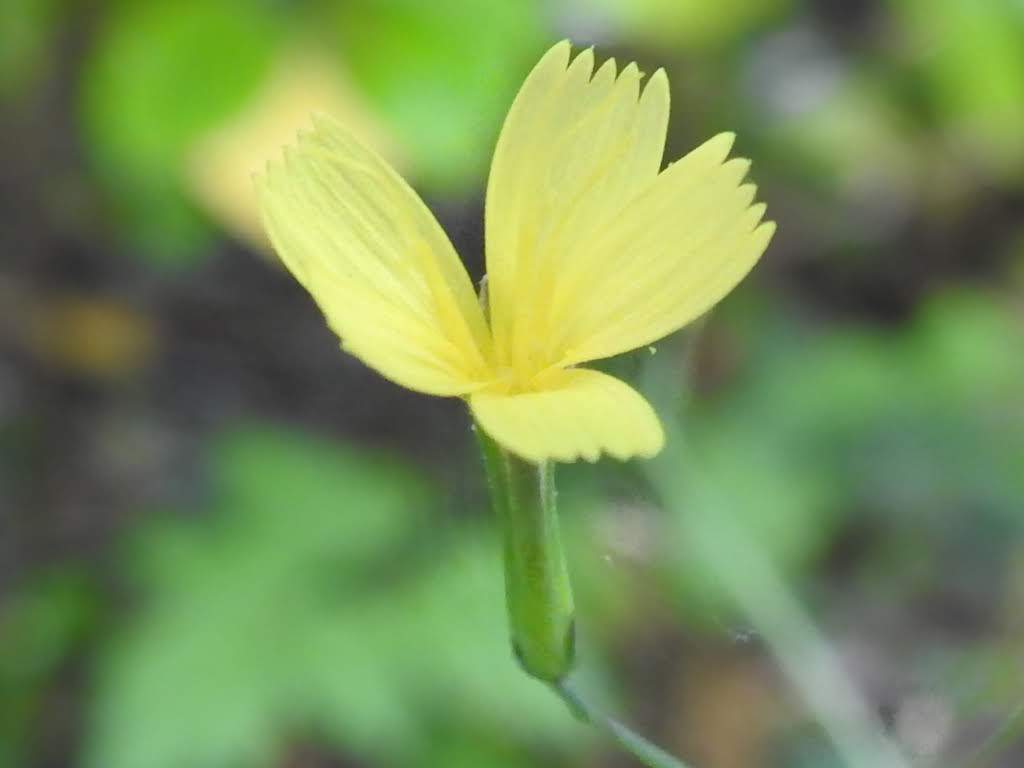
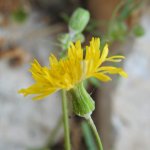
The inflorescences consist of numerous small capitula (7-10 mm), arranged in a branched, loose, and spreading panicle. Each capitulum has an involucre made up of linear and equal bracts, 8-9 mm long, with some small outer bracts. The flowers, all ligulate and hermaphroditic, are pale yellow, generally five per capitulum. The flower symmetry is actinomorphic and the habit is scapose.
The fruit is a flattened cypsela (achene), dark brown or glossy black, 2.5 to 4 mm long, with about 13 ribs and a short beak of 0.5-1 mm. The pappus consists of white hairs and serves for anemochorous dispersal.
The root system, as in many perennial herbaceous species, is fibrous and allows the plant to survive in woodland environments through buds located at ground level.
Habitat and distribution
The species is widespread in Europe and the Caucasus, with confirmed presence throughout the Italian peninsula, including the Alpine, Apennine, and insular regions such as Corsica. In the Mediterranean, it is mainly reported in temperate and cool areas, usually up to 1800 meters altitude.
It grows mainly in shady woodland environments, preferring cool, humus-rich places, but also adapts to shaded walls and rocks. It favors well-drained but fresh substrates, with moderate exposure to shade or partial shade, typical of mixed forests and hilly-mountainous areas.
Flowering period
Flowering occurs mainly between July and August, with slight variations depending on altitude and geographic area. In mountainous and subalpine areas, it may start later, but generally concentrates in mid-summer.
Ecology and pollination
The plant relies on pollinating insects, particularly bees and flies, attracted by the yellow ligulate flowers. Flowering and flower morphology favor entomogamous pollination. Seed dispersal occurs via the feathery pappus that allows anemochorous dispersal (airborne transport).
As a scapose hemicryptophyte, the perennial plant survives through buds at ground level, allowing resilience to external agents and adverse seasons.
Curiosities and traditional uses
The species is edible: young leaves can be eaten raw as salad, especially in spring. The plant has a long tradition of food use in local contexts, although it is not widely cultivated or used as a medicinal plant.
No particularly relevant medicinal or folkloric uses are reported, but the presence of latex and its belonging to the Asteraceae family make it related to other species with purifying or digestive properties used traditionally.
Etymology
The genus name, Mycelis, derives from an ancient term of uncertain origin, while the specific epithet muralis indicates the typical habitat of the plant, i.e., the "walls" or rocky cliffs on which it frequently grows. The Italian common name "Wall Lettuce" refers both to the resemblance of the leaves to common lettuces and to its prevalent natural environment, namely shady and cool woods.
Sources
- Acta Plantarum - Flora delle regioni italiane (scheda di Giuliano Salvai)
- Tela Botanica / H. Coste, Flore descriptive et illustrée de la France
- World Flora Online (WFO)
Characteristics
Scheda botanica
| Famiglia | Asteraceae |
|---|---|
| Fioritura | luglio – agosto |
| Forma biologica | Scapose |
| Habitat | with yellow flowers, annual plant |
Domande frequenti
- Quando fiorisce Wall Lettuce?
- Wall Lettuce fiorisce luglio – agosto.
- Che tipo di pianta è Wall Lettuce?
- Wall Lettuce è una Hemicryptophytes (Scapose) secondo la classificazione di Raunkiaer.
- A quale famiglia appartiene Wall Lettuce?
- Wall Lettuce appartiene alla famiglia botanica Asteraceae.
Where I found it (10 sightings)
Classification
- Kingdom
- Plantae
- Family
- Asteraceae
- Full name
- Mycelis muralis (L.) Dumort. subsp. muralis
- Synonyms
- Lactuca muralis (L.) Fresen.; Cicerbita muralis (L.) Wallr.; Lactuca muralis (L.) Gaertn.; Phaenopus muralis (L.) Coss. & Germ.; Prenanthes muralis L.
- Life form
- Hemicryptophytes scapose
Similar species
Search for species with similar characteristicsFurther reading
Noticed an error in the identification? Write to me
Other species of the same family
Asteraceae
Explore
Other species of Asteraceae