Botanical species
Lamium purpureum
L.
Red Dead-nettle
Description
Morphological description
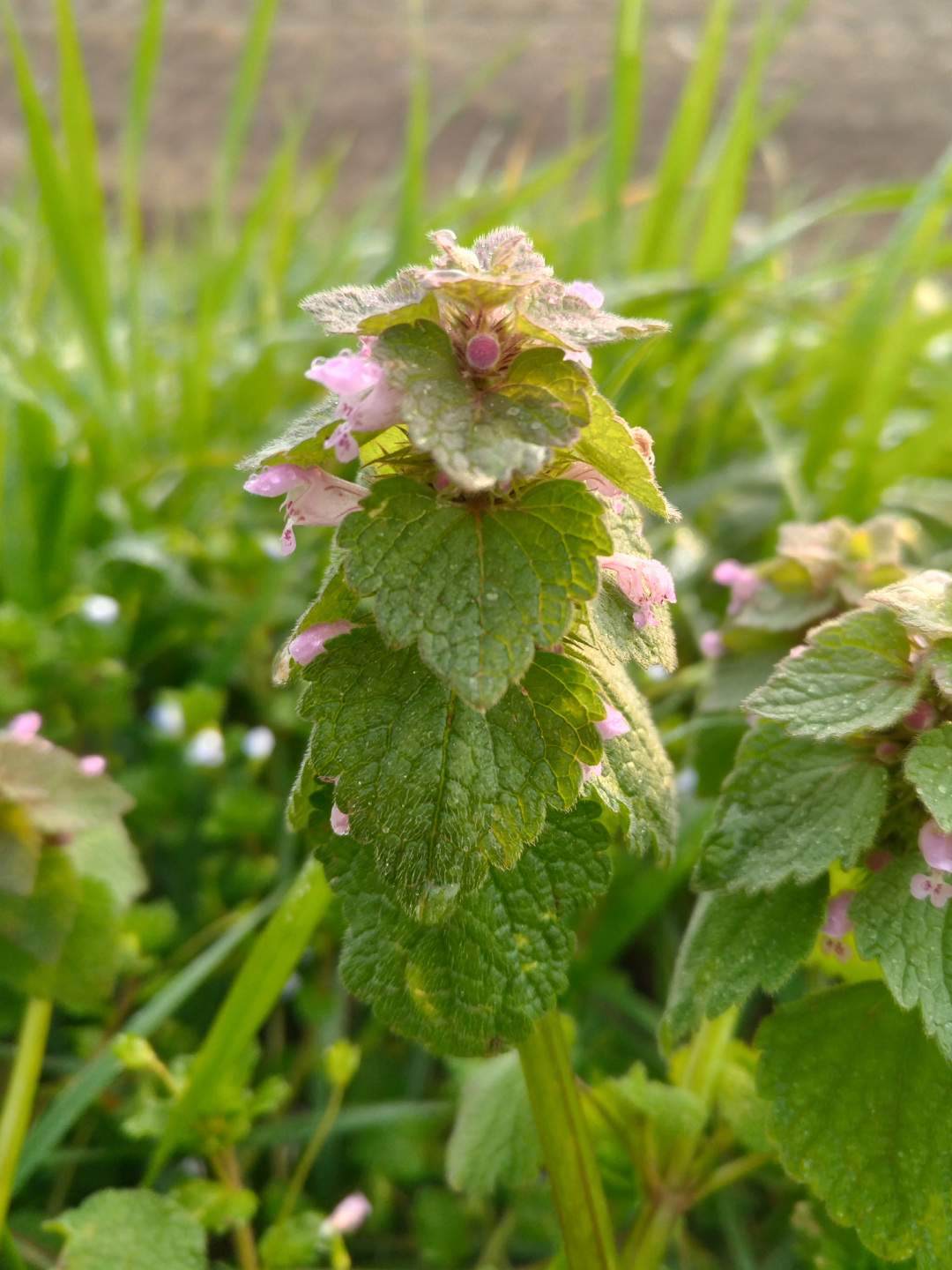
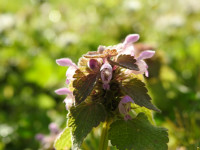
Annual herbaceous plant, with height generally ranging between 10 and 30 cm, characterized by a variable habit: stems can be erect, prostrate, or decumbent, often branched at the base and sometimes rooting at the nodes. The stem has a quadrangular section, typical of Lamiaceae, and is covered by a sparse pubescence that gives a slightly hairy appearance. Stems often show a reddish coloration, especially in the upper parts.
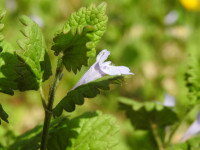
The leaves are all petiolate, ovate in shape with a cordate base, with irregularly dentate or crenate margins. The leaf surface is pubescent on both sides, giving a herbaceous and soft texture to the touch. The upper cauline leaves are often violet or purple in color, smaller and appressed towards the inflorescence, while the basal ones are larger and spaced along the stem.
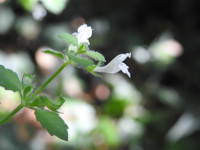
The flowers are hermaphroditic, zygomorphic, and gathered in dense verticillasters (whorled inflorescences) located in the axils of the upper leaves and at the branch tips. Each verticillaster is composed of 3-10 small flowers, with bilabiate corollas of purplish-violet color, about 1-1.5 cm long, characterized by a straight tube internally equipped with a ring of hairs at the base of the throat. The upper lip is entire, concave, and pubescent on the outside, while the lower lip has two small lateral lobes and a larger median lobe, often darkly spotted. The calyx is tubular-campanulate, 5-7 mm long, with acute, ciliate, and spreading teeth that elongate and open further after flowering.
The stamens are four, didynamous (with two long and two short), with anthers provided with tufts of hairs. The ovary is superior and divided into four locules. The fruit consists of four nutlets (tetrachenium), trigonal in shape with a truncated apex, smooth and small in size.
The root system consists of a slender and fibrous main root, supporting the annual plant with rapid development.
Habitat and distribution
Lamium purpureum is a Eurasian species native to Europe and Asia, now widely naturalized throughout the Mediterranean, including Italy, where it is commonly found in anthropized environments. It grows preferably in cultivated fields, vegetable gardens, vineyards, road edges, uncultivated lands, and ruins, often manifesting as a weed.
It adapts to various soil conditions, preferring well-drained but also slightly disturbed soils. Exposure is generally sunny or partially shaded. The species is found from the plains up to submontane altitudes of about 1500 meters, demonstrating good ecological plasticity.
Flowering period
Flowering mainly occurs between March and October, with possible extension until November in milder climates. In Italy and the Mediterranean, the most intense flowering period is spring, when the plant rapidly colonizes open spaces, but it can also be observed in flower in autumn, especially in temperate climate areas.
Ecology and pollination
Lamium purpureum produces hermaphroditic and zygomorphic flowers, adapted to entomophilous pollination. The main pollinating insects are bees, bumblebees, and other hymenopterans, attracted by the purplish-violet color and the presence of hairs inside the corolla tube that facilitate pollen deposition on the insects. The plant emits an unpleasant odor when rubbed, which however does not seem to hinder the action of pollinators.
Seed dispersal occurs through the four nutlets produced by the fruits, which can fall near the mother plant or be transported by animals or water. The presence of small roots at the stem nodes can contribute to vegetative propagation, although sexual reproduction remains predominant.
Curiosities and traditional uses
Lamium purpureum is edible and was formerly used as a wild herb to prepare soups, fillings, and other dishes, especially during periods of vegetable scarcity. Young leaves are particularly appreciated for their delicate flavor.
From a medicinal point of view, the plant possesses depurative, astringent, antihemorrhagic, vulnerary, antispasmodic, and expectorant properties, similar to those found in other species of the genus Lamium. It was used in folk medicine to promote wound healing and to treat gastrointestinal problems. However, its pharmacological use is now limited and should always be accompanied by caution.
The common name "purple dead-nettle" derives from the resemblance of its leaves to those of nettle, although it lacks stinging hairs, and from the characteristic purple color of the upper leaves and flowers.
Etymology
The scientific name of the genus, Lamium, derives from the Greek "laimós" meaning "throat" or "pharynx," referring to the bilabiate shape of the corolla that resembles an open mouth. The specific epithet purpureum (from Latin purpureus, -a, -um) indicates the purplish-violet color typical of the flowers and apical leaves.
The Italian common name "falsa ortica purpurea" emphasizes the resemblance of the plant to true nettles, despite lacking their stinging properties, while the denomination "purpurea" refers to the characteristic color of the flowers and upper leaves.
Sources
- Prof. P.V. Arrigoni, "Flora analitica della Toscana", "Flora dell'Isola di Sardegna"
- Acta Plantarum - Flora delle regioni italiane (sheet by Anja Michelucci)
- Tela Botanica / H. Coste, "Flore descriptive et illustrée de la France"
- World Flora Online (WFO)
Characteristics
Where I found it (7 sightings)
Classification
- Kingdom
- Plantae
- Family
- Lamiaceae
- Full name
- Lamium purpureum L.
- Life form
- Terofite scapose
Similar species
Search for species with similar characteristicsFurther reading
Noticed an error in the identification? Write to me
Other species of the same family
Lamiaceae
Explore
Other species of Lamiaceae