Botanical species
Lavandula stoechas
L.
French Lavender
Description
Morphological description
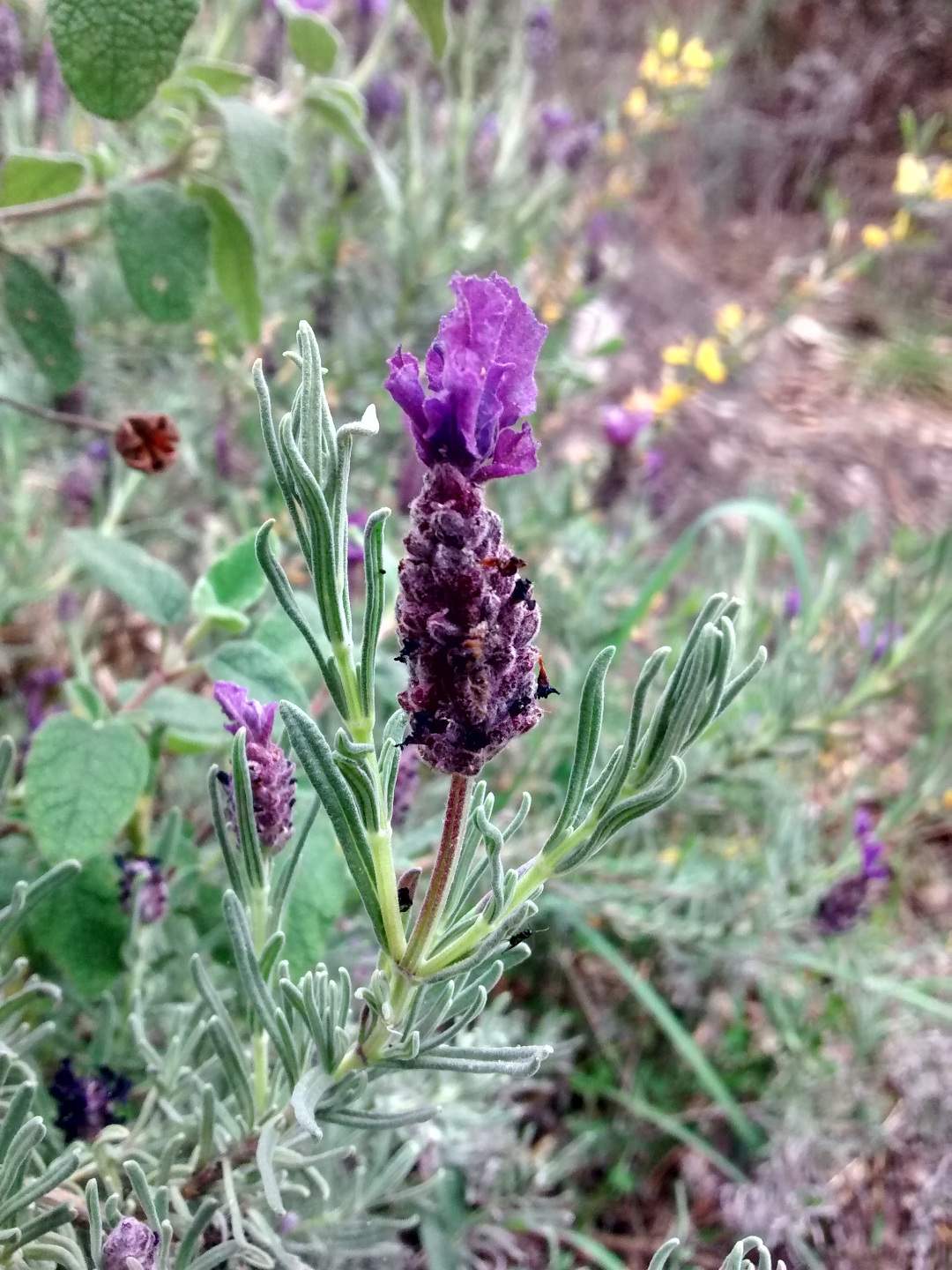
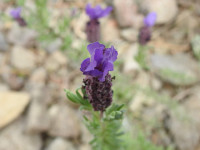
Wild lavender is a small perennial shrub that generally reaches a height between 30 and 60 cm. The habit is erect and bushy, with rigid, branched stems of brown-reddish color, particularly evident in the specimens of the current year. These stems are characterized by a tomentose surface, covered by a dense gray-whitish hairiness that gives the entire plant a gray-pubescent appearance.
The leaves are arranged oppositely along the branches and are linear-lanceolate, with variable sizes: the lower ones measure about 2-3 mm in width by 10-20 mm in length, while the upper leaves can reach larger sizes, up to 7 mm in width and 35 mm in length. They are characterized by entire margins, hairy surface on both sides, and a reticulate venation particularly evident on the lower side. Small tufts of smaller leaves are often found in the axils of the main leaves.
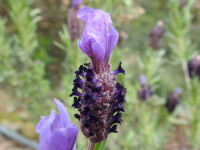
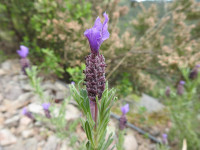
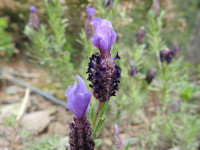
The flowers are gathered in compact inflorescences, consisting of terminal ovoid spikes about 15 x 25 mm. The corolla is dark violet in color and measures 5-6 mm in length. Above the floral spike is a cluster of petaloid bracts of violet color, large and showy (about 15 x 20 mm), which give the flowering its characteristic appearance. The calyx, also tomentose and very hairy, measures 4-5 mm. The fruits are three-angled oval carpels, typical of the Lamiaceae family.
The root system, although not described in specific sources, is typical of Mediterranean shrub species, with fibrous roots that favor anchorage in rocky and sandy substrates.
Habitat and distribution
Wild lavender is a typical species of Mediterranean vegetation, mainly distributed on the western slopes of the Italian peninsula, with almost total absence on the Adriatic side. In Italy, it is frequent in the coastal areas of Tuscany and in the hills around Florence, Siena, Pistoia, and Monte Albano, extending up to the Val di Nievole. Towards the north, the species stops at the base of the Apuan Alps and in the lower Serchio Valley, north of Lucca.
It prefers mountainous and hilly environments characterized by siliceous, acidic, and granitic soils, often in association with Cistus vegetation. It is also widespread in areas frequently subject to fires, demonstrating a good capacity for recovery in these disturbed environments. In the broader Mediterranean area, it is found in regions with hot and dry climates such as Provence, Languedoc, Roussillon, and Corsica. It prefers sunny exposures and dry soils, often on stony and superficially leached calcareous slopes.
Flowering period
Flowering generally occurs in late spring, from March to May (April-June in the broader Mediterranean belt), with possible variations depending on altitude and latitude. This time window allows the species to make the most of the mild spring climatic conditions before the arrival of the summer heat.
Ecology and pollination
Wild lavender is an aromatically active plant, whose characteristic scent attracts numerous pollinating insects, including bees and butterflies. The compact and colorful structure of the inflorescences favors entomophilous pollination, in which insects transfer pollen from one flower to another while searching for nectar. Seed dispersal, although not detailed, likely occurs by gravity and through small animals, as commonly happens in Lamiaceae.
Curiosities and traditional uses
Wild lavender has been known for centuries for its aromatic and medicinal properties. Traditionally, it has been used as a medicinal plant to prepare infusions and essential oils employed in the treatment of respiratory disorders, as a calming agent, and as a natural insect repellent. Its intense fragrance also makes it a species appreciated for the production of pot-pourri and in herbal medicine. In the food sector, some lavender varieties are used to a limited extent as flavoring, although wild lavender is less used for this purpose compared to cultivated species.
Etymology
The scientific name "Lavandula" derives from the Latin "lavare," meaning "to wash," referring to the traditional use of lavender flowers to scent and purify bath water. The specific name "stoechas" derives from the Greek "stoichas," meaning "in a row" or "arranged in order," probably referring to the regular arrangement of the floral bracts. The Italian common name "lavanda selvatica" indicates its spontaneous and uncultivated nature, distinguishing it from lavender cultivated for commercial purposes.
Sources
- Prof. S. Pignatti, "Flora d'Italia"
- Tela Botanica / H. Coste, "Flore descriptive et illustrée de la France"
Characteristics
Where I found it (9 sightings)
Classification
- Kingdom
- Plantae
- Family
- Lamiaceae
- Full name
- Lavandula stoechas L.
- Life form
- Fanerofite nano-fanerofite
Similar species
Search for species with similar characteristicsFurther reading
Noticed an error in the identification? Write to me
Other species of the same family
Lamiaceae
Explore
Other species of Lamiaceae