Botanical species
Melittis melissophyllum
L.
Bastard Balm
Description
Morphological description
Perennial herbaceous plant, 20 to 60 cm tall, with an erect and generally simple, unbranched habit. The stem is quadrangular, characterized by a fine whitish pubescence, denser especially at the nodes, with spreading elongated hairs of 1.2-2 mm and sometimes tomentose or hirsute. The roots consist of a robust rhizome accompanied by filiform secondary roots.
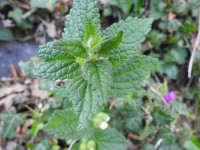
The leaves are opposite, subsessile or with a short petiole, oval or elliptic-lanceolate in shape, generally measuring between 3 and 9 cm in length and 3-8 cm in width. The blade has a herbaceous texture, is glabrous or slightly hairy especially along the central vein, and the margins are dentate or crenate-dentate with 10-20 acute or rounded teeth per side. The leaf base is typically cordate, forming a 3-5 mm notch between the two lobes, although variants with truncate or rounded bases exist, giving rise to more elliptical and smaller leaves. The leaves emit a pleasant aroma when crushed, similar to lemon, due to the presence of coumarin.
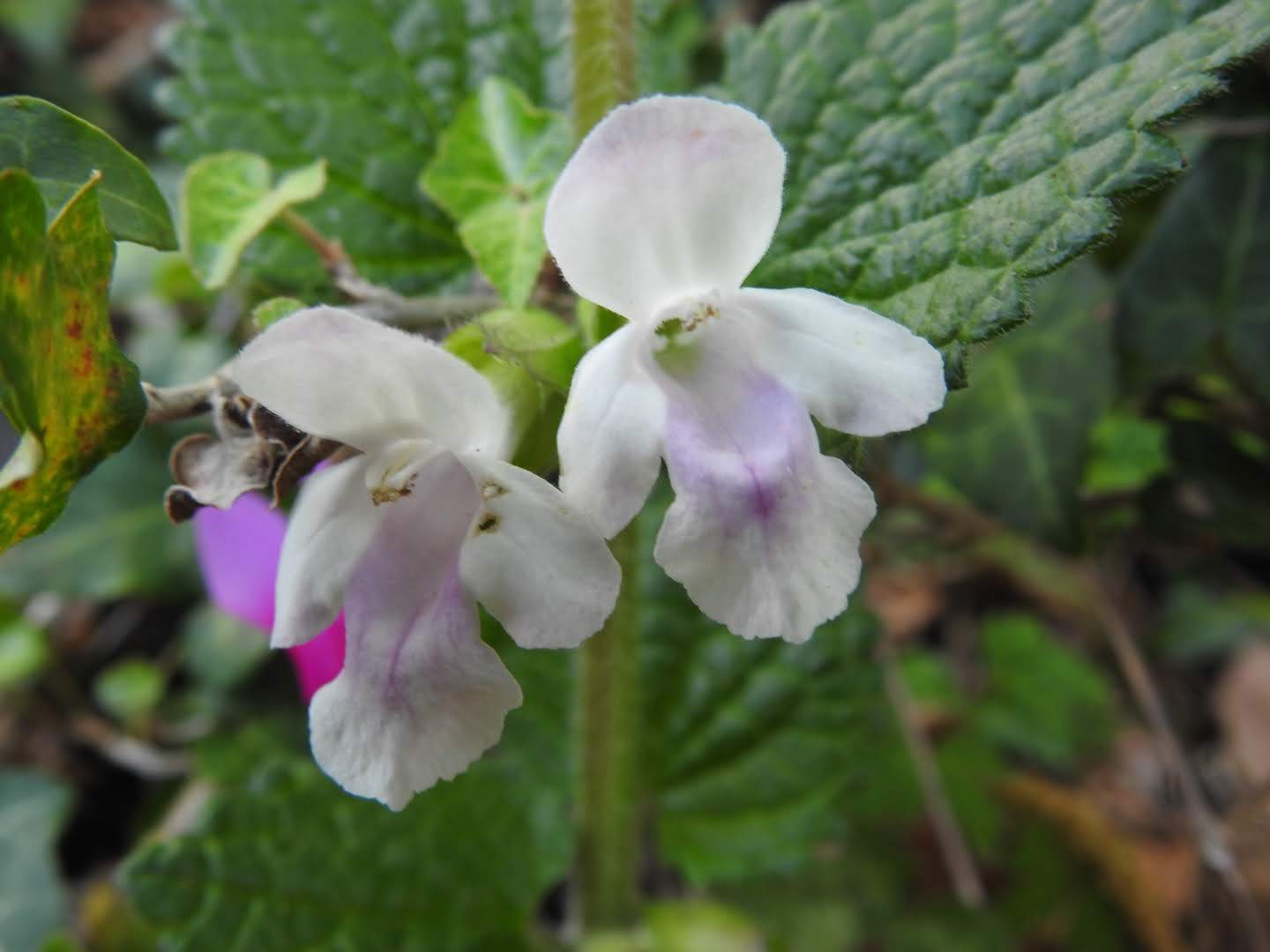
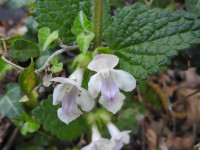
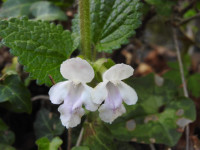
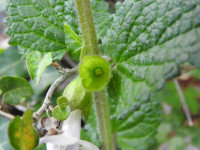
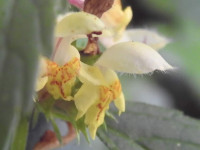
The flowers are large, hermaphroditic, fragrant, and vary in color from dark red to pink to white, with all possible intermediate shades. They are grouped in clusters of 1 to 6, more frequently 2-4, arranged unilaterally in the axils of the upper leaves and borne on hairy peduncles 5-12 mm long. The calyx is campanulate, green and often membranous, dry brown, hairy, with mucronate teeth, sometimes denticulate and shortly ciliate; the upper lip is about twice as long as the lower one.
The corolla, 3 to 4.5 cm long, has an elongated trumpet shape with an erect tube and a strongly widened throat anteriorly. The upper lip is quadrangular, slightly concave and finely glandular, while the lower lip is trilobed with the central lobe larger and often slightly curved downward; it may have purplish spots or a yellow area. The stamens are four, didynamous, with hairy filaments that do not exceed the corolla lobes. The stigma is bifid.
The fruit is a tetrachene (four achenes grouped), each about 3-5 mm, smooth, globose and trigonal, slightly hairy and brown at maturity, enclosed within the calyx.
There are several varieties: var. melissophyllum with lanceolate-acuminate or elliptic-cordate leaves and corolla from dark red to white; var. kerneriana with smaller, elliptical leaves, truncate or rounded at the base and generally white corolla; finally, in some southern regions the subsp. albida is present, larger with abundant glandular hairs and white corolla.
Habitat and distribution
The species is mainly distributed in temperate Europe, from Central Europe to Ukraine, with a widespread presence in Italy from the Po Valley to the southern regions, where it is found mainly in hilly and mountainous areas up to about 1400 m altitude.
It prefers warm climate habitats and calcareous soils, typically growing in warm broadleaf forests, more rarely in coniferous forests. It frequents forest edges, thickets, hedges, path and road margins, preferring semi-shaded or partially shaded exposures. Its preference for calcareous and thermophilous environments makes it a typical species of hilly and mountainous woods especially in regions with calcareous substrate.
Within Italy, the distribution sees var. melissophyllum prevalent in the northern area and in Abruzzo, while var. kerneriana is more widespread from Tuscany to the South, with sporadic presences also on the southern edge of the Alps in Piedmont, in the Venetian Prealps and in Friuli.
Flowering period
Flowering extends from April to August, with possible local variations depending on altitude and climate. Usually, peak flowering is observed between May and July.
Ecology and pollination
The flowers are mainly visited by bees, from which the genus name derives, and other pollinating insects attracted by the large colorful and fragrant corolla. The shape of the corolla, with an elongated tube and trilobed lower lip, facilitates pollination by pollinating insects that land on the lower lip while reaching the nectar.
The plant produces seeds contained in achenes grouped in fours (tetrachene), slightly hairy, which can disperse mainly by natural fall at the base of the plant or by secondary transport by animals or abiotic agents, although details on specific dispersal are not well documented.
Curiosities and traditional uses
Bastard Balm is known for its characteristic aroma, due to coumarin, similar to lemon, which is released especially during leaf drying. This feature has favored its use in traditional herbal medicine and phytotherapy.
It is used to prepare aromatic infusions, appreciated for their digestive and sedative properties, especially useful after meals. The calming and antispasmodic action is also exploited in the treatment of duodenal spasms and as a mild sedative. Traditionally, combined with other herbs such as Achillea and Primula, it is used as a natural sleep aid.
Fresh or dried leaves are also considered emmenagogues, promoting and regulating menstrual flow and alleviating associated pains. In external applications, the plant is used for its astringent and vulnerary properties, aiding wound healing and relieving pain from bruises or inflammations.
From a botanical point of view, Melittis melissophyllum is the species of the genus Melittis and is distinguished by having the largest flowers among Lamiaceae, a characteristic that makes it easily recognizable in its environment.
Etymology
The genus name derives from the Greek melissa, meaning “bee”, referring to the fact that the flowers are much visited by these pollinating insects. The specific name melissophyllum means “with leaves like Melissa”, indicating the similarity of this plant’s leaves to those of Melissa officinalis, a well-known aromatic herb.
The Italian common name “erba limona” refers to the characteristic coumarin aroma reminiscent of lemon scent, particularly evident in crushed leaves or during drying.
Sources
- Prof. S. Pignatti, Flora d'Italia
- Acta Plantarum - Flora delle regioni italiane (scheda di Giuliano Salvai)
- World Flora Online (WFO)
Characteristics
Scheda botanica
| Famiglia | Lamiaceae |
|---|---|
| Fioritura | aprile – agosto |
| Forma biologica | Scapose |
| Habitat | with white flowers, with red flowers, with pink flowers |
Domande frequenti
- Quando fiorisce Bastard Balm?
- Bastard Balm fiorisce aprile – agosto.
- Che tipo di pianta è Bastard Balm?
- Bastard Balm è una Hemicryptophytes (Scapose) secondo la classificazione di Raunkiaer.
- A quale famiglia appartiene Bastard Balm?
- Bastard Balm appartiene alla famiglia botanica Lamiaceae.
Where I found it (5 sightings)
Classification
- Kingdom
- Plantae
- Family
- Lamiaceae
- Full name
- Melittis melissophyllum L.
- Life form
- Hemicryptophytes scapose
Similar species
Search for species with similar characteristicsFurther reading
Noticed an error in the identification? Write to me
Other species of the same family
Lamiaceae
Explore
Other species of Lamiaceae