Botanical species
Stachys recta
L.
Perennial Yellow-Woundwort
Description
Morphological description
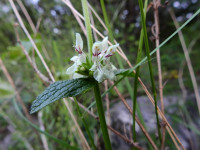
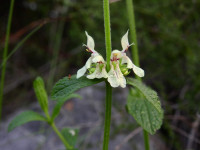
Perennial plant of the Lamiaceae family, it has an erect habit with ascending or arcuate-ascending stems, which can reach a height between 20 and 60 cm. The stem is more or less hairy, with a surface that can vary from glabrescent to densely pubescent depending on the subspecies and environmental conditions.
The leaves are sessile or with a short petiole, oblanceolate in shape, from linear-lanceolate to almost spatulate, with a toothed margin. The dimensions vary from 2 to 5 cm in length and from 0.5 to 2 cm in width, often narrower and more flexible towards the apex of the stem. The leaf blade can be glabrous or with varying hair density, a characteristic that contributes to the remarkable morphological plasticity of the species.
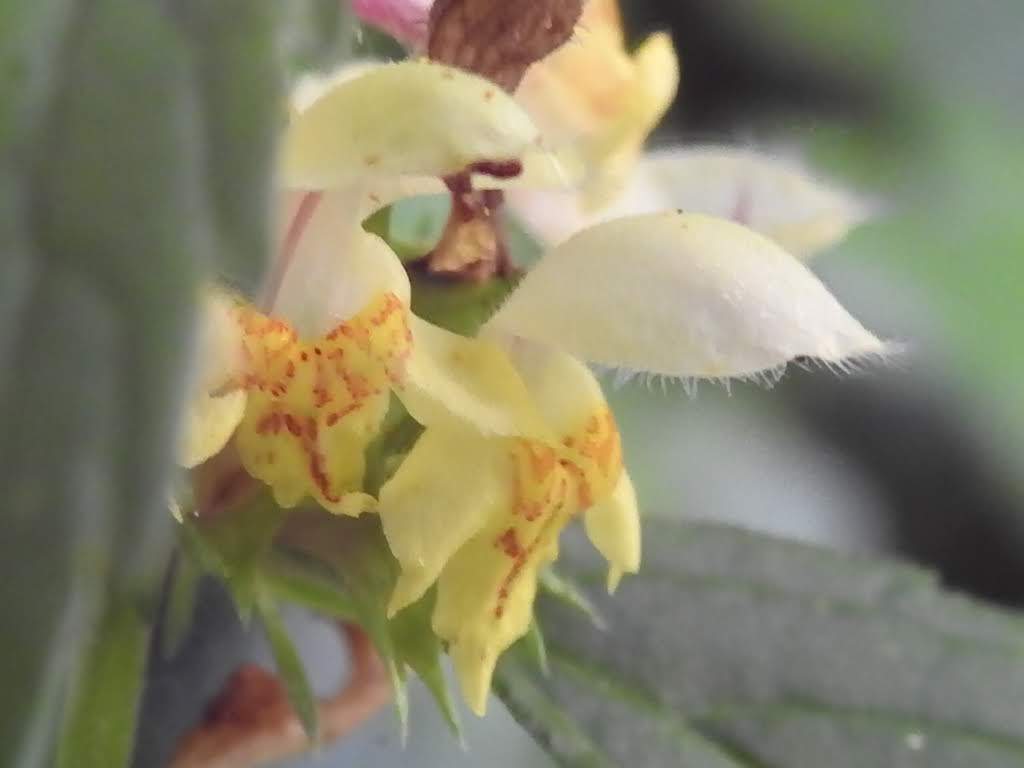
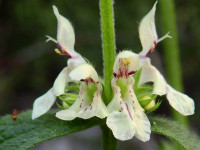
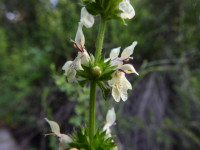
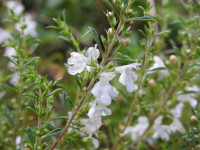
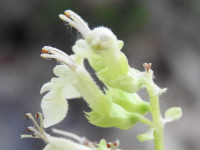
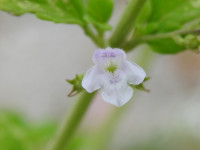
The inflorescence appears in cylindrical verticillasters, composed of 4-16 flowers, themselves gathered in the axil of reduced and oval leaves, forming an erect and elongated spike, which can be interrupted at the base. The flowers have a corolla of pale yellow or white-yellowish color, 10 to 20 mm long, with the lower lip spotted with brownish or reddish-violet, especially at the throat and on the lower lip. The upper lip is generally woolly, about 4-6.5 mm long, while the calyx is hirsute, with subequal teeth and glabrous at the tips, of similar length to the corolla tube. The fruits are smooth achenes, 1.5-2 mm long.
The root system is taproot and robust, typical of perennial species that colonize poor and rocky environments, contributing to the stability of the plant even in difficult substrates such as serpentine screes.
Habitat and distribution
The species is widespread in the mountainous and hilly regions of Italy and the Mediterranean, preferring natural environments little disturbed by human activity. It grows mainly in rocky crevices, screes, and on ophiolitic substrates, particularly on serpentine, but also adapts to calcareous soils. Its presence is reported in biotopes characterized by xeric conditions, usually sunny exposure, and altitudes ranging from hill level up to subalpine elevations.
In Italy it is frequently observed in the mountain massifs of the Tuscan-Emilian and Pavese Apennines, with some subspecies or varieties characterized by specific adaptations to serpentine substrates, such as subsp. subcrenata, typical of the serpentine screes of Monteferrato (PO).
The overall range of the species includes areas with Mediterranean and mountain climates, where it develops in plant associations of garrigue, pinewoods, and pubescent oak woods, often in xerothermophilous environments.
Flowering period
The flowering generally extends from May to September, with possible variations related to altitude and latitude. In more southern territories or milder climatic conditions, flowering can start early in May, while at higher elevations or in cooler areas it can last until September.
Ecology and pollination
The species is mainly pollinated by pollinating insects, attracted by the pale yellow color of the flowers and the presence of dark spots that serve as visual signals. The spike inflorescence and the arrangement of flowers in verticillasters favor the access of pollinating insects, such as bees and bumblebees, which facilitate fertilization.
Seed dispersal occurs through smooth achenes, probably transported by falling or by small animals, although no particularly specialized dispersal strategies are known.
The species shows remarkable morphological plasticity, with variations in pubescence density and leaf shape linked to environmental conditions, particularly xericity and soil composition.
Curiosities and traditional uses
Plants of the genus Stachys are traditionally known in Italy as "Erbe stregone" for their connection with ritual practices and popular beliefs. In Tuscany, Stachys recta was used to "wash away fear": after stressful events, an ablution was performed with water in which the plant had been boiled, accompanied by ritual prayers; if the water thickened, it was believed that the fear had been dispelled.
This plant, sometimes sold dried in local markets, still retains a role in ethnobotanical traditions, although its medicinal or food use is not widely documented.
Etymology
The generic name Stachys derives from Greek and means "spike", referring to the typical inflorescence of the plant, which appears as an erect and straight spike. The specific epithet recta is Latin and refers precisely to this morphological characteristic of the inflorescence, "straight" or "erect".
The Italian common name "Perennial Yellow-Woundwort" derives from the color of the flowers and the resemblance to other species commonly known as betonica, a term with ancient origins that may be linked to the popular use of plants with similar medicinal properties.
Sources
- Prof. S. Pignatti, "Flora d’Italia"
- Acta Plantarum - Flora delle regioni italiane (scheda di Giovanni Gestri)
- World Flora Online (WFO)
Characteristics
Scheda botanica
| Famiglia | Lamiaceae |
|---|---|
| Fioritura | maggio – settembre |
| Forma biologica | Scapose |
| Habitat | with white flowers, with yellow flowers, Perennial plant |
Domande frequenti
- Quando fiorisce Perennial Yellow-Woundwort?
- Perennial Yellow-Woundwort fiorisce maggio – settembre.
- Che tipo di pianta è Perennial Yellow-Woundwort?
- Perennial Yellow-Woundwort è una Hemicryptophytes (Scapose) secondo la classificazione di Raunkiaer.
- A quale famiglia appartiene Perennial Yellow-Woundwort?
- Perennial Yellow-Woundwort appartiene alla famiglia botanica Lamiaceae.
Where I found it (17 sightings)
Classification
- Kingdom
- Plantae
- Family
- Lamiaceae
- Full name
- Stachys recta L.
- Synonyms
- Betonica annua L. var. hirsuta L.; Betonica recta (L.) Baill.; Ortostachys recta (L.) Fourr.; Prasium stachys E.H.L.Krause
- Life form
- Hemicryptophytes scapose
Similar species
Search for species with similar characteristicsFurther reading
Noticed an error in the identification? Write to me
Other species of the same family
Lamiaceae
Explore
Other species of Lamiaceae