Botanical species
Clinopodium vulgare
L.
Wild Basil
Description
Morphological description
Perennial herbaceous plant, Wild Basil typically grows between 30 and 70 cm in height, with stems that can be erect or ascending-prostrate. The stem is softly velvety, covered with patent white hairs about 1-1.5 mm long, giving a tomentose surface. The plants have a thin, creeping rhizome from which the herbaceous stems arise.
The leaves are opposite, shortly petiolate (2-6 mm), with an ovate-lanceolate or oval-oblong blade, measuring between 15 and 46 mm long and about 15 to 32 mm wide. The margin is entire or slightly dentate with short and scattered teeth. The leaf surface is pubescent, with patent hairs, and the leaf base is rounded, while the apex is subobtuse.
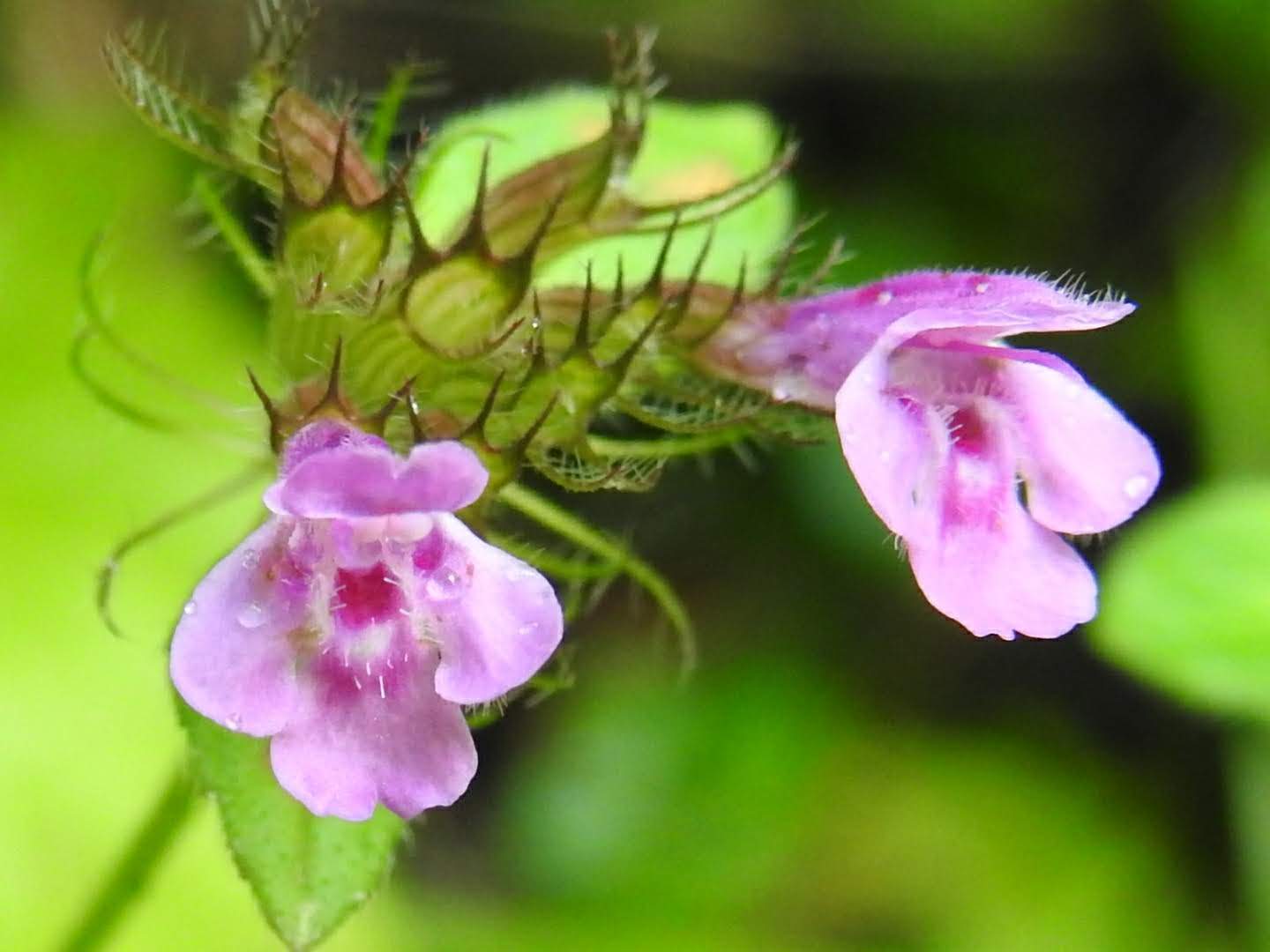
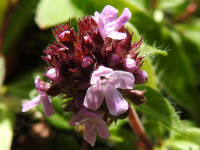
The inflorescence is characterized by compact and globose verticillasters, formed by 10-40 hermaphrodite flowers, arranged both at the stem apex and in the axils of the upper leaves. The bracteoles surrounding the flowers are filiform, linear, and long-ciliate. The calyx, 7 to 12 mm long, is cylindrical in shape and shows 13 well-marked veins. The calyx teeth are subequal, with the upper ones slightly shorter than the lower ones; they are also ciliate and slightly curved.
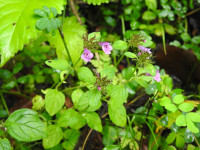
The corolla is rose-purple, with a length varying between 12 and 15 mm, rarely white, with a flat and emarginate upper lip and a trilobed lower lip. The four stamens are didynamous (two long and two short) and convergent. The fruit is a tetrachene composed of four oval nutlets, brown in color with a whitish hilum, about 1 x 0.8 mm in size.
The root system consists of a thin woody rhizome from which perennial herbaceous stems develop.
Habitat and distribution
Wild Basil is a species widely distributed in Italy and the Mediterranean basin, with documented presence in woodland environments, clearings, forest edges, dry meadows, and hedgerows. It is a mesophilous and mesoxerophilous plant, preferring fresh but well-aerated environments, and shows some adaptability to substrate, growing indifferently on different soils.
Its growth altitude ranges from 0 up to about 1500 meters above sea level, spanning from plains to hilly and submontane areas. In Italy, it is common in the central-northern regions and is also found on the major islands, often in semi-shaded habitats with preferably bright but not excessively sunny exposure.
Flowering period
Flowering mainly occurs in July and August, sometimes extending until September in cooler or mountainous areas. In some regions, flowering may start slightly earlier or end later, depending on local climatic conditions.
Ecology and pollination
The species reproduces mainly sexually through seeds produced by hermaphrodite flowers, which attract a variety of pollinating insects, particularly bees and bumblebees, attracted by the vivid color of the rose-purple corolla and the slightly perceptible aromatic scent. The flower structure and the arrangement of the stamens favor entomophilous pollination. Seed dispersal mainly occurs near the mother plant, facilitated by the natural fall of the nutlets.
Curiosities and traditional uses
Wild Basil is an aromatic species with historically recognized medicinal and food properties. The leaves and flowering tops are known to exert tonic, stimulating, and carminative actions, which is why they have been used in traditional herbal medicine to promote digestion and relieve gastrointestinal disorders.
In cooking, the leaves can be used as a flavoring for soups and salads, although less commonly than other more well-known Lamiaceae. The plant is considered edible and can be harvested in the wild, always with attention to sustainable collection.
Etymology
The genus name "Clinopodium" derives from ancient Greek: “κλίνω” (klino) means "to incline" and “ποδείον” (podeion) is a diminutive of “πούς” (pous), meaning "foot" or "stem," probably referring to the particular shape of the stem or the arrangement of the flowers.
The specific epithet "vulgare" derives from Latin vulgaris, meaning "common," indicating the frequency and distribution of the species in European territories.
The Italian common name "clinopodio dei boschi" refers both to the botanical genus and to the typical habitat where the plant is found, namely woodland environments and forest edges.
Sources
- Prof. P.V. Arrigoni, "Flora analitica della Toscana", "Flora dell'Isola di Sardegna"
- Acta Plantarum - Flora delle regioni italiane (scheda di Anja Michelucci)
- Tela Botanica / H. Coste, "Flore descriptive et illustrée de la France"
- World Flora Online (WFO)
Characteristics
Scheda botanica
| Famiglia | Lamiaceae |
|---|---|
| Fioritura | luglio – agosto |
| Forma biologica | Scapose |
| Habitat | with fuchsia flowers, plant with a prostrate-ascending habit |
Domande frequenti
- Quando fiorisce Wild Basil?
- Wild Basil fiorisce luglio – agosto.
- Che tipo di pianta è Wild Basil?
- Wild Basil è una Hemicryptophytes (Scapose) secondo la classificazione di Raunkiaer.
- A quale famiglia appartiene Wild Basil?
- Wild Basil appartiene alla famiglia botanica Lamiaceae.
Where I found it (5 sightings)
Classification
- Kingdom
- Plantae
- Family
- Lamiaceae
- Full name
- Clinopodium vulgare L.
- Synonyms
- Satureja vulgaris (L.) Fritsch
- Life form
- Hemicryptophytes scapose
Similar species
Search for species with similar characteristicsFurther reading
Noticed an error in the identification? Write to me
Other species of the same family
Lamiaceae
Explore
Other species of Lamiaceae