Botanical species
Teucrium marum
L.
Cat Thyme
Description
Morphological description
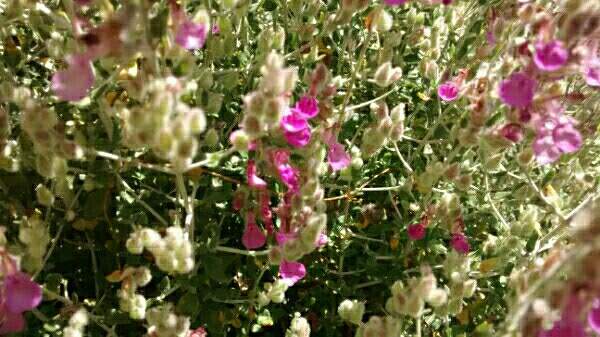
The Cat Thyme is a perennial suffrutescent, evergreen plant belonging to the family Lamiaceae, presenting a bushy habit and reaching a height between 20 and 50 cm. The stems are erect, woody at the base and covered by a dense white-tomentose down that gives them an almost woolly appearance; over time they harden and can become subspiny.
The leaves are opposite, sessile or shortly petiolate, elliptic-lanceolate in shape, with dimensions approximately ranging from 2-3 mm in width to 6-8 mm in length. They are entire, acute, with revolute margins (rolled downward), and have a green or green-grayish upper surface, while the lower surface is densely white-tomentose. The texture is fleshy and the surface is hairy, a characteristic that contributes to protection against dehydration in its xeric habitats.
The inflorescence is terminal, consisting of compact verticillasters of 1-2 flowers, grouped in a dense, unilateral cylindrical spike. The bracts accompanying the flowers are similar to the leaves but smaller and pubescent. The calyx, about 5-7 mm long, is campanulate, villous and glandular, slightly gibbous at the base, with subequal triangular teeth about one third the length of the calyx tube. The corolla is zygomorphic, 10-12 mm long, pink-purple (fuchsia) in color, hairy externally. It has a missing upper lip and a lower lip divided into five lobes, with the median lobe more developed, suborbicular and concave. Inside the corolla tube there is a ring of hairs (carpostegium) that protects the reproductive organs.
The stamens are four, didynamous (two shorter and two longer), with purplish filaments. The fruit is a schizocarp consisting of four velvety brown nutlets, which disperse separately.
Habitat and distribution
Cat Thyme is a species native to the western Mediterranean basin, present in Italy, Sardinia, Corsica, the Tuscan Archipelago (Gorgona, Capraia, Montecristo, Elba Island), and in some coastal areas of southern France (Hyères Islands) and Dalmatia. Its presence in the Balearic Islands and Spain is uncertain or rare.
In Italy it is mainly reported in Sardinia and in some coastal and insular locations of the Tyrrhenian Sea. It is a heliophilous, thermophilous and xerophilous species, typical of dry and rocky environments such as garrigues and Mediterranean maquis. It grows on poor, well-drained soils, often calcareous or siliceous, preferably in sunny exposures. It can grow from sea level up to about 1200 m a.s.l., with occasional reports up to 1700 m.
Flowering period
The flowering of Cat Thyme extends from May to October, with a higher concentration in the summer months. This period may vary slightly depending on geographic location and altitude, but in general it is a species that flowers during the warm Mediterranean season.
Ecology and pollination
Cat Thyme prefers open, sunny and dry environments, where its tomentose structure helps limit water loss. The plant is adapted to xeric conditions and presents a chemical defense strategy derived from the production of essential oils and resins that reduce herbivore attacks.
Pollination is entomogamous, favored by pollinating insects attracted by the fuchsia flowers, which offer nectar and pollen. The zygomorphic shape and the presence of hairs inside the corolla tube are adaptations to guide the pollinating action of insects, ensuring effective contact with the stamens and stigma.
Seed dispersal occurs through the four velvety mericarps, which can fall near the mother plant. No particular long-distance dispersal strategies are known.
Curiosities and traditional uses
Cat Thyme has been known since antiquity for its medicinal properties. The leaves and flowering tops contain essential oils, resinous and tannic substances, giving the plant a pungent odor and a bitter taste. Traditionally it was used as a bitter-tonic, antiseptic, stimulant and antispasmodic, particularly for respiratory system ailments such as catarrhs and bronchitis, as well as for digestive disorders and diarrhea.
In Sardinia, shepherds used this plant to induce sneezing and clear the respiratory tract, so much so that it was given local names such as isturridahe or isturridina. Another curiosity concerns its effect on cats, similar to that of valerian, which particularly attracts them, from which derives the German common name "Katzenkraut" (cat herb) and the English name "Cat thyme".
In the past it was cultivated as a medicinal plant, but many wild populations have disappeared, especially on the mainland, while it remains more frequent in some insular and coastal areas.
Etymology
The genus name, Teucrium, derives from the ancient Greek "τεύκριον" (teúkrion), which was the name attributed to this plant already by Dioscorides. According to tradition, the name is linked to Teucer, an ancient Trojan king who, according to Pliny the Elder, was the first to use it for medicinal purposes.
The specific epithet marum comes from the ancient Greek "màron" and refers to a fragrant Egyptian plant mentioned by Theophrastus and Dioscorides.
The Italian common name "camedrio maro" recalls its affinity with other species of the genus Teucrium (commonly called cat thymes) and emphasizes its characteristic bitter and aromatic scent.
Sources
- Prof. S. Pignatti, "Flora d'Italia", Edagricole, 1982
- Acta Plantarum - Flora delle regioni italiane (scheda di Anja Michelucci)
- Tela Botanica / H. Coste, "Flore descriptive et illustrée de la France"
Characteristics
Scheda botanica
| Famiglia | Lamiaceae |
|---|---|
| Fioritura | maggio – ottobre |
| Forma biologica | Fruticose |
| Habitat | with fuchsia flowers, plant with a spreading bushy habit |
Domande frequenti
- Quando fiorisce Cat Thyme?
- Cat Thyme fiorisce maggio – ottobre.
- Che tipo di pianta è Cat Thyme?
- Cat Thyme è una Chamaephyte (Fruticose) secondo la classificazione di Raunkiaer.
- A quale famiglia appartiene Cat Thyme?
- Cat Thyme appartiene alla famiglia botanica Lamiaceae.
Classification
- Kingdom
- Plantae
- Family
- Lamiaceae
- Full name
- Teucrium marum L.
- Synonyms
- Chamaedrys marum (L.) Moench
- Life form
- Chamaephyte fruticose
Similar species
Search for species with similar characteristicsFurther reading
Noticed an error in the identification? Write to me
Other species of the same family
Lamiaceae
Explore
Other species of Lamiaceae