Botanical species
Lamium maculatum
(L.) L.
Spotted Dead-nettle
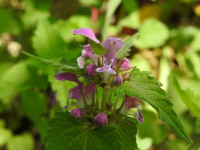
Description
Morphological description
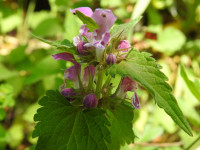
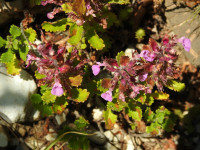
Perennial herbaceous plant, the Spotted Dead-nettle has a variable habit from erect to ascending or prostrate-ascending, with quadrangular stems generally between 20 and 50 cm long, but sometimes up to 80 cm. The stems can be glabrous, shiny or more or less pubescent, sometimes rooting at the nodes, with a subglabrous surface and sometimes slightly hairy.
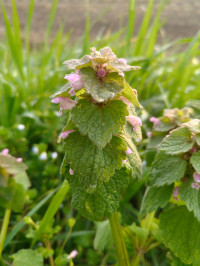
The leaves are opposite and petiolate, with petioles 2-4 cm long, mainly concentrated in the lower part of the stem. The blade is ovate, lanceolate or triangular-ovate in shape, often cordate at the base, measuring between 3 and 6 cm in length and 3-5 cm in width, with irregularly toothed and sometimes incised margins. A distinctive feature is the presence of a whitish or silvery spot, elongated along the central vein of the leaf, often irregular and of variable shape. The blade can be glabrous or slightly pubescent.
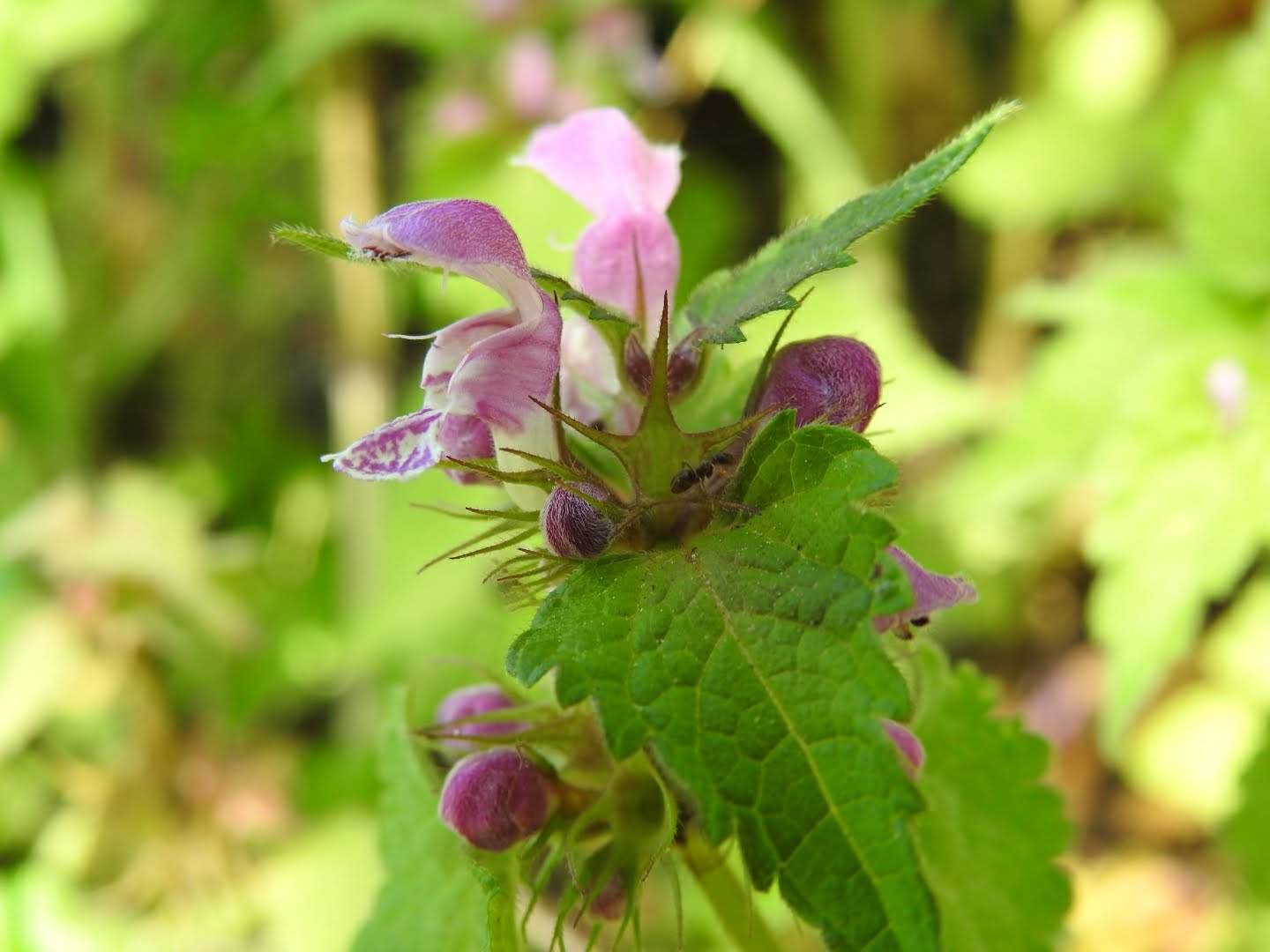
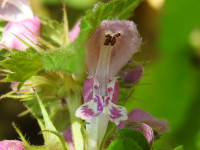
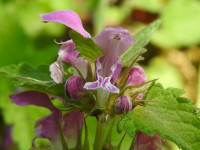
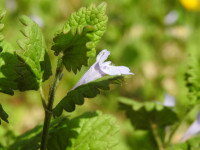
The flowers are gathered in apical spike-like inflorescences, consisting of loosely arranged whorls of 4-8 elements each, inserted in the axils of the upper leaves. The corolla, typical of Lamiaceae, is bilabiate and measures between 20 and 30 mm. The corolla tube is curved in an “S” shape and has an inner ring of hairs; it is whitish or pink-lilac, with a concave, entire and curved upper lip of purplish-pink color, while the lower lip is bilobed, light with clearly visible purple spots, often fringed at the margins. The calyx is 5-6 mm long, with thin, elongated and hairy teeth. The flowers can vary in color from purplish-pink to white.
The fruits are four small mericarps (achenes) of obovoid-triangular shape, smooth and brown in color, about 3 mm long.
The root system is rhizomatous, with rhizomes that allow perennation and the formation of extensive colonies, contributing to a often ground-covering habit.
Habitat and distribution
The Spotted Dead-nettle is widespread in Europe and temperate regions of Asia, with confirmed presence from the Mediterranean to Japan. In Italy it grows in woodland environments, at the edges of woods and in grassy places, often in disturbed areas such as ruins, gardens, dumps and shaded cultivated fields. It prefers fresh, clayey soils rich in nitrogen compounds, with a generally shaded or semi-shaded exposure.
Its growth altitude ranges from 0 up to 1200 meters in Southern Italy, while in more northern areas it can reach 2000 meters above sea level. In Mediterranean environments it is more common in cool mountainous and hilly areas, while in continental Europe it is also found in subalpine environments.
Flowering period
Flowering extends from March to October, with a variable duration depending on altitude and latitude. In the milder Mediterranean areas the plant can flower as early as March, while in colder or mountainous environments flowering is concentrated between April and September.
Ecology and pollination
The Spotted Dead-nettle is a species mainly pollinated by pollinating insects, especially bees and bumblebees, attracted by the bilabiate corolla and contrasting colors that signal the presence of nectar. The curved corolla tube and the presence of internal hairs facilitate contact with the reproductive organs of the pollinating insect, ensuring effective fertilization.
The plant reproduces sexually through seeds and vegetatively through rhizomes, which allow the formation of dense and ground-covering colonies, favoring local persistence and spread. Seed dispersal occurs mainly over short distances, probably through falling near the mother plant and secondary transport by small animals or water.
Curiosities and traditional uses
The Spotted Dead-nettle has had some use in traditional medicine and folk cuisine. The flowering tops are used in infusions to treat seborrhea and skin infections, thanks to the medicinal properties attributed to the plant. In food use, the young leaf tips are eaten boiled, similar to other Lamium species, although with less diffusion.
The common name “Spotted Dead-nettle” derives from the resemblance of the leaves to those of nettles (Urticaceae), although they are not stinging, and from the characteristic light spot that distinguishes them.
Etymology
The genus name Lamium derives from the Greek “lamos” or “laimos,” meaning “open mouth,” referring to the bilabiate and open shape of the corolla, similar to a wide-open mouth. The specific epithet “maculatum” is Latin and means “spotted,” alluding to the typical whitish or silvery spot on the leaves, which is a distinctive character of the species.
The Italian common name “falsa ortica macchiata” emphasizes the resemblance to true nettles, but distinguishes the species by the absence of stinging hairs and by the presence of spots on the leaves.
Sources
- Prof. S. Pignatti, "Flora d'Italia"
- Acta Plantarum - Flora delle regioni italiane (scheda di Marinella Zepigi)
- Tela Botanica / H. Coste, "Flore descriptive et illustrée de la France"
- World Flora Online (WFO)
Characteristics
Scheda botanica
| Famiglia | Lamiaceae |
|---|---|
| Fioritura | marzo – novembre |
| Forma biologica | Scapose |
| Habitat | with white flowers, with pink flowers, plant with a prostrate-ascending habit |
| Uso officinale | Pianta officinale |
Domande frequenti
- Quando fiorisce Spotted Dead-nettle?
- Spotted Dead-nettle fiorisce marzo – novembre.
- Che tipo di pianta è Spotted Dead-nettle?
- Spotted Dead-nettle è una Hemicryptophytes (Scapose) secondo la classificazione di Raunkiaer.
- A quale famiglia appartiene Spotted Dead-nettle?
- Spotted Dead-nettle appartiene alla famiglia botanica Lamiaceae.
Where I found it (13 sightings)
Classification
- Kingdom
- Plantae
- Family
- Lamiaceae
- Full name
- Lamium maculatum (L.) L.
- Synonyms
- Lamium garganicum L. subsp. laevigatum (L.) Arcang.; Lamium garganicum L. var. laevigatum (L.) Ces., Pass. & Gibelli; Lamium laevigatum L.
- Life form
- Hemicryptophytes scapose
Similar species
Search for species with similar characteristicsFurther reading
Noticed an error in the identification? Write to me
Other species of the same family
Lamiaceae
Explore
Other species of Lamiaceae