Botanical species
Lactuca saligna
L.
Wild Lettuce
Description
Morphological description
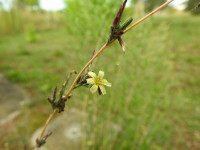
Biennial herbaceous plant generally 30 to 100 cm tall, with an erect habit and a stem that is simple or branched at the base. The stem is glabrous, white-ashen in color, thinner compared to related species such as Lactuca serriola, and devoid of subspiny hairs. The root system, typical of biennial species, is well developed to support the vegetative and reproductive phases.
The basal leaves are pinnatifid-runcinate or sinuately toothed, glaucous green in color, with thin lobes and often elongated and acuminate apex. The cauline leaves are almost linear, entire or rarely slightly divided, sometimes with a spiny margin on the lower vein, glaucous green in color, and clasp the stem with two acute and mucronate auricles, giving an appearance similar to willow leaves, from which the common name derives. The leaves often arrange themselves parallel to the sun’s rays, a behavior known as “compass plant”.
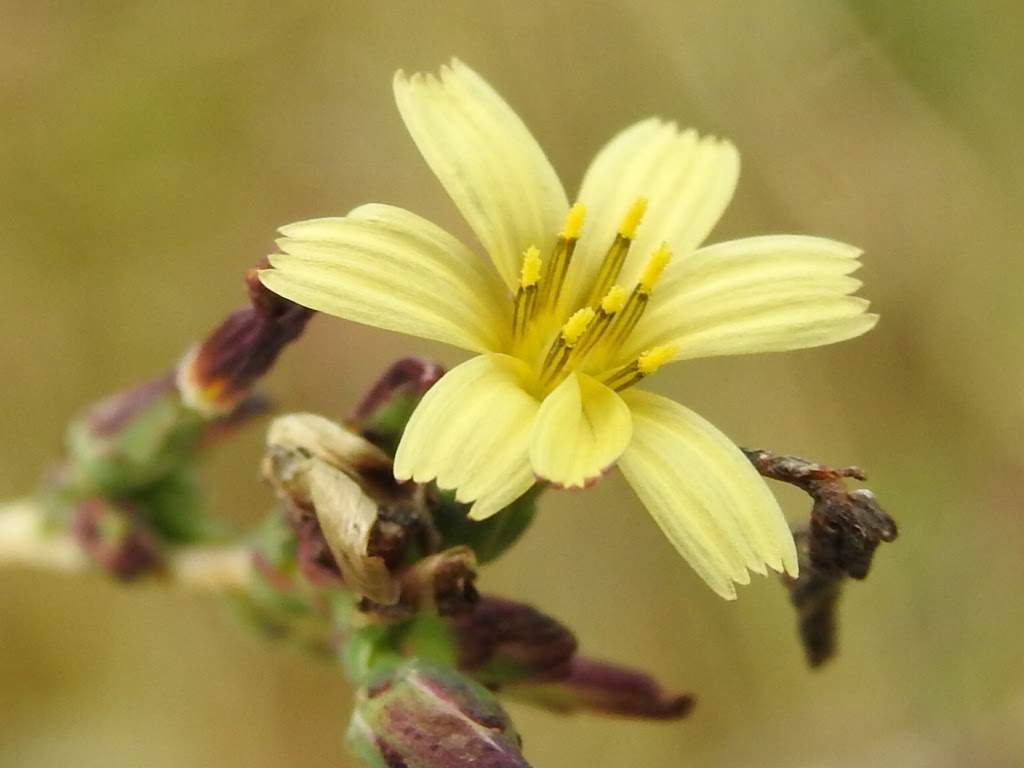
The inflorescence consists of numerous subsessile heads, arranged in elongated spikes pressed along the stem. Each head has an involucre with lanceolate-obtuse scales arranged in 3-4 series. The flowers are all ligulate, hermaphroditic, pale yellow in color, often streaked with purple on the outer face, with actinomorphic symmetry and scapose habit (i.e., arranged terminally on long, thin peduncles).
The fruits are fusiform achenes (cypsela), light brown in color, with a subglabrous surface and a filiform beak about one and a half to twice the length of the achene body. The pappus is made up of simple white hairs that facilitate anemochory (wind dispersal).
The internal latex is cream-colored, typical of the genus Lactuca.
Habitat and distribution
The species is widespread in central and southern Europe, the Mediterranean basin, North Africa, and western Asia up to central Asia. In Italy, it is present throughout the central and northern territory, including Corsica.
It grows mainly in mountainous and hilly environments, up to about 1000 meters altitude. It prefers uncultivated areas, road edges, plowed fields, rubble, and rocky zones, with a preferably calcareous substrate. It is a species that easily adapts to disturbed and poorly fertilized soils, typical of anthropized and semi-natural habitats.
Exposure is usually sunny, with a preference for open and well-drained environments.
Flowering period
Flowering mainly occurs from May to August, with some variation related to altitude and latitude. In some Mediterranean areas, it can extend until September. The flowers appear in elongated spikes and are visible simultaneously along the stem.
Ecology and pollination
The plant is mainly pollinated by pollinating insects, attracted by the pale yellow color of the flowers and the presence of nectar. The morphology of the flowers, all ligulate and hermaphroditic, facilitates visits by bees, hymenopterans, and other pollinating insects.
Seed dispersal occurs through the feathery pappus that allows the fruit to be carried by the wind, promoting effective colonization of new environments, especially in disturbed areas.
The plant is characterized by a particular phototropic behavior: the leaves tend to arrange themselves parallel to the sun’s rays, reducing evapotranspiration and optimizing photosynthesis.
Curiosities and traditional uses
The genus name Lactuca derives from the Latin "lac", meaning milk, referring to the white and creamy latex contained in the internal tissues of the plant, similar to that of other species in the genus.
The specific epithet "saligna" refers to the similarity of the leaves to those of the willow (Salix spp.), particularly evident in the narrow, linear cauline leaves with auricles clasping the stem.
Historically, as with other Lactuca species, the latex has been used in herbal medicine for its mildly sedative and analgesic properties, although Lactuca saligna is not among the species most exploited for medicinal or food purposes.
In local folklore, the leaves of Lactuca saligna, like those of Lactuca serriola, have been observed for their phototropic behavior, which gave rise to the nickname "compass plant," useful for orientation relative to the sun.
Etymology
The scientific name derives from the Latin "lac" (milk), referring to the white latex present in the plant, and from the adjective "salignus," meaning "similar to willow," due to the shape of the cauline leaves.
The Italian common name “lattuga a foglie di salice” directly recalls this leaf characteristic, which indeed resembles the narrow and elongated leaves of the willow.
Sources
- Prof. S. Pignatti, Flora d’Italia
- Acta Plantarum - Flora delle regioni italiane (scheda di Anja Michelucci)
- Tela Botanica / H. Coste, Flore descriptive et illustrée de la France
- World Flora Online (WFO)
Characteristics
Scheda botanica
| Famiglia | Asteraceae |
|---|---|
| Fioritura | maggio – agosto |
| Forma biologica | Scapose |
| Habitat | with yellow flowers, biennial plant |
Domande frequenti
- Quando fiorisce Wild Lettuce?
- Wild Lettuce fiorisce maggio – agosto.
- Che tipo di pianta è Wild Lettuce?
- Wild Lettuce è una Therophytes (Scapose) secondo la classificazione di Raunkiaer.
- A quale famiglia appartiene Wild Lettuce?
- Wild Lettuce appartiene alla famiglia botanica Asteraceae.
Where I found it (10 sightings)
Classification
- Kingdom
- Plantae
- Family
- Asteraceae
- Full name
- Lactuca saligna L.
- Life form
- Therophytes scapose
Similar species
Search for species with similar characteristicsFurther reading
Noticed an error in the identification? Write to me
Other species of the same family
Asteraceae
Explore
Other species of Asteraceae