Botanical species
Cirsium vulgare
(Savi) Ten.
Bull Thistle
Description
Morphological description
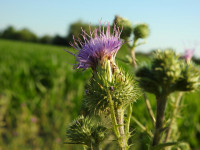
Biennial or perennial herbaceous plant, with a height ranging between 50 and 130 cm, but under some conditions it can also reach 200-300 cm. The habit is erect, with angular and branched stems, characterized by spiny wings along the lateral veins. The stem is pubescent, equipped with a large central pith, and presents spreading spines about 3 mm long on the surfaces.
The leaves are alternate, sessile, and running along the entire internode; the basal ones gather in a rosette and can measure from 7-10 cm in width up to 20-30 cm in length. The leaves have a shape ranging from oblong-lanceolate to obovate, deeply pinnatifid or pinnatipartite, with strongly serrated margins and spiny tips (2-15 mm). The upper surface is green, often glabrous or slightly silky, while the lower surface is tomentose or gray-tomentose. The leaf segments are sharply spiny, with spines present both on the main lobes and on the smaller margins. No bracteal leaves are present.
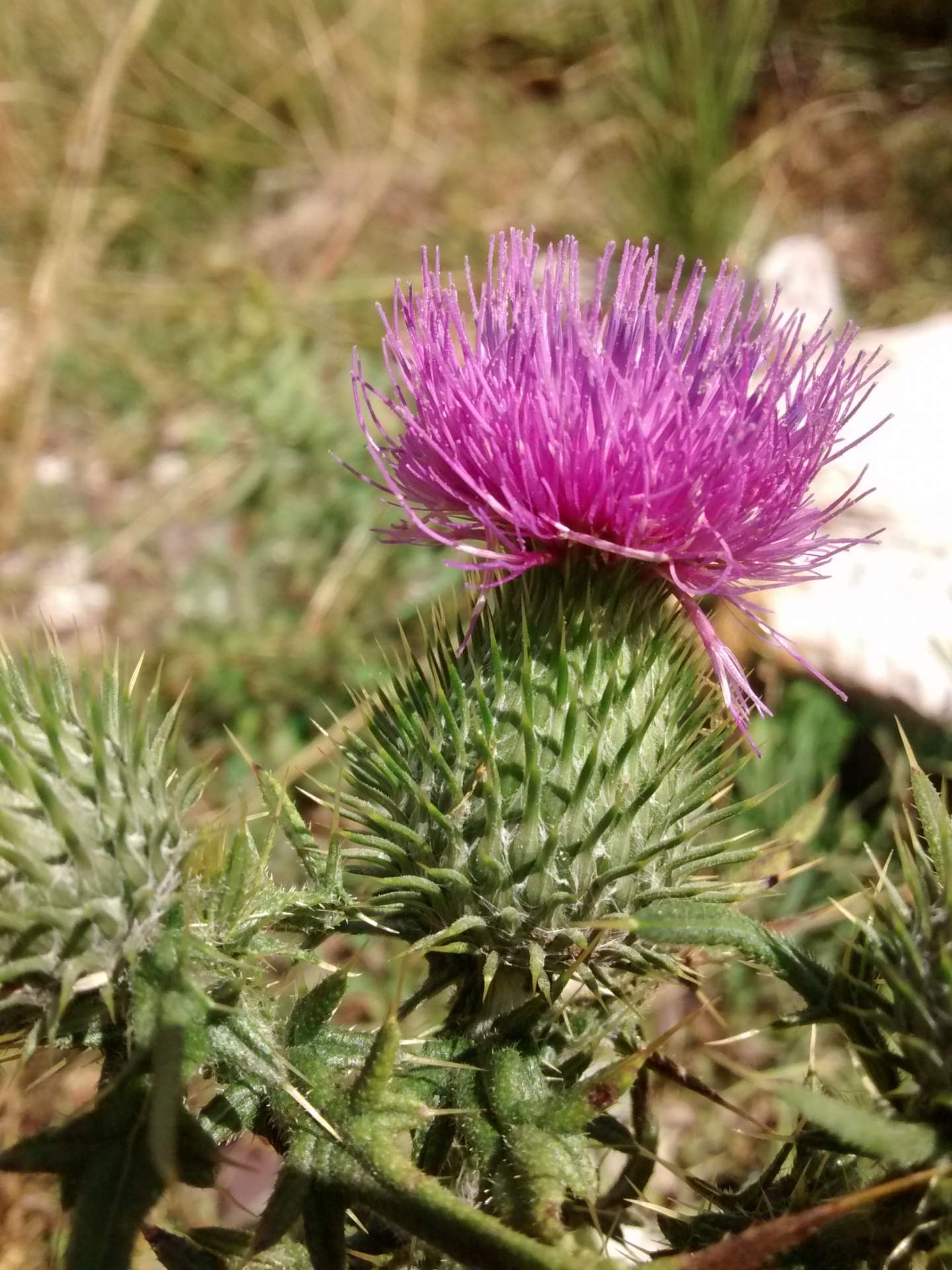
The inflorescence consists of solitary capitula or grouped in small clusters of 2-3 at the apex of the branches. The capitula are subsessile, ovoid-pyriform in shape, with a diameter of about 2.4-5 cm. The involucre is composed of several series of bracts (10-12), arranged imbricately, lanceolate or linear, with spiny apices (2-8 mm), and often with a tomentose outer surface or covered by arachnoid hairs. The outer bracts have a keeled back.
The flowers are all tubular, hermaphroditic, purplish-pink or violet in color (rarely white), with a pentamerous corolla and slightly zygomorphic symmetry. The corolla measures about 25-40 mm, with a tube length of 18-25 mm and lobes of 5-7 mm. The stamens are five, protruding from the corolla, with papillose filaments and bifid stigma. Each capitulum can contain up to 200 flowers.
The fruit is an obovate cypsela, 3-4 mm long, with a light surface and darker vertical stripes. It is topped by a feathery pappus of setose hairs 20-30 mm long, connate at the base, which facilitates wind dispersal. The root system is a robust taproot, rich in inulin.
Habitat and distribution
This species is widely distributed in Italy and the Mediterranean basin, with a subcosmopolitan distribution extending also to many other temperate regions of the world. It mainly grows in anthropized and disturbed environments such as wastelands, ditch edges, road and path margins, embankment areas, and abandoned lands.
It prefers well-drained soils, often calcareous or clayey, with predominantly sunny or partially shaded exposure. It is found from the plains up to mountain elevations of about 2000 meters, adapting to various climatic conditions, from hills to subalpine zones.
Flowering period
The flowering period mainly extends from June to October, with peak activity in the summer months. In some areas and milder climatic conditions, it can start as early as May and continue until October, while at higher altitudes flowering is concentrated in the warmer months. The flowering duration is quite prolonged, favoring the continuous presence of flowers for pollination.
Ecology and pollination
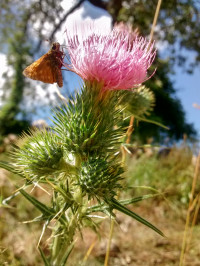
The species reproduces via entomogamy, with pollination carried out by a wide range of pollinating insects. During flowering it is visited by bees, bumblebees, wasps, flies, butterflies (such as Zigaena), and even spiders, which contribute to flower fertilization.
Seed dispersal occurs mainly by wind (anemochory), thanks to the feathery pappus that facilitates transport even over considerable distances. The plant is adapted to rapidly colonize disturbed environments, exploiting its biennial biology and the ability to produce numerous seeds.
Curiosities and traditional uses
The common name "Bull Thistle" derives from the fact that the young parts of the plant are particularly appreciated as food by donkeys and horses.
Despite its spines, the plant is edible after removing the spines: leaves, stems, and capitula can be consumed in cooking, prepared similarly to cultivated artichokes. The leaves and stems are usually boiled or blanched and can be fried after being breaded. The capitula can be cooked like artichokes, offering a milder flavor compared to cultivated thistles.
The roots are rich in inulin, a prebiotic substance, but their dietary use is discouraged due to the bitter taste and difficulty of preparation.
Traditionally, the inner fiber of the stem was used for paper production, while oil can be extracted from the seeds for local use.
Historically, the scientific name recalls an ancient belief about the therapeutic properties of the roots, considered effective for treating varicose veins.
Etymology
The genus name derives from the Greek "kírsion," meaning "thistle," itself from "kirsós" indicating a varicose vein or swelling of the veins. This name refers to the traditional medicinal use of the plant's roots to treat varicose veins.
The specific epithet "vulgare" comes from the Latin "vulgus," meaning "common," indicating the wide distribution and frequency of the species.
The Italian common name "Bull Thistle" refers to the appreciation of the plant by donkeys and other pack animals, which willingly consume the young parts of the plant before they become spiny.
Sources
- Prof. S. Pignatti, "Flora d'Italia"
- Acta Plantarum - Flora delle regioni italiane (scheda di Roberta Alberti)
- Tela Botanica / H. Coste, "Flore descriptive et illustrée de la France"
- World Flora Online (WFO)
Characteristics
Scheda botanica
| Famiglia | Asteraceae |
|---|---|
| Fioritura | giugno – ottobre |
| Forma biologica | Biennials |
| Habitat | edible plant, with fuchsia flowers, spiny plant |
| Tossicità | Tossica — non consumare |
Domande frequenti
- Quando fiorisce Bull Thistle?
- Bull Thistle fiorisce giugno – ottobre.
- È tossica Bull Thistle?
- Bull Thistle è una pianta tossica o velenosa. Non consumare nessuna sua parte senza aver consultato un esperto.
- Che tipo di pianta è Bull Thistle?
- Bull Thistle è una Hemicryptophytes (Biennials) secondo la classificazione di Raunkiaer.
- A quale famiglia appartiene Bull Thistle?
- Bull Thistle appartiene alla famiglia botanica Asteraceae.
Where I found it (14 sightings)
Classification
- Kingdom
- Plantae
- Family
- Asteraceae
- Full name
- Cirsium vulgare (Savi) Ten.
- Synonyms
- Ascalea lanceolata (L.) Hill; Carduus lanceolatus L.; Carduus vulgaris Savi; Cirsium cardoleonis Lojac.; Cirsium crinitum Boiss. ex DC.; Cirsium dubium Lojac.; Cirsium lanceolatum (L.) Scop.; Cirsium lanceolatum (L.) Scop. subsp. crinitum (Boiss. ex DC.) Bonnier & Layens; Cirsium lanceolatum (L.) Scop. subsp. rosanoi (Ten.) Arcang.; Cirsium lanceolatum (L.) Scop. subsp. silvaticum (Tausch) Vollm.; Cirsium lanceolatum (L.) Scop. var. subbipinnatum Lojac.; Cirsium lanceolatum (L.) Scop. var. tenuispinum Lojac.; Cirsium lucanicum Lojac.; Cirsium misilmerense Ces., Pass. & Gibelli; Cirsium rosanoi Ten.; Cirsium silvaticum Tausch; Cirsium vulgare (Savi) Ten. subsp. crinitum (DC.) Arènes; Cirsium vulgare (Savi) Ten. subsp. silvaticum (Tausch) Arènes; Cirsium vulgare (Savi) Ten. var. longespinosum Rouy; Cnicus lanceolatum (L.) Willd. subsp. rosanoi (Ten.) Arcang.; Cnicus lanceolatus (L.) Willd.; Eriolepis lanceolata (L.) Cass.
- Life form
- Hemicryptophytes biennials
Similar species
Search for species with similar characteristicsFurther reading
Noticed an error in the identification? Write to me
Other species of the same family
Asteraceae
Explore
Other species of Asteraceae