Botanical species
Cota tinctoria
(L.) J.Gay
Golden Chamomile
Description
Morphological description
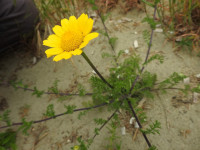
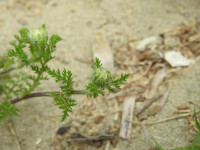
Perennial or sometimes biennial plant, generally ranging in height between 20 and 50 centimeters, Golden Chamomile is characterized by a woody rhizome, often with a suffruticose appearance, from which ascending herbaceous stems develop, simple and covered with a grayish tomentosity. The stem has a cobwebby surface, giving the plant a slightly woolly appearance.
The leaves are bipinnatisect, about 2-3 cm long, with linear-lanceolate lobes and serrated margins. The leaf teeth end in a small cartilaginous mucro, which gives precision and detail to the leaf edge. The leaves are pubescent, contributing to the overall woolly appearance of the plant.
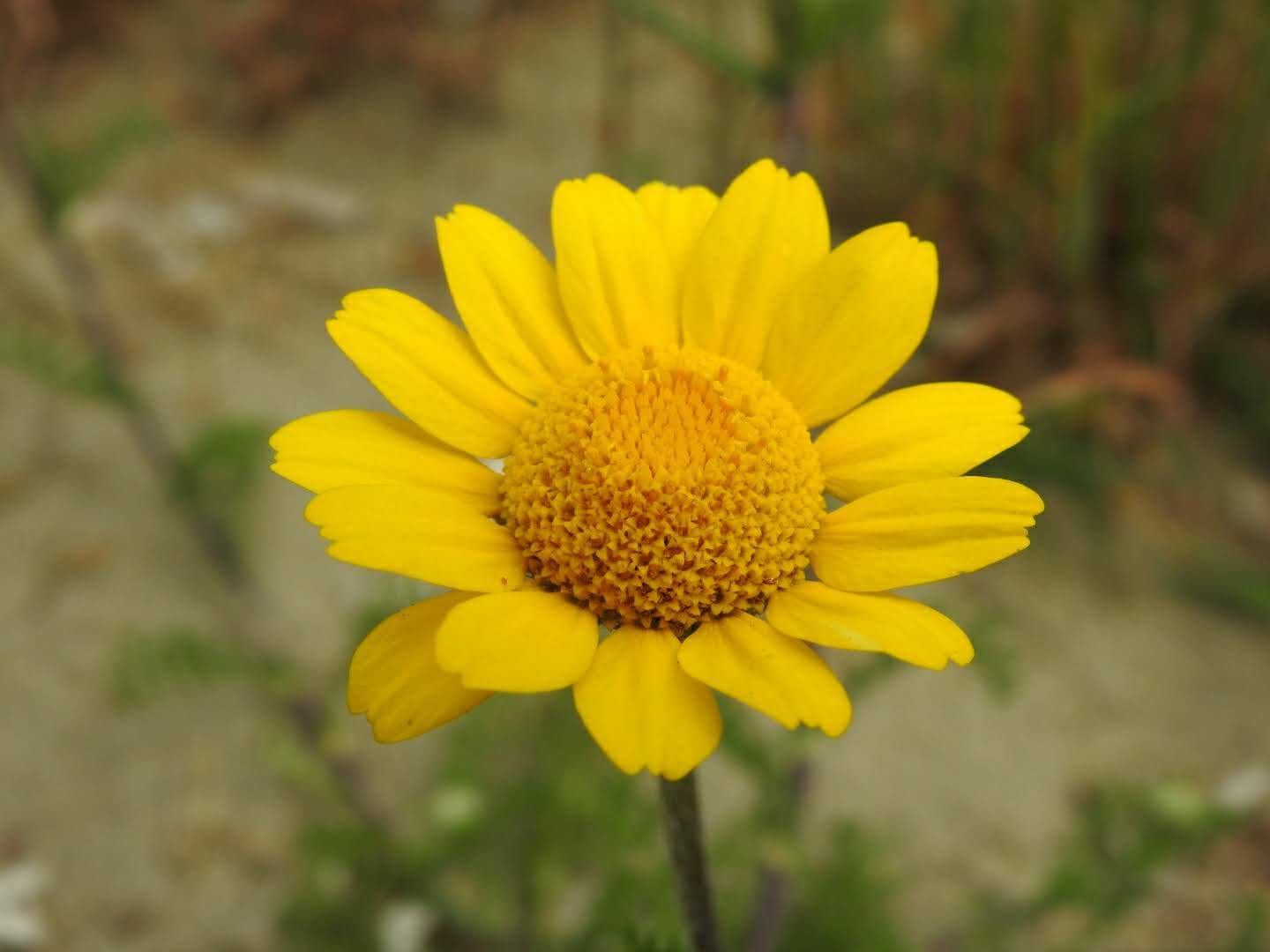
The flowers appear in solitary capitula, with a diameter between 2 and 2.5 cm, supported by a thickened peduncle. The involucre of the capitulum is composed of imbricated scales, with a pale yellow or yellowish woolliness; the inner scales are sharper. The receptacle, convex or conical, is equipped with lanceolate, membranous-scarious or cartilaginous chaff scales, firmly attached. The peripheral flowers are ligulate, bright yellow, generally female and, in some cases, may be absent; their length is shorter than the central part of the capitulum. The central flowers are hermaphroditic, tubular and five-toothed, with yellow or whitish coloration and have a cylindrical ovary.
The fruit is an achene with a rhombic cross-section, noticeably compressed, with prominent veins but lacking wings. The achene can be glabrous or crowned by a short membranous structure, entire or ear-shaped.
The root system consists of a superficial, woody and often suffruticose rhizome, which allows the plant to survive and regenerate over the years.
Habitat and distribution
Golden Chamomile is mainly distributed in temperate Europe, with a range extending from France to Ukraine, including the Pontic area around the Black Sea. In Italy it is present throughout the territory with two subspecies, although the actual distribution of these is not always well documented.
It prefers habitats characterized by dry meadows and roadside edges, with a particular preference for calcareous substrates. It grows from sea level up to about 1500 meters in altitude, demonstrating high adaptability to different climatic and environmental conditions. Its hardiness allows it to thrive both in warm areas and in those subject to cold.
Flowering period
Flowering generally occurs from May to September, thus extending over much of the summer season. No significant geographical variations in the flowering period have been reported; however, local climatic conditions may influence its exact duration.
Ecology and pollination
The plant presents a floral structure typical of Asteraceae, with capitula formed by peripheral ligulate flowers and central tubular flowers. Pollination is entomogamous, mainly mediated by pollinating insects attracted by the bright yellow color of the flowers and their scent.
The presence of central hermaphroditic flowers ensures fertilization, while the female ligulate flowers can facilitate the attraction of pollinating insects. Seed dispersal occurs through achenes, which lack wings but have membranous structures that can favor limited dispersal by wind or through contact with animals and soil.
Curiosities and traditional uses
Golden Chamomile is a medicinal species known since antiquity for its dyeing and medicinal properties. The specific name "tinctoria" refers precisely to its use in fabric dyeing, due to the presence of yellow pigments belonging to the flavonoid group. Although it has been cultivated mainly in North America and Great Britain for this purpose, in continental Europe it has been less used due to the presence of other more valuable dye plants, such as Reseda luteola and Serratula tinctoria.
In popular medicine, the dried capitula were used similarly to those of Chamaemelum nobile and Matricaria chamomilla: to prepare infusions, macerates, and balsamic, diaphoretic, and stimulating potions. The pleasant and subtle aroma of the flowers favored their use as a calming agent against migraines and to aid digestion. For external use, preparations based on this plant were applied to redness and skin or eye inflammations.
The essential oil extracted from the capitula is used in cosmetics for the preparation of creams and hair lightening solutions, as well as exerting an effective sedative action when applied locally. The hardiness of the plant and its large yellow flowers also make it appreciated in ornamental gardening, where it is cultivated both in open ground and in pots, with good resistance to variable climatic conditions.
Etymology
The genus name, Cota, derives from the Greek “kòta”, meaning “cup”, probably referring to the shape of the capitula or the receptacle. The specific name "tinctoria" indicates the traditional use of the plant as a source of dyes, particularly to obtain yellow pigments used in fabric dyeing.
The Italian common name "Golden Chamomile" directly recalls this affinity with dyeing and distinguishes its appearance from other chamomile species better known for their medicinal or aromatic properties.
Sources
- Acta Plantarum - Flora delle regioni italiane (actaplantarum.org)
- Acta Plantarum - Flora delle regioni italiane (scheda di Daniela Longo)
Characteristics
Scheda botanica
| Famiglia | Asteraceae |
|---|---|
| Fioritura | maggio – settembre |
| Forma biologica | Biennials |
| Habitat | with yellow flowers |
| Uso officinale | Pianta officinale |
Domande frequenti
- Quando fiorisce Golden Chamomile?
- Golden Chamomile fiorisce maggio – settembre.
- Che tipo di pianta è Golden Chamomile?
- Golden Chamomile è una Hemicryptophytes (Biennials) secondo la classificazione di Raunkiaer.
- A quale famiglia appartiene Golden Chamomile?
- Golden Chamomile appartiene alla famiglia botanica Asteraceae.
Where I found it (5 sightings)
Classification
- Kingdom
- Plantae
- Family
- Asteraceae
- Full name
- Cota tinctoria (L.) J.Gay
- Life form
- Hemicryptophytes biennials
Similar species
Search for species with similar characteristicsNoticed an error in the identification? Write to me
Other species of the same family
Asteraceae
Explore
Other species of Asteraceae