Botanical species
Erigeron annuus
(L.) Desf.
Tall Fleabane
Description
Morphological description
Annual herbaceous plant, with an erect habit and height ranging between 30 and 150 cm, often branched especially in the upper part of the stem. The stem is rough due to the presence of spreading hairs, giving the plant a rough surface to the touch. The roots are fibrous, suitable for rapid anchorage and absorption in poor or disturbed soils.
The lower leaves are lanceolate-spatulate or oval, with dimensions around 1-1.5 cm wide and 5-7 cm long, equipped with a short petiole. These have a coarsely toothed margin with 3-5 teeth per side, often 4. The cauline leaves are progressively smaller and narrower, lanceolate, sessile and arranged alternately along the stem; they also have a widespread pubescence on both surfaces.
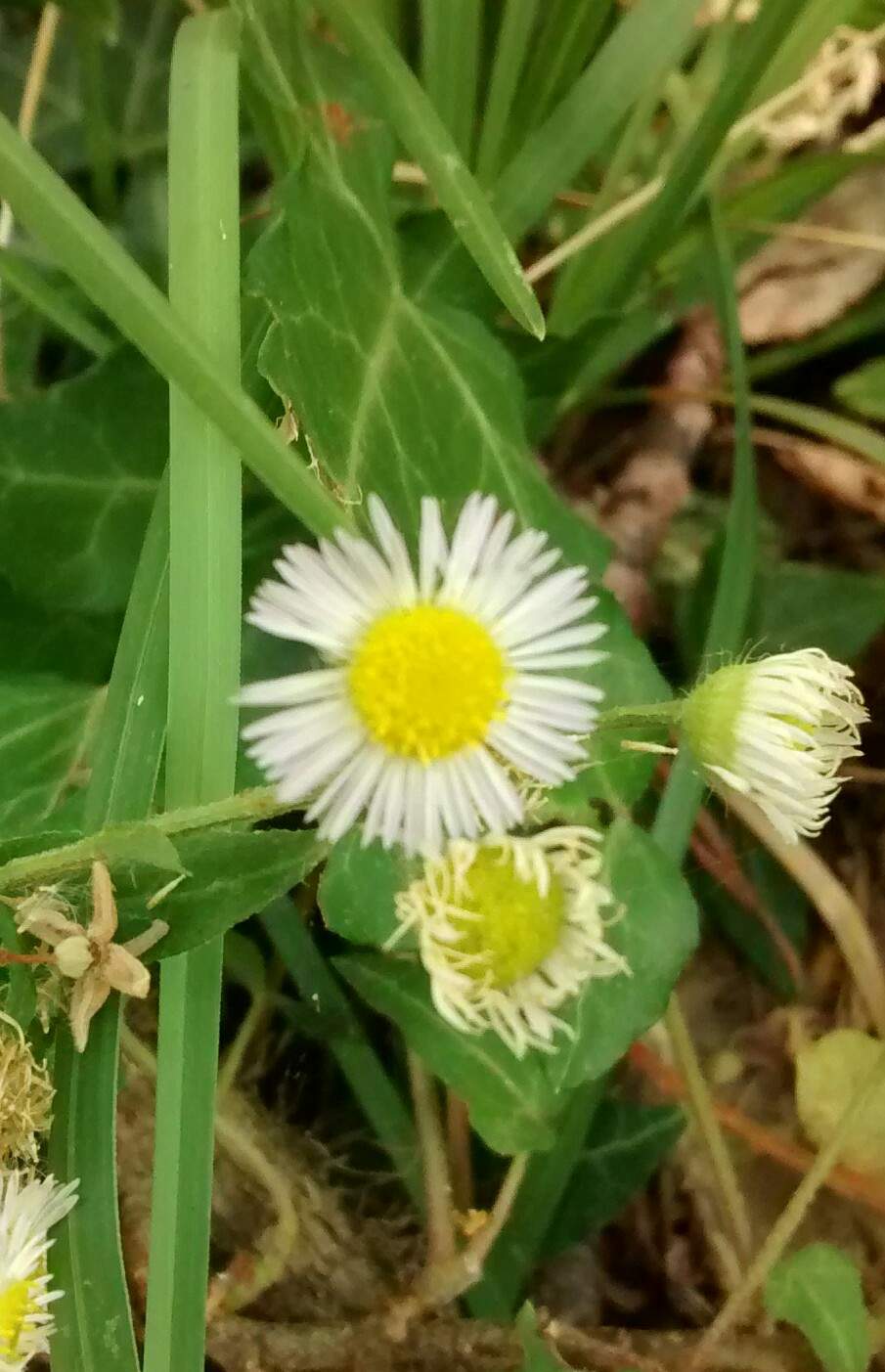
The inflorescence consists of numerous capitula gathered in loose corymbs or racemes, with a diameter ranging from 10 to 25 mm. The calyx is reduced to a crown of scales, typical of Asteraceae. The ray flowers are ligulate, white or white-violet in color, about 9-10 mm long, longer than the involucre; they are very numerous and arranged around the central disc. The disc flowers are tubular, yellow, and form a compact center. The flowers have actinomorphic symmetry. The scapose habit indicates that the floral axis is elongated and often leafless.
The fruits are achenes about 1 mm long, covered with hairs, and equipped with a white, soft, and sparse pappus about 2 mm long, which facilitates anemochorous dispersal (wind transport). The achenes have two well-marked longitudinal veins.
Habitat and distribution
Native to North America, the species is now fully naturalized in Europe, including Italy, where it has widely spread in anthropized environments. It commonly grows in disturbed areas such as uncultivated lands, road edges, vineyards, ditch banks, and rubble zones. It prefers well-drained and often nutrient-poor soils but easily adapts to different environmental conditions.
In Italy and the Mediterranean basin, the species is found from the plains up to 1800 m altitude, showing remarkable ecological plasticity. Its presence is mainly reported in hilly and low mountain areas but can also colonize flat and slightly mountainous environments.
Flowering period
Flowering extends from July to November, with a higher concentration of flowers in the summer and autumn months. Although no significant variations related to the Mediterranean geographic area are known, the long flowering period favors its spread and reproductive success in different habitats.
Ecology and pollination
The species is mainly pollinated by pollinating insects, such as bees and other hymenopterans, attracted by the color contrast between the white or violet ligulate flowers and the yellow central disc. The presence of numerous ligulate and tubular flowers facilitates the attraction of a wide range of pollinators.
From a reproductive point of view, Erigeron annuus belongs to an apomictic group, with populations that may show little genetic differentiation. This implies that reproduction also occurs through seeds produced without fertilization, favoring rapid colonization of new environments.
Seed dispersal is favored by the feathery and light pappus, which allows long-distance transport by wind. This anemochorous mechanism, combined with ecological adaptability, contributes to its spread and occasionally to invasive behavior in some areas.
Curiosities and traditional uses
Introduced to Europe in the 18th century for ornamental purposes, the plant subsequently colonized numerous anthropized environments. The spreading hairs covering the stem can cause skin irritations and annoying erythemas, which is why direct contact with bare skin is advised against in areas where the species is abundant.
No particular traditional food or medicinal uses are known for this species in the Mediterranean context. However, its common name "cèspica annua" recalls its short life cycle and its tendency to form sparse clumps.
Etymology
The genus name derives from two roots: the Greek “eri” meaning “wool” and the Latin “gerere” meaning “to carry,” a clear reference to the presence of woolly or spreading hairs that characterize the plant. Another interpretation proposes “eri” as “beginning” and “geron” as “old,” perhaps alluding to the pappus that ages turning gray or to the short flowering period.
The specific name “annuus” emphasizes the annual life cycle of the plant, which completes its biological cycle in one year. The Italian common name “cèspica annua” indicates the annual herbaceous nature and the tendency to form small clumps or aggregates of individuals.
Sources
- Prof. S. Pignatti, "Flora d'Italia"
- Acta Plantarum - Flora delle regioni italiane (scheda di Marinella Zepigi)
- Tela Botanica / H. Coste, "Flore descriptive et illustrée de la France"
- World Flora Online (WFO)
Characteristics
Classification
- Kingdom
- Plantae
- Family
- Asteraceae
- Full name
- Erigeron annuus (L.) Desf.
- Synonyms
- Aster annuus L.; Aster stenactis E.H.L.Krause, nom. illeg.; Diplopappus annuus (L.) Bluff & Fingerh.; Diplopappus dubius Cass., nom. illeg.; Doronicum bellidiflorum Schrank, nom. illeg.; Erigeron annuus (L.) Desf. subsp. septentrionalis (Fernald & Wiegand) Wagenitz; Erigeron annuus (L.) Desf. subsp. strigosus auct. p.p., non (Muhl. ex Willd.) Wagenitz; Erigeron annuus (L.) Pers., isonym; Erigeron bellidioides Spenn., nom. illeg.; Erigeron ramosus (Walter) Britton, Sterns & Poggenb. f. discoideus (Robbins ex A.Gray) Dole; Erigeron ramosus (Walter) Britton, Sterns & Poggenb. var. discoideus (Robbins ex A.Gray) Britton, Sterns & Poggenb.; Erigeron ramosus (Walter) Britton, Sterns & Poggenb. [non Raf.] var. septentrionalis Fernald & Wiegand; Erigeron strigosus auct. p.p., non Muhl. ex Willd.; Erigeron strigosus Muhl. ex Willd. f. discoideus (Robbins ex A.Gray) Fernald; Erigeron strigosus Muhl. ex Willd. var. discoideus Robbins ex A.Gray; Erigeron strigosus Muhl. ex Willd. var. septentrionalis (Fernald & Wiegand) Fernald; Phalacroloma acutifolium Cass., nom. illeg.; Phalacroloma annuum (L.) Dumort.; Phalacroloma annuum (L.) Dumort. subsp. septentrionale (Fernald & Wiegand) Adema; Phalacroloma septentrionale (Fernald & Wiegand) Tzvelev; Pulicaria bellidiflora Wallr., nom. illeg.; Stenactis annua (L.) Cass. ex Less.; Stenactis annua (L.) Cass. ex Less. f. breviradiata Nyár.; Stenactis annua (L.) Cass. ex Less. subsp. septentrionalis (Fernald & Wiegand) Á.Löve & D.Löve; Stenactis annua (L.) Nees, isonym; Stenactis bellidiflora A.Braun ex W.D.J.Koch, nom. illeg.; Stenactis septentrionalis (Fernald & Wiegand) Holub; Stenactis strigosa (Muhl. ex Willd.) DC. var. septentrionalis (Fernald & Wiegand) J.Duvign. & Lambinon
- Life form
- Terofite scapose
Similar species
Search for species with similar characteristicsFurther reading
Noticed an error in the identification? Write to me
Other species of the same family
Asteraceae
Explore
Other species of Asteraceae