Botanical species
Galatella sedifolia
(L.) Greuter subsp. sedifolia
Stonecrop Aster
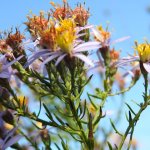
Description
Morphological description
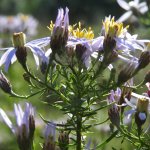
Perennial herbaceous plant, with a scapose and erect habit, Galatella sedifolia reaches a height between 20 and 50 cm, but under favorable conditions can reach up to 100 cm. The stem is glabrous, longitudinally striated, robust and ascending-branching, with branches starting already from the middle part of the plant. The stem surfaces are smooth, hairless, and have a furrowed structure.
The leaves are sessile, that is without petiole, with a leathery texture and a glandular surface characterized by small visible punctiform glands. The leaf shape varies from lanceolate to linear, with an entire blade, acute both at the apex and at the base. The lower leaves are wider (about 1.5 x 6 cm), erect-patent and have three prominent veins, while the upper ones are narrower, erect, uninerved and accompanied by axillary bundles of leaflike bractlets with a strap-like shape. The leaf arrangement is alternate and contributes to a rather rigid overall appearance.
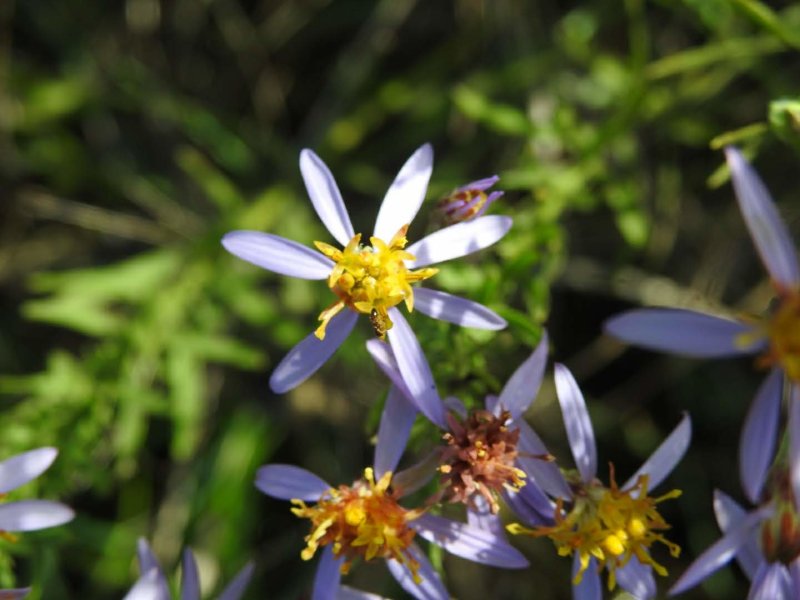
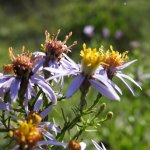
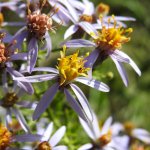
The capitula, typical of the Asteraceae family, are gathered in compact corymbs and have a diameter ranging from 1.5 to 3 cm. Each capitulum is supported by a short peduncle and presents a thick involucre of scarious and appressed scales, with outer scales lanceolate and inner scales more obtuse; the margin of the scales may show purplish tones and is slightly revolute. The peripheral flowers are ligulate, sterile, blue-violet or lilac in color, and vary in number from 5 to 10; the central ones are tubular, fertile, yellow and protruding, giving the capitulum a characteristic bicolor appearance. The pistil is absent or subnull, that is barely developed, a feature that may affect the sexual reproduction of the plant. The fruit is a hairy achene, equipped with a white-reddish pappus that favors anemochory (seed dispersal by wind).
The root system is not described in detail in the available sources, but like many perennial species of the Asteraceae family, a taproot or rhizomatous root is presumed, which allows perennation and adaptation to dry soils.
Habitat and distribution
Galatella sedifolia is a typical species of southern European regions and some arid areas of southern Siberia, with a Eurasian range extending from Europe to Japan. In Italy it is mainly present in the central-southern and insular regions, but its distribution also reaches more northern areas, always in habitats characterized by arid conditions and poor soils.
It grows mainly in uncultivated lands, garrigues and dry slopes, where the substrate is well-drained and often calcareous or stony. The species prefers sunny exposures, typical of Mediterranean environments, with altitudes ranging from 0 up to 1200 meters above sea level. This adaptability to extreme conditions and the presence of leaf glands suggest good resistance to drought and environmental stresses typical of steppe or dry Mediterranean areas.
Flowering period
The flowering extends from June to November, with a peak between July and September. This long flowering period makes Galatella sedifolia particularly appreciated also in ornamental contexts. No significant variations in the flowering period related to specific geographical conditions are reported, although in warmer and sunnier areas flowering may start earlier.
Ecology and pollination
The reproductive strategy of the species is characterized by the presence of sterile ligulate flowers and fertile tubular flowers at the center of the capitulum. Pollination is mainly entomogamous, favored by the presence of showy and colorful flowers (yellow and blue-violet) that attract pollinating insects such as bees, bumblebees and other hymenoptera. The blue-violet color of the peripheral ligules, although sterile, acts as a visual cue for pollinating insects visiting the fertile central tubular flowers.
The presence of a white-reddish pappus, formed by hairs, facilitates the anemochorous dispersal of the achenes, allowing the seeds to be carried by the wind and colonize new sites.
Curiosities and traditional uses
This species, thanks to its long flowering period and the vivid colors of its flowers, is also appreciated in gardening and nursery for the embellishment of flowerbeds and green spaces. It is used as an ornamental plant especially in areas with a Mediterranean climate and poor soils, where other plants struggle to thrive.
No specific traditional medicinal or food uses for Galatella sedifolia are reported in the consulted sources. However, the common name "Stonecrop Aster" indicates a visual link with the genus Sedum (stonecrop), known for some species with medicinal properties, although in this case it is a morphological comparison and not ethnobotanical uses.
Etymology
The genus name Galatella derives from the diminutive of "Galatea," a mythological nymph daughter of Nereus, in love with the shepherd Acis, probably evoking the delicacy and grace of the plants of the genus. The specific epithet sedifolia refers to the similarity of the leaves to those of the genus Sedum (stonecrop), characterized by a lanceolate-linear shape and a fleshy or leathery texture.
The Italian common name "astro con foglie di borracina" precisely recalls this leaf similarity with species of Sedum and the characteristic "aster" appearance due to the typical inflorescence of Asteraceae.
Sources
- Acta Plantarum - Flora delle regioni italiane (actaplantarum.org)
- Acta Plantarum - Flora delle regioni italiane (scheda di Antonino Messina)
Characteristics
Scheda botanica
| Famiglia | Asteraceae |
|---|---|
| Fioritura | giugno – novembre |
| Forma biologica | Scapose |
| Habitat | with yellow flowers, with purple flowers, plant with a scapose habit |
Domande frequenti
- Quando fiorisce Stonecrop Aster?
- Stonecrop Aster fiorisce giugno – novembre.
- Che tipo di pianta è Stonecrop Aster?
- Stonecrop Aster è una Hemicryptophytes (Scapose) secondo la classificazione di Raunkiaer.
- A quale famiglia appartiene Stonecrop Aster?
- Stonecrop Aster appartiene alla famiglia botanica Asteraceae.
Where I found it (12 sightings)
Classification
- Kingdom
- Plantae
- Family
- Asteraceae
- Full name
- Galatella sedifolia (L.) Greuter subsp. sedifolia
- Synonyms
- Aster acris L., nom. illeg.; Aster sedifolius L.
- Life form
- Hemicryptophytes scapose
Similar species
Search for species with similar characteristicsNoticed an error in the identification? Write to me
Other species of the same family
Asteraceae
Explore
Other species of Asteraceae