Botanical species
Cichorium intybus
L.
Chicory
Description
Morphological description
Herbaceous biennial or perennial plant, equipped with a taproot system, long, often cylindrical or conical and branched. The root, if cut, emits a white latex with a bitter taste. The stem is erect, robust, generally 20 to 150 cm tall, branched with rigid and spreading branches, characterized by a rough surface due to downward-facing hairs, sometimes nearly glabrous in the more depressed forms.
The basal leaves form a rosette, are petiolate and have a herbaceous blade, often hairy especially in dry climates; they can vary from entire and not toothed in the very first leaves to irregularly pinnately lobed with sharp triangular segments in the subsequent ones. The color ranges from dark green to slightly reddish tones, especially along the veins. The cauline leaves are alternate, sessile, with lower blades lobed and hairy on the upper surface, while the upper ones, smaller, are lanceolate and partially sheathing the stem.
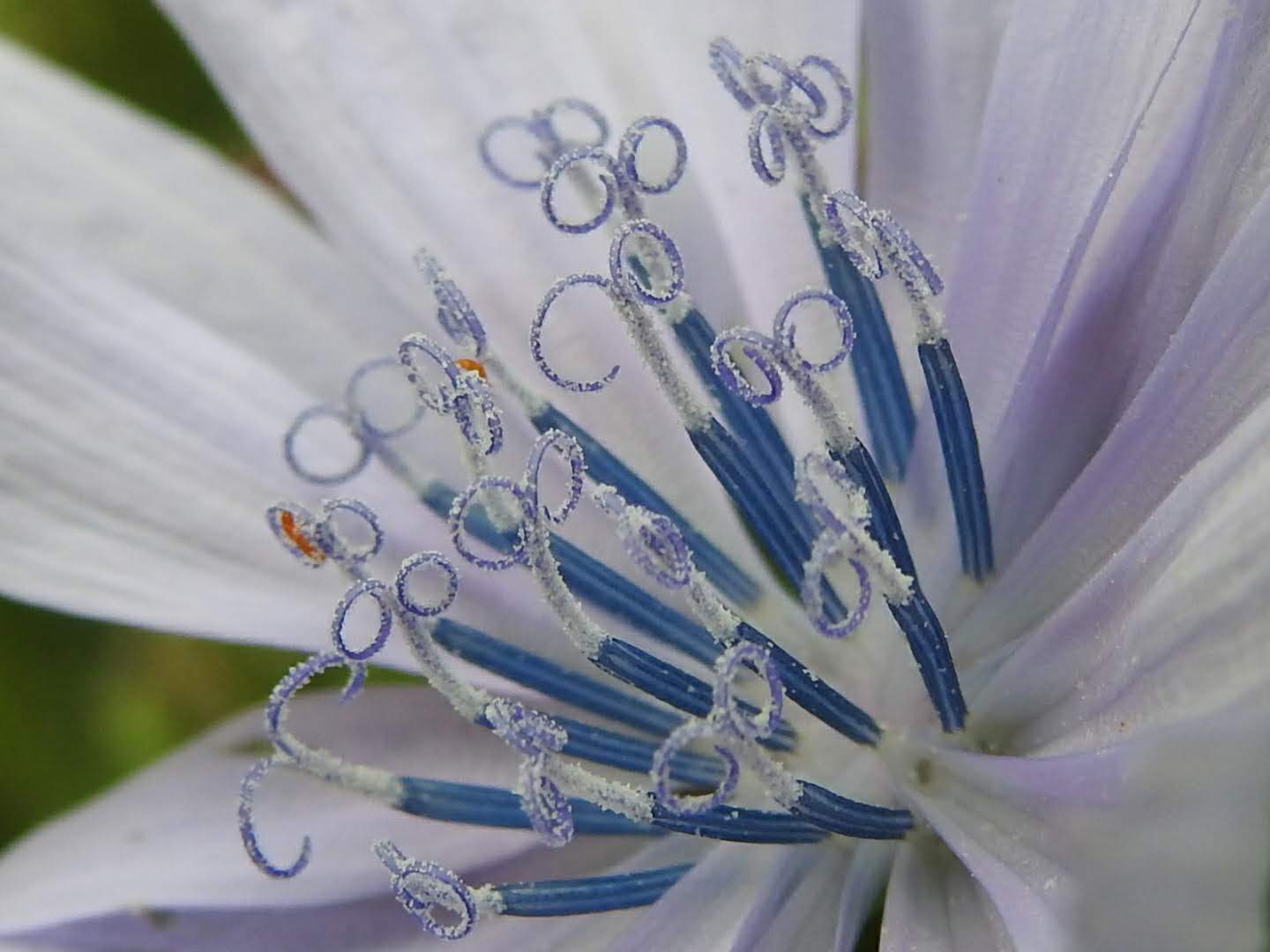
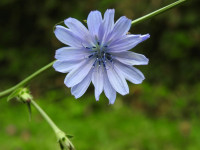
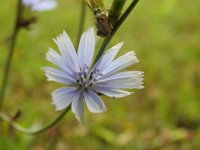
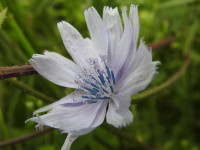
The inflorescence consists of ligulate capitula, generally grouped in small clusters of 2-3 or solitary, borne on short or long peduncles, sometimes apically thickened and slightly swollen. The involucre is cylindrical, formed by two series of leathery and ciliate bracts, with the outer ones shorter and oval and the inner ones lanceolate and straight. The flowers are all ligulate, with a tongue divided into five teeth, of intense blue color, but white or pale pink varieties may also appear. The inflorescences close in the afternoon or in case of bad weather.
The fruits are achenes of sand color, subcylindrical or obovoid, with rough margins and five faintly marked sides. They are topped by a pappus made up of very short small scales, about one tenth or one eighth the length of the achene, which facilitates dispersal.
Habitat and distribution
Chicory is widely distributed throughout Italy, present in all regions, from the plains up to about 1,200 meters of altitude. In the Mediterranean basin, it is found in similar habitats, from the plains to hilly and low mountain areas.
It prefers open environments such as grassy places, uncultivated fields, edges of roads and paths, often in well-drained and sunny soils, but it also adapts to slightly drier conditions. It can grow on soils of various types, from more fertile to poor ones, with generally full or partially shaded exposure.
Flowering period
Flowering mainly extends from June to September, with slight variations depending on altitude and local climate. Sometimes flowers can be observed as early as May, especially in temperate climates or in lower areas.
Ecology and pollination
Chicory is an entomogamous species, mainly pollinated by pollinating insects, particularly bees, bumblebees and other hymenopterans, attracted by the vivid blue color of the flowers and the nectar. The presence of a reduced pappus suggests that seed dispersal occurs mainly by wind, although to a limited extent, and probably with the aid of animals or by mechanical transport.
The plant is a good melliferous species, providing useful resources to the hive and other pollinating insects during the summer period.
Curiosities and traditional uses
Chicory has been appreciated for centuries for its multiple medicinal and food properties. In ancient times, its use was already established: the Egyptians mentioned it in the Ebers Papyrus 4,000 years ago as a therapeutic remedy, while the Greeks, such as Galen, considered it “friendly to the liver and not harmful to the stomach.” In the Roman period it was cultivated as a vegetable, and the Latin poet Horace was a fan.
The leaves, with a slightly bitter taste, are used in cooking both raw in salads and cooked, for their characteristic bitter flavor and richness in nutrients. In times of war or crisis, the roasted roots were used as a coffee substitute, a practice introduced in Europe in the 17th century.
From a medicinal point of view, the plant contains sesquiterpene lactones, derivatives of caffeic acid, hydroxycoumarins, flavonoids, vitamins and mineral salts. It is known for its diuretic, mild laxative, anti-inflammatory, febrifuge and tonic properties for the liver and gallbladder. The dicaffeoyltartaric acid present makes it a useful depurative and adjunct in slimming therapies. Moreover, fresh or cooked crushed roots are used as an emollient and refreshing mask for irritated or reddened skin.
In ethnobotany, chicory has been associated with magical practices: it was believed that the root could make one invisible. Various popular legends, such as the Romanian “Domna Floridor” or the German name "sponsa solis" (bride of the sun), testify to its symbolic role linked to the sun and temperance. The language of flowers identifies it with frugality and temperance.
Etymology
The genus name "Cichorium" seems to derive from the Greek "kikhória," probably connected to "kikhéo" (I find, I seek) and "óros" (mountain), perhaps referring to the mountainous habitat or the ease of finding the plant. The specific name "intybus" derives from the Greek “éntubon,” a term corresponding to the Italian indivia, with which it has historically often been confused or associated.
The Italian common name "cicoria" derives directly from the Latin cichoria, itself taken from Greek, referring to the bitter and edible plant well known since antiquity.
Sources
- Acta Plantarum - Flora delle regioni italiane (actaplantarum.org)
- Acta Plantarum - Flora delle regioni italiane (scheda di Marinella Zepigi)
- Tela Botanica / H. Coste, "Flore descriptive et illustrée de la France"
- World Flora Online (WFO)
Characteristics
Scheda botanica
| Famiglia | Asteraceae |
|---|---|
| Fioritura | giugno – settembre |
| Forma biologica | Scapose |
| Habitat | edible plant, with purple flowers, Perennial plant |
| Uso alimentare | Commestibile |
| Uso officinale | Pianta officinale |
Domande frequenti
- Quando fiorisce Chicory?
- Chicory fiorisce giugno – settembre.
- È commestibile Chicory?
- Chicory è considerata commestibile. Verifica sempre le parti eduli e la preparazione corretta prima del consumo.
- Che tipo di pianta è Chicory?
- Chicory è una Hemicryptophytes (Scapose) secondo la classificazione di Raunkiaer.
- A quale famiglia appartiene Chicory?
- Chicory appartiene alla famiglia botanica Asteraceae.
Where I found it (9 sightings)
Classification
- Kingdom
- Plantae
- Family
- Asteraceae
- Full name
- Cichorium intybus L.
- Synonyms
- Cichorium intybus L. subsp. glabratum (C.Presl) Arcang.; Cichorium intybus L. subsp. spicatum I.Ricci
- Life form
- Hemicryptophytes scapose
Similar species
Search for species with similar characteristicsFurther reading
Noticed an error in the identification? Write to me
Other species of the same family
Asteraceae
Explore
Other species of Asteraceae