Botanical species
Hypochaeris radicata
L.
Flatweed
Description
Morphological description
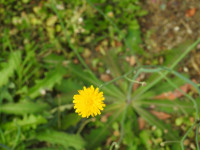
Perennial herbaceous plant of the Asteraceae family, it has a scapose habit, with erect scapes that can reach a height between 30 and 60 cm. The stem is generally simple or slightly branched in the upper part, glabrous or slightly rough at the base, glaucous green in color, sometimes with greenish or pinkish shades. The surface of the stem is hairless or with few rough hairs especially near the bracts supporting the flower heads.
The root system is robust, formed by a fleshy, semi-woody, and often branched rhizome, which contains white latex. This swollen root is particularly resistant and allows the plant to live for several years.
The leaves are all arranged in a basal rosette adhering to the ground, sessile, oblanceolate or spatulate in shape, with variable sizes from 1.5-2 cm in width up to 5-10 cm in length. The leaf margin can be entire, crenate, sinuate, pinnately lobed or pinnatifid with obtuse lobes, often with a rough and hairy-setose upper and lower surface due to robust unicellular hairs. The leaves are bright green in color, with a well-visible central vein.
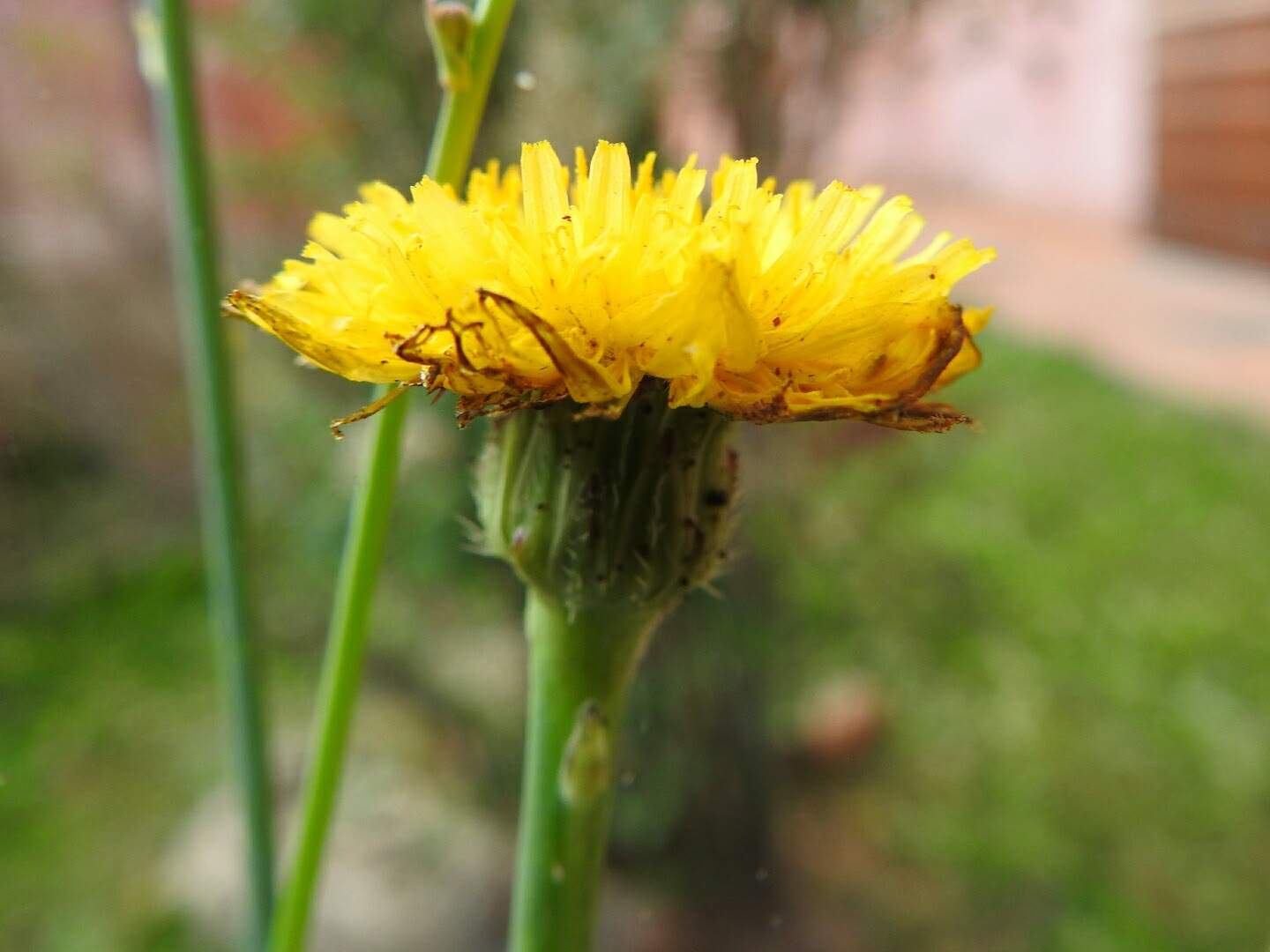
The flower heads are solitary and terminal, obconical or cup-shaped, with a diameter of 2-4 cm. The involucre is cylindrical, formed by 3-4 series of lanceolate, acute scales, glabrous or sometimes slightly rough along the central vein, with scarious (membranous and thin) margins. The involucre bracts are arranged spirally and can reach a length of 10-25 mm depending on the geographic strain.
The flowers are all ligulate and perfect (hermaphrodite), with bright yellow corollas. The outer ligules, longer (about 15 mm), have 5 sharp apical teeth and sometimes reddish spots; the inner ones are shorter and narrower. Anthesis occurs between May and September. The receptacle is convex and provided with chaff at the base of the flowers that protect the achenes.
The fruit is a rough brown achene, with a cylindrical-fusiform body 4-6 mm long, finely ribbed (about 14 longitudinal ribs) and with a long beak, which can vary between 4.5 and 7 mm. The beak of the peripheral achenes is generally shorter than that of the inner achenes. The pappus consists of two series of bristles: the inner ones, feathered and about 1 cm long, and the outer ones, shorter and denticulate, of a stiffer consistency. This system facilitates anemochorous dispersal (wind-borne).
Habitat and distribution
The species is widespread throughout almost all of Europe and North Africa, with an extensive presence in the Italian Mediterranean regions, from the plains up to about 1500 m altitude. In Italy it is particularly common in the hilly and mountainous areas of Northern and Central Italy, but it is also found in the South and Sicily, where some subspecific variants with slightly smaller flower heads are observed.
It grows preferably in sunny and open environments, such as dry meadows, pastures, roadsides, uncultivated areas, and on sandy or well-drained soils. It is a heliophilous species, which prefers sunny exposures and often poor and dry soil conditions. Sometimes it can behave as a weed in crops and meadows, given its ability to spread rapidly through rhizomes and achenes.
Flowering period
Flowering extends from May to September, with variations depending on climatic conditions and altitude. In warmer and lower areas it can start already in May, while in mountainous areas flowering is concentrated more in the summer months. The duration and intensity of flowering can also vary depending on local subpopulations.
Ecology and pollination
The plant appears as a heliophilous and perennial species, with a biological cycle based on a survival strategy through rhizome and anemochorous seed dispersal. The yellow ligulate flowers are particularly attractive to numerous pollinating insects, such as bees, bumblebees, butterflies, and other hymenopterans, which ensure entomogamous pollination. The presence of hermaphrodite and fertile flowers also allows sexual reproduction, while the ability to emit new shoots from the rhizome enables rapid colonization of habitats.
The structure of the pappus, with inner feathered bristles and stiffer outer bristles, favors the aerial dispersal of the fruit by wind, facilitating colonization of new sites.
Curiosities and traditional uses
The species is known to be edible and has had some importance in Mediterranean ethnobotany. The young leaves, harvested when still tender, are used both raw in salads and cooked as vegetables. The roots, roasted, have traditionally been used as a coffee substitute, similarly to what happens with Dandelion (Taraxacum officinale).
In folk medicine, the aerial part of the plant was used in the form of a decoction for depurative and antidiabetic purposes, administered especially in the morning on an empty stomach. These traditional uses refer to historical herbal practices but are not supported by modern clinical evidence and therefore should be considered with caution.
The common name "Flatweed" recalls the slender and filamentous shape of the stem and leaves, which resemble those of rushes, while etymologically the genus name derives from the Greek "hypo" (under) and "choiros" (pig), alluding to the fact that the roots were considered good food for pigs.
Etymology
The scientific genus name derives from ancient Greek: "hypo" means "under" and "choiros" means "pig" or "swine," referring to the fact that in the past it was believed that pigs particularly appreciated the roots of this plant. The specific epithet "radicata" comes from Latin and indicates the presence of a well-developed and robust root system, a distinctive characteristic of the species.
The Italian common name "Flatweed" refers to the slender and filiform appearance of the stem and leaves, which resemble rushes, while the term "costolina" is a diminutive probably referring to the rigid and pointed bracts of the involucre.
Sources
- Prof. S. Pignatti, "Flora d'Italia"
- Acta Plantarum - Flora delle regioni italiane (scheda di Anja Michelucci)
- Tela Botanica / H. Coste, "Flore descriptive et illustrée de la France"
- World Flora Online (WFO)
Characteristics
Scheda botanica
| Famiglia | Asteraceae |
|---|---|
| Fioritura | maggio – settembre |
| Forma biologica | Rosulate |
| Habitat | edible plant, with yellow flowers, Perennial plant |
| Uso alimentare | Commestibile |
Domande frequenti
- Quando fiorisce Flatweed?
- Flatweed fiorisce maggio – settembre.
- È commestibile Flatweed?
- Flatweed è considerata commestibile. Verifica sempre le parti eduli e la preparazione corretta prima del consumo.
- Che tipo di pianta è Flatweed?
- Flatweed è una Hemicryptophytes (Rosulate) secondo la classificazione di Raunkiaer.
- A quale famiglia appartiene Flatweed?
- Flatweed appartiene alla famiglia botanica Asteraceae.
Where I found it (10 sightings)
Classification
- Kingdom
- Plantae
- Family
- Asteraceae
- Full name
- Hypochaeris radicata L.
- Synonyms
- Hypochaeris radicata L. subsp. platylepis (Boiss.) Jahand. & Maire; Porcellites radicata (L.) Cass.
- Life form
- Hemicryptophytes rosulate
Similar species
Search for species with similar characteristicsFurther reading
Noticed an error in the identification? Write to me
Other species of the same family
Asteraceae
Explore
Other species of Asteraceae