Botanical species
Jacobaea maritima
(L.) Pelser & Meijden subsp. maritima
Silver Ragwort
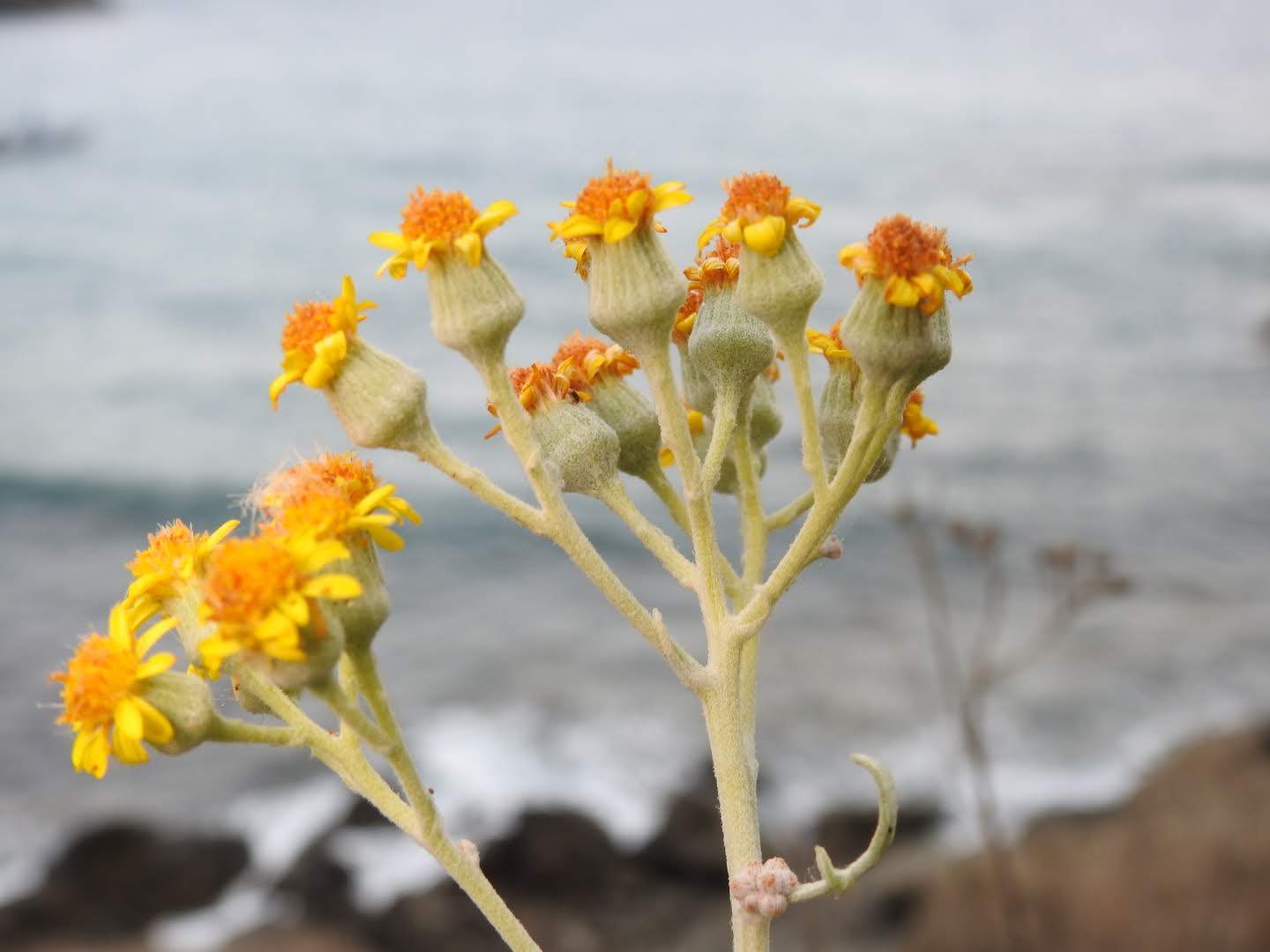
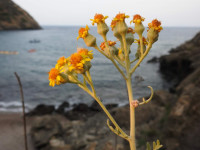
Description
Morphological description
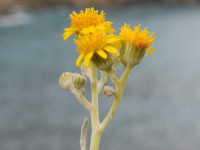
The Silver Ragwort is an evergreen suffruticose plant reaching a height between 30 and 100 cm. It has a bushy habit with erect, robust stems covered by a dense white-tomentose pubescence that gives the plant a characteristic silvery and velvety appearance. The stems are branched and woody at the base, while the apical parts are more herbaceous.
The leaves are pinnatifid, with a blade divided into thin segments that can be linear or lanceolate, spaced apart, while the central part is undivided and a few millimeters wide. The lower leaves have a triangular shape with 4-5 pairs of lateral lanceolate or linear lobes and an apical lobe that is lobed or parted. The upper leaves are similar but smaller in size. The leaf texture is fleshy, with the upper surface ash-grey and the lower surface white-tomentose, giving the plant a silvery and soft-to-the-touch appearance.
The flowers are bright yellow and gathered in rich and relatively small corymbs, often accompanied by shorter lateral branches. The flower heads have a diameter of about 12 mm and are composed of central tubular flowers and peripheral ligulate flowers arranged in a single series; all flowers are hermaphroditic. The involucre, initially conical-hemispherical and later cylindrical, has a diameter of 5-6 mm and consists of tomentose and whitish scales, with 13 inner scales about 7 mm long and 1-3 very reduced or absent outer scales.
The fruit is a striated achene, with a finely pubescent or glabrous surface, equipped with a white pappus made of deciduous bristles, useful for anemochorous seed dispersal.
The root system is not specifically described in the sources but, as typical of coastal psammophilous plants, it is presumably well developed and adapted to anchor the plant in sandy or rocky coastal substrates.
Habitat and distribution
This species is typical of the coastal areas of the western Mediterranean basin, with a range extending along the Mediterranean coasts, especially in warmer regions, including southern Italy and Sicily, where the highest diversity of the taxonomic group is observed.
It prefers marine habitats, colonizing psammophilous and rocky environments such as cliffs, steep and rugged areas, old walls, and pebble beaches. Although it is not a halophyte species (it does not tolerate high soil salinity), it adapts well to coastal environments exposed to wind and sun. Occasionally, it can also be found in locations relatively far from the sea, up to 300 meters in altitude, on poor and well-drained substrates.
The plant grows on sandy or rocky soils, preferably in sunny exposures, typical of Mediterranean areas with mild and breezy climates.
Flowering period
Flowering mainly occurs between May and August. No significant variations in the flowering period are reported throughout its Mediterranean range, although the duration and intensity of flowering may vary depending on local climatic conditions.
Ecology and pollination
The Silver Ragwort has a reproductive strategy based on the production of flower heads rich in hermaphroditic flowers, with central tubular flowers and peripheral ligulate flowers, which attract a variety of pollinating insects. Among the main pollinators are bees, bumblebees, and other generalist pollinating insects, attracted by the intense yellow color and the visible arrangement of the flowers.
Seed dispersal mainly occurs through the feathery pappus that facilitates anemochory, allowing seeds to be carried by the wind and colonize new suitable areas.
Curiosities and traditional uses
The Silver Ragwort is a species known for its toxic properties, due to the presence of alkaloids such as senecionine, common in the genus Jacobaea. In the past, this plant was used for its presumed decongestant and anti-inflammatory properties, particularly for treating eye inflammations. However, given the plant's toxicity, medicinal use is now strongly discouraged and should only occur under strict medical supervision to avoid risks.
Nevertheless, the species is widely appreciated as an ornamental plant for its silvery and velvety foliage and its bright yellow blooms. It is a rustic and hardy plant, often cultivated in Mediterranean gardens and parks, also in pots. In colder climates, it can be grown as an annual, propagated by seed or herbaceous cutting.
Etymology
The genus name, Jacobaea, derives from "Jacob," one of the biblical patriarchs, to whom the genus dedication is attributed. Others suggest the name refers to Saint James. The specific name "maritima" indicates the species' preferred habitat, namely maritime or coastal areas, highlighting its adaptation to littoral environments.
The Italian common name "Senecione cinerario costiero" refers both to the grey-silvery color ("cinerario") of the leaves and to the typical growth environment ("costiero").
Sources
- Acta Plantarum - Flora delle regioni italiane (actaplantarum.org)
- Acta Plantarum - Flora delle regioni italiane (scheda di Daniela Longo)
Characteristics
Scheda botanica
| Famiglia | Asteraceae |
|---|---|
| Fioritura | maggio – agosto |
| Forma biologica | Suffruticose |
| Habitat | with yellow flowers, psammophilous plant, plant with a spreading bushy habit |
| Tossicità | Tossica — non consumare |
| Uso officinale | Pianta officinale |
Domande frequenti
- Quando fiorisce Silver Ragwort?
- Silver Ragwort fiorisce maggio – agosto.
- È tossica Silver Ragwort?
- Silver Ragwort è una pianta tossica o velenosa. Non consumare nessuna sua parte senza aver consultato un esperto.
- Che tipo di pianta è Silver Ragwort?
- Silver Ragwort è una Chamaephyte (Suffruticose) secondo la classificazione di Raunkiaer.
- A quale famiglia appartiene Silver Ragwort?
- Silver Ragwort appartiene alla famiglia botanica Asteraceae.
Where I found it (9 sightings)
Classification
- Kingdom
- Plantae
- Family
- Asteraceae
- Full name
- Jacobaea maritima (L.) Pelser & Meijden subsp. maritima
- Synonyms
- Cineraria maritima (L.) L.; Othonna maritima L.; Senecio bicolor (Willd.) Tod. subsp. cineraria (DC.) Chater; Senecio cineraria DC., nom. nov.; Senecio gibbosus subsp. cineraria; Senecio maritimus
- Life form
- Chamaephyte suffruticose
Similar species
Search for species with similar characteristicsFurther reading
Noticed an error in the identification? Write to me
Other species of the same family
Asteraceae
Explore
Other species of Asteraceae