Botanical species
Achillea tomentosa
L.
Yellow Milfoil
Description
Morphological description
Perennial herbaceous plant 10 to 50 cm tall, characterized by a scapose habit and erect or sometimes bent (knuckled) stems at the base. The stem is branched in the inflorescence part and covered by a dense soft and woolly pubescence giving a gray-tomentose appearance. This woolliness can reach a length of over 1 mm.
The leaves are lanceolate and linear, with a length from 3 to 30 mm and a width about four to five times less than the length. They are bipinnatisect, i.e. divided into small linear lobes, from 20 to 40, further segmented into three linear parts. Initially, they have a gray-woolly surface due to abundant pubescence, which then tends to thin out with maturation, making the leaf almost glabrous. The texture is herbaceous and the surface is covered by soft but non-viscous hairs.
The root system consists of woody and oblique rhizomes, superficial, which allow the plant's perennation and spread.
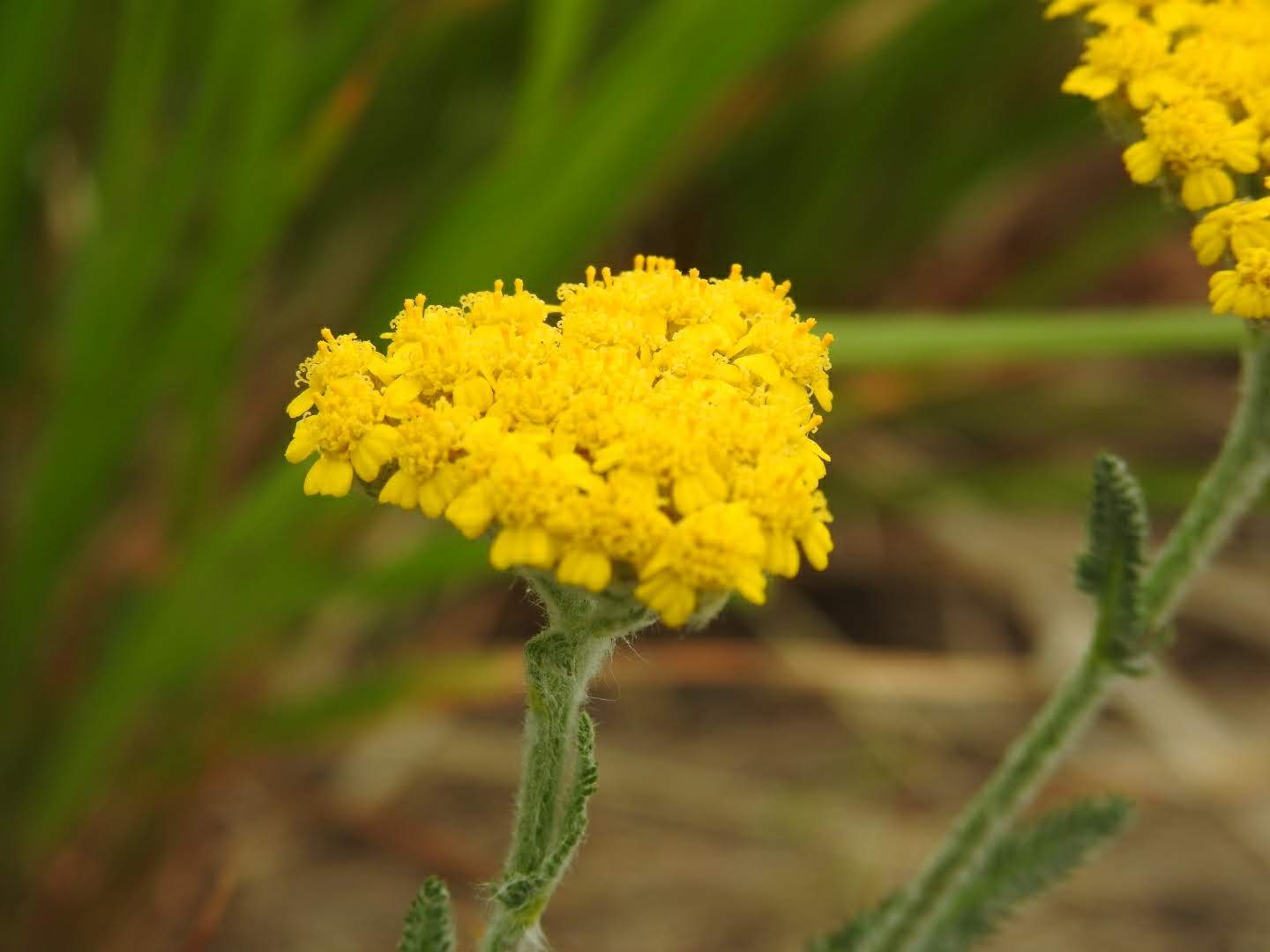
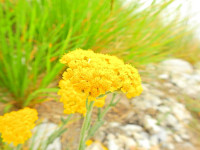
The inflorescence consists of a compact terminal corymb, ovoid-umbelliform, 2-4 cm wide, formed by numerous relatively small capitula (between 15 and 50), each with a diameter of 5-7 mm. The capitula are composed of yellow tubular flowers in the disc and 4-6 ligulate flowers of yellow color, with trilobed ligules about as long as the involucre. These ligules are often turned downward, partially covering the involucre, which is ovoid, 2-3 mm long and 4 mm wide, with light brown scales and hyaline margins. The flower habit is scapose and the symmetry is actinomorphic.
The fruits are small achenes 1-1.3 mm long, without pappus, truncate at the apex and flat. This characteristic facilitates local dispersal by falling and transport by wind or small animals.
Habitat and distribution
This species is typical of xerothermic environments, preferring dry, rocky and sunny slopes, mainly on siliceous substrates. It grows from the plains up to mountain altitudes of about 1700 meters, frequenting montane and submontane environments, often characterized by low humidity conditions and well-drained soil.
In Italy it is mainly present in the central and northern Alps, with distribution from Trentino to Liguria and along the northern and central Apennines up to Abruzzo. The distribution also extends to Southern Europe and some areas of southern Siberia. In Sardinia it is mainly found on heavy and moist soils, although generally it prefers drier places.
Flowering period
Flowering is mainly concentrated in the summer months, from June to August, with possible variations related to altitude and latitude. In the Apuan Alps, for example, flowering can start as early as mid-May and last until mid-June.
Ecology and pollination
Xerothermophilous plant, adapted to conditions of low water availability and sunny, warm exposures. The bright yellow flowering attracts numerous pollinating insects, especially bees and other pollinating insects that visit the capitula to collect nectar and pollen. The compact arrangement of the capitula in corymbs facilitates cross-pollination and maximum reproductive efficiency.
Seed dispersal occurs mainly by falling near the mother plant, given the absence of pappus that limits long-distance anemochory. Probably animals can also contribute to their secondary distribution.
Curiosities and traditional uses
The genus name Achillea derives from the mythological figure Achilles, who according to legend used this plant to heal the wounds of his soldiers during the siege of Troy or who was himself healed by the centaur Chiron with this plant.
The specific name "tomentosa" refers to the characteristic woolly pubescence that covers the plant.
The woolly yarrow, like other species of the genus Achillea, has been traditionally used in phytotherapy for its hemostatic and healing properties, although for this specific species traditional information is less documented compared to other Achillea species.
Etymology
The common name "woolly yarrow" refers both to the characteristic of the leaves finely divided into many small lobes ("yarrow"), and to the presence of dense pubescence ("woolly") that covers the entire plant, giving it a woolly and grayish appearance.
The origin of the scientific name is linked to the mythological figure of Achilles and the tomentose appearance of the plant, which defines its specificity within the genus.
Sources
- Prof. P.V. Arrigoni, "Flora analitica della Toscana", "Flora dell'Isola di Sardegna"
- Acta Plantarum - Flora delle regioni italiane (scheda di Giuliano Salvai)
- World Flora Online (WFO)
Characteristics
Classification
- Kingdom
- Plantae
- Family
- Asteraceae
- Full name
- Achillea tomentosa L.
- Life form
- Emicriptofite scapose
Similar species
Search for species with similar characteristicsNoticed an error in the identification? Write to me
Other species of the same family
Asteraceae
Explore
Other species of Asteraceae