Botanical species
Achillea millefolium
L.
Yarrow
Description
Morphological description
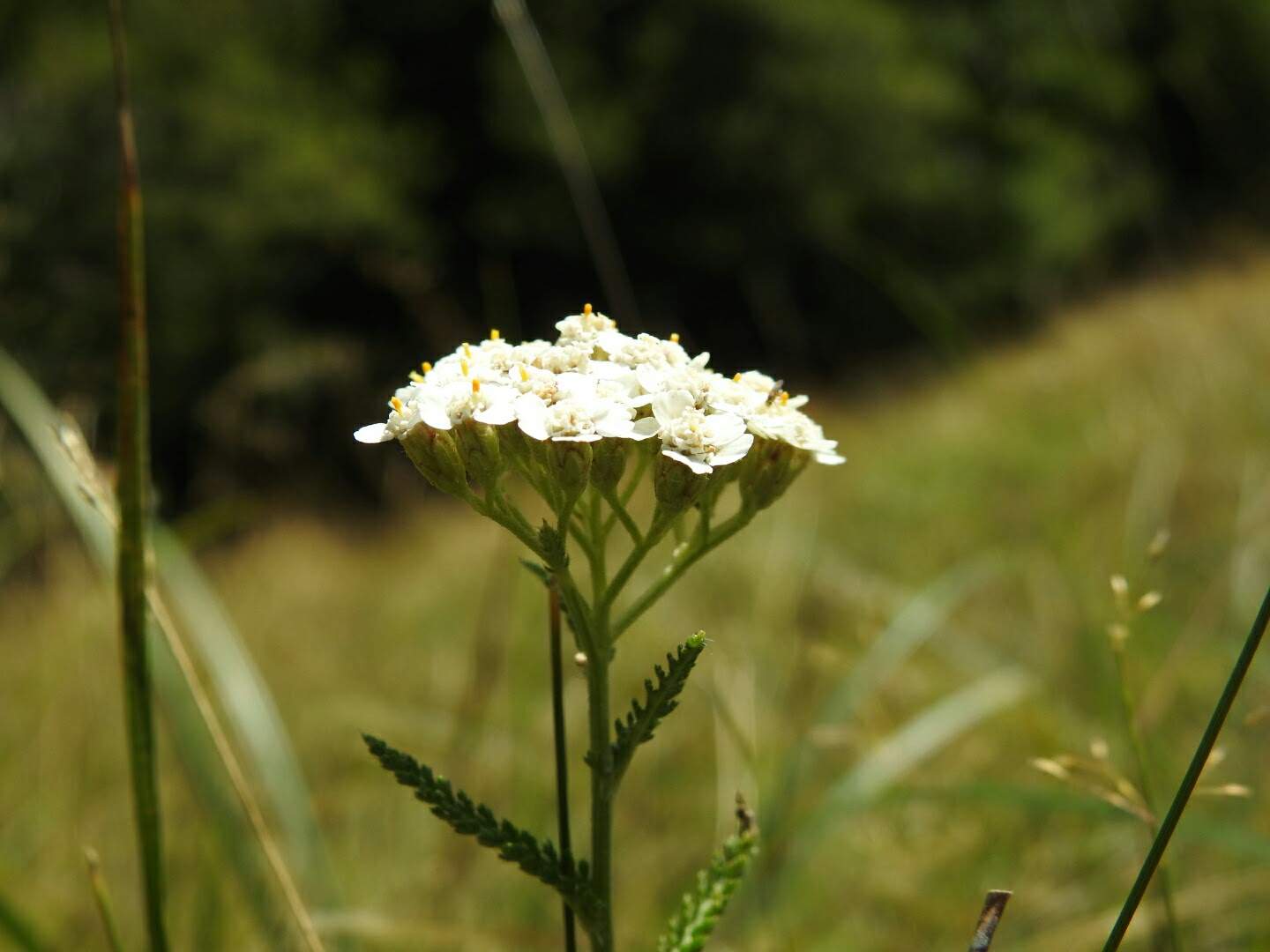
Perennial herbaceous plant, aromatically scented, generally 30 to 100 cm tall, with an erect habit and scapose stem, that is with an elongated floral axis often leafless. The stem, about 2 mm in diameter, is pubescent and woolly, longitudinally grooved and branched mainly at the top. The surface is covered with simple, soft hairs 1 to 3 mm long, giving a slight woolliness.
The root system consists of an elongated horizontal rhizome, often with epigeal stolons that allow the plant to spread vegetatively as well.
The leaves are alternate and lanceolate elongated in shape, arranged along the stem with a bipinnatisect arrangement. The basal leaves, larger and petiolate, can be two to three times pinnate with very thin linear segments arranged on different planes; these lobes are dense, soft to the touch and often have a mucronate tip. The cauline leaves are sessile, smaller, subspatulate and arranged at an acute angle to the stem, while the upper leaves, located at the axil of the inflorescence, are linear-lanceolate, mucronate and almost perpendicular to the stem. All the leaves are covered on the lower surface with fine and soft hairs.
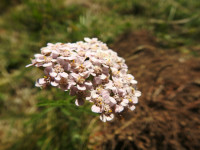
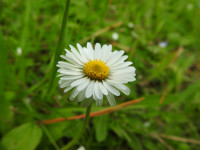
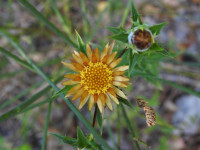
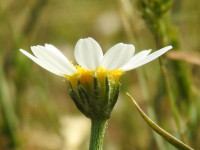
The inflorescence is a wide, compact and flattened corymb, made up of numerous small capitula, each with an ovoid involucre composed of 4-6 series of scales with membranous margins, often light or brown-rusty, sometimes scarious-woolly. The peripheral ligulate flowers are white or pale pink, sometimes with purplish or reddish shades, with a ligule about 3 mm wide and wider than long, trilobed with the central lobe smaller than the lateral ones. The numerous (10-25) central tubular flowers are perfect, white or cream, with a 5-lobed corolla and an expanded tube forming a hood above the ovary. The combination of ligulate and tubular flowers forms the reproductive unit called capitulum.
The fruit is an obovate, compressed achene, about 1.7-2 mm long, glabrous, without pappus. The achenes produced by the ligulate flowers have a narrow wing while those derived from the tubular flowers have a wider wing.
Habitat and distribution
The species is widespread throughout Italy and the Mediterranean basin, preferring countryside environments, dry meadows, uncultivated areas, edges of paths and roads, from sea level up to about 2500 meters altitude. It is particularly common in hilly and mountainous areas, with a higher concentration in the Alps and subalpine environments.
Yarrow adapts to different soils, preferring well-drained and sunny grounds, although it is frequently found in anthropized and disturbed habitats, often as a weed species. It grows well in meadows, pastures and open areas, showing good resistance to drought conditions and temperate-cold climates.
Flowering period
Flowering mainly occurs from May to September, with slight variations depending on altitude and latitude. In higher mountain environments it can extend until October, while in the plains it is concentrated in the summer months.
Ecology and pollination
Yarrow is a strongly aromatic plant that attracts numerous pollinating insects, including bees, bumblebees and butterflies, which facilitate entomophilous pollination. The structure of the inflorescence, consisting of many small grouped flowers, facilitates the simultaneous visit of multiple insects, increasing reproductive efficiency.
Seed dispersal mainly occurs by falling near the mother plant, but the presence of rhizomes and stolons allows rapid vegetative expansion, contributing to its spread and invasive capacity.
Curiosities and traditional uses
The genus name Achillea derives from the legend that Achilles, the famous Greek hero, used this plant to heal the wounds of his companions during the Trojan War. This tradition is passed down by Pliny the Elder and also inspired the Italian common name “millefoglio,” which refers to the particular shape of the finely divided leaves.
Yarrow is historically known for its medicinal properties: it has been used as a hemostatic, vulnerary, antispasmodic, stomachic and circulatory tonic. It contains essential oil rich in terpenic compounds (such as cineole, pinene, thujone, borneol), azulene, achillein and valerianic acid. In herbal medicine it is used as an antihemorrhagic, for the treatment of epistaxis, bleeding hemorrhoids and bladder inflammations.
In cosmetics, distilled water of Achillea is appreciated for its soothing action and for the presence of azulene, similar to that of chamomile. It is also used in the production of tonic and digestive liqueurs. Traditionally, the seeds were placed in cotton bags inside barrels to improve wine preservation.
From a cultural point of view, in Ireland the plant was considered an amulet against the evil eye and diseases, with a Gaelic song celebrating its protective virtues and ability to enhance personal beauty. Moreover, yarrow is often used in gardening for borders and flowerbeds thanks to its hardiness and beauty.
Etymology
The scientific name Achillea millefolium refers both to the mythological figure of Achilles, who according to tradition used this plant to heal wounds, and to the morphological characteristic of the “thousand-leaved” leaves, finely divided into numerous lobes. The term “Yarrow” is therefore a direct translation of the specific epithet “millefolium” and well describes the typical leaf structure of this species.
Sources
- Prof. S. Pignatti, "Flora d'Italia"
- Acta Plantarum - Flora delle regioni italiane (scheda di Antonino Messina)
- Tela Botanica / H. Coste, "Flore descriptive et illustrée de la France"
- World Flora Online (WFO)
Characteristics
Scheda botanica
| Famiglia | Asteraceae |
|---|---|
| Fioritura | maggio – settembre |
| Forma biologica | Scapose |
| Habitat | with white flowers, with pink flowers, Perennial plant |
Domande frequenti
- Quando fiorisce Yarrow?
- Yarrow fiorisce maggio – settembre.
- Che tipo di pianta è Yarrow?
- Yarrow è una Hemicryptophytes (Scapose) secondo la classificazione di Raunkiaer.
- A quale famiglia appartiene Yarrow?
- Yarrow appartiene alla famiglia botanica Asteraceae.
Where I found it (9 sightings)
Classification
- Kingdom
- Plantae
- Family
- Asteraceae
- Full name
- Achillea millefolium L.
- Synonyms
- Achillea aspleniifolia auct.
- Life form
- Hemicryptophytes scapose
Similar species
Search for species with similar characteristicsFurther reading
Noticed an error in the identification? Write to me
Other species of the same family
Asteraceae
Explore
Other species of Asteraceae