Botanical species
Anthemis maritima
L.
Camomilla marittima
Description
Morphological description
Perennial aromatic plant averaging 20-30 cm in height, with a prostrate-ascending habit and glabrous or nearly glabrous stems, branched and leafy for at least two-thirds of their length. The root system consists of a vigorous root with long fibers, anchoring the plant to sandy coastal substrates.
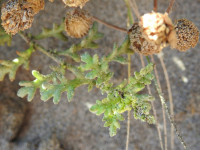
The leaves, herbaceous in texture, are green with a punctate-glandular surface especially on the lower side. The basal leaves, 2-4 cm long, are 2-pinnatisect with narrow lanceolate lobes about 1 x 3 mm. The cauline leaves are smaller (1-2 cm), with a widened rachis (1.5-2 mm) and have 2-4 divergent teeth per side; the leaf apex is generally obtuse. The leaves are slightly thick and partially glabrous.
The capitula, 1.5 to 3 cm in diameter, are borne on thin peduncles, sometimes slightly thickened at the apex, and are characterized by acute scales with a light margin and briefly mucronate chaff. The receptacle is provided with linear-oblong scales, abruptly cuspidate at the apex.
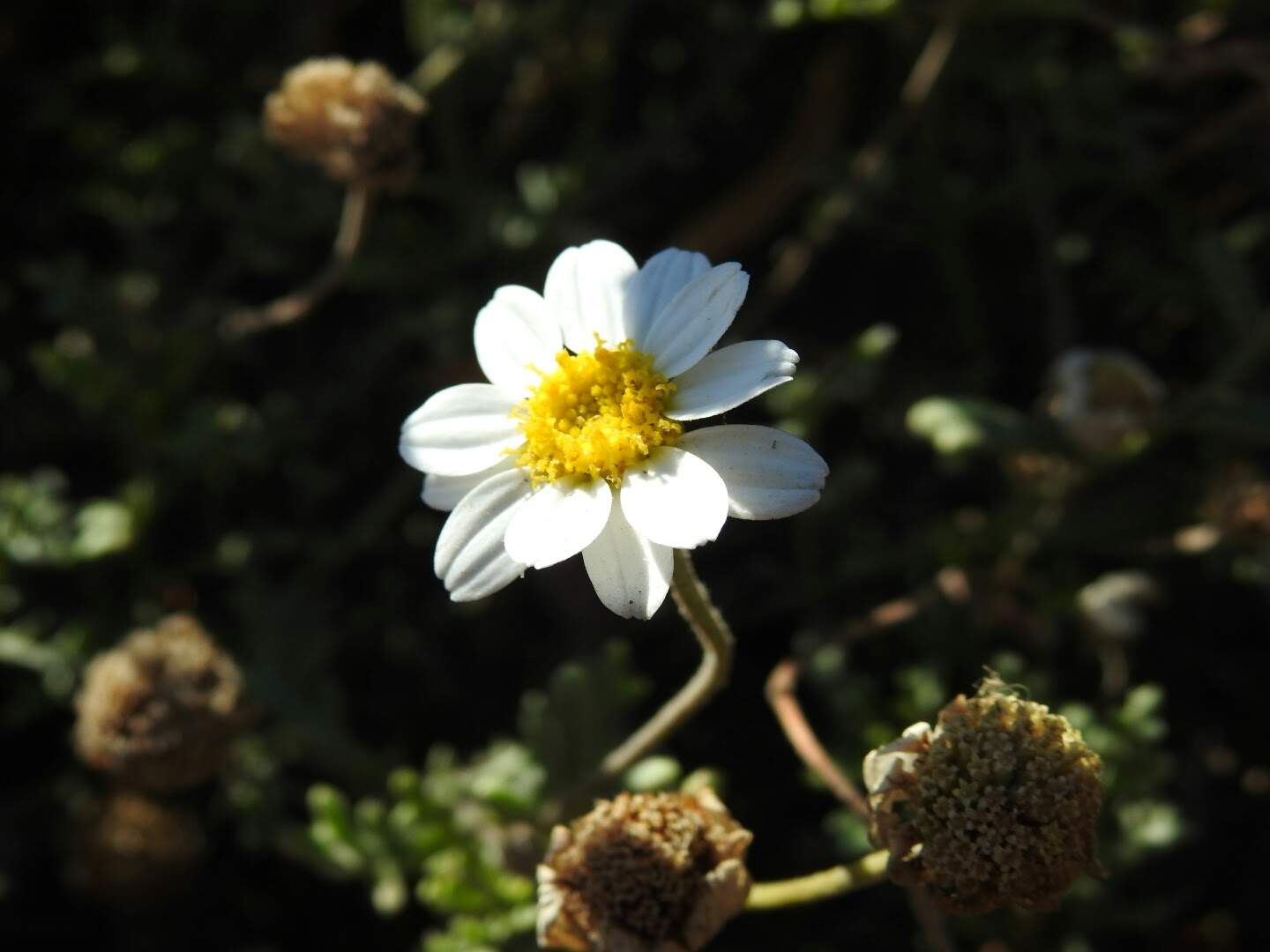
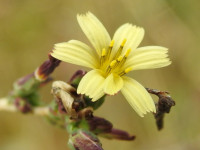
The peripheral flowers are ligulate, white, with ovate ligules 3.5 to 5 mm long and 5-7 mm wide, often folded downward. The central flowers are tubular and bright yellow. The inflorescence presents actinomorphic symmetry and the typical ligulate shape of the Asteraceae. The achenes, 2-2.5 mm long, are denticulate at the apex, white or yellow-greenish in color, smooth or finely wrinkled.
Habitat and distribution
Psammophilous species typical of sandy coastal and dune areas, it grows preferably on marine beaches and in temperate marine environments. In Italy it is mainly present in southern and insular regions, such as Campania, Puglia, Calabria, Sicily, and Sardinia; in some areas, such as Lazio, it is no longer found. It is also found along the coasts of the western Mediterranean, from Spain to Greece, and in some areas of northern Africa.
It prefers maritime sandy substrates, often under conditions of strong soil dynamics. Its presence is typical of environments with full sun exposure and a warm-temperate Mediterranean climate. The growth altitude is generally low, limited to coastal zones.
Flowering period
Flowering extends from May to November, with a peak between the spring and summer months (May-August). In some Mediterranean areas, flowering may vary slightly depending on local climatic conditions, but no substantial differences in the period are documented.
Ecology and pollination
The species is mainly pollinated by pollinating insects attracted by the white ligulate and yellow tubular flowers, which offer nectar and pollen. The prolonged flowering allows a long temporal window for pollination, increasing the chances of reproductive success.
Seed dispersal occurs through achenes equipped with morphological features that facilitate transport and dissemination in sandy substrates, although no particular long-distance dispersal strategies are known.
Curiosities and traditional uses
Anthemis maritima is a medicinal species known for its aromatic properties. Recent studies have isolated some cyclohexanones from its leaves with antiproliferative activity on leukemic cells, suggesting potential pharmacological interest.
Traditionally, maritime chamomile has been used in herbal medicine for its aromatic and medicinal properties, although it is not among the most commonly used chamomile species. However, widespread alimurgic uses or particular folkloric references are not documented.
Etymology
The generic name Anthemis derives from the Greek “anthos” meaning “flower,” referring to the particular floral structure typical of the genus. The specific epithet maritima clearly refers to the plant’s habitat, typical of marine and sandy coastal areas.
The Italian common name “camomilla marittima” highlights the similarity to more common chamomiles, while also emphasizing its exclusively coastal growth habitat.
Sources
- Prof. S. Pignatti, "Flora d'Italia"
- Acta Plantarum - Flora delle regioni italiane (scheda di Gianluca Nicolella)
- Tela Botanica / H. Coste, "Flore descriptive et illustrée de la France"
Characteristics
Scheda botanica
| Famiglia | Asteraceae |
|---|---|
| Fioritura | maggio – novembre |
| Forma biologica | Scapose |
| Habitat | with white flowers, psammophilous plant, Perennial plant |
Domande frequenti
- Quando fiorisce Camomilla marittima?
- Camomilla marittima fiorisce maggio – novembre.
- Che tipo di pianta è Camomilla marittima?
- Camomilla marittima è una Hemicryptophytes (Scapose) secondo la classificazione di Raunkiaer.
- A quale famiglia appartiene Camomilla marittima?
- Camomilla marittima appartiene alla famiglia botanica Asteraceae.
Where I found it (3 sightings)
Classification
- Kingdom
- Plantae
- Family
- Asteraceae
- Full name
- Anthemis maritima L.
- Life form
- Hemicryptophytes scapose
Similar species
Search for species with similar characteristicsFurther reading
Noticed an error in the identification? Write to me
Other species of the same family
Asteraceae
Explore
Other species of Asteraceae