Botanical species
Dianthus seguieri
Vill.
Ragged Pink
Description
Morphological description
The Ragged Pink is a perennial herbaceous plant, with a scapose habit and sometimes briefly creeping. The height generally varies between 30 and 60 cm. The stems are angular, often branched, glabrous and woody at the base; the flowering stems are erect and leafless along the main axis. The roots are filiform and thin.
The leaves are opposite, linear-lanceolate, rather firm in texture, with entire and slightly rough margins. Their width is generally between 1 and 3 mm, but specimens with leaves up to 6 mm can be found, especially in some relict populations such as in the Apuan Alps. The leaf sheaths are narrow, 1-2 mm long, and partially wrap the stem.
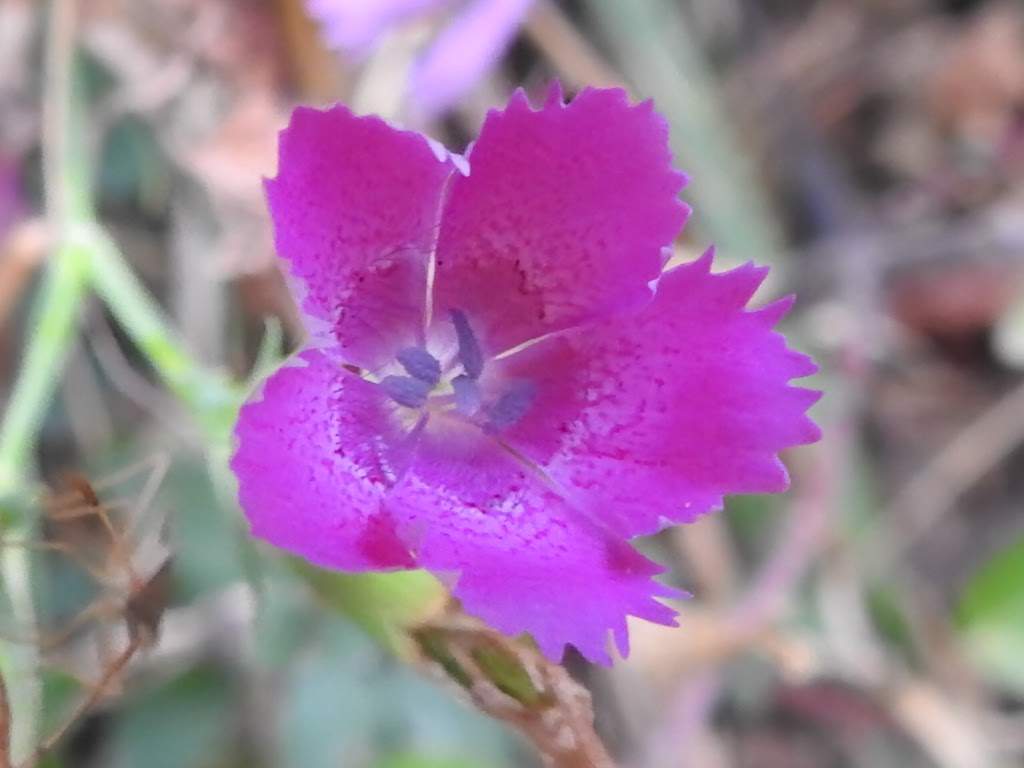
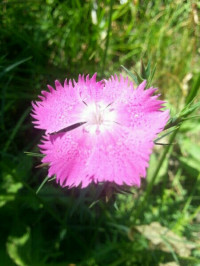
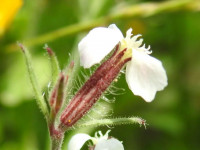
The flowers are gathered in small clusters, from 1 up to 8 per inflorescence, placed at the apex of the stem. Each flower is pedunculate and enclosed by oval, mucronate calyx bracts, about half to three quarters the length of the calyx. The calyx is cylindrical, 14-18 mm long, with longitudinal striations and acute lanceolate teeth at the apex. The corolla is dialipetalous, formed by five petals of light pink or fuchsia color, often speckled with purple spots, with a deeply dentate margin and a throat covered with hairs (bearded). The petals measure between 6 and 12 mm. The presence of a darker ring around the center of the flower is a distinctive characteristic of the species.
The stamens are ten, the ovary is superior and the fruit is a cylindrical capsule that opens by five apical teeth, containing dark-colored seeds.
Habitat and distribution
The Ragged Pink is widespread in central and temperate Europe, with a distribution ranging from France to Ukraine, and also extends into some areas of western Asia. In Italy it grows mainly in mountainous and hilly environments, from the plains up to about 1000 meters of altitude. It is typical of broadleaf forests, forest edges, mesophilous and dry meadows, often on rocky slopes and in xerophilous environments.
It prefers well-drained soils, calcareous or siliceous, and is found in areas with sunny or partially shaded exposure. In some regions such as the Veronese Prealps, the Apennines above Pontremoli and the Apuan Alps, it shows some morphological variability, adapting to local conditions. It is also reported in subalpine and hilly environments in the Italian alpine regions.
Flowering period
Flowering occurs between June and August, with possible variations related to altitude and latitude. In general, flowers appear in summer, with a peak development in July and August. In cooler high mountain climates, flowering may be shorter and slightly delayed.
Ecology and pollination
The Ragged Pink is a scapose hemicryptophyte, capable of surviving thanks to buds located at ground level. Its reproductive strategy is mainly based on entomogamous pollination: showy flowers with deeply dentate petals and purple spots attract various pollinating insects, including bees and butterflies, which facilitate fertilization.
Seed dispersal occurs through dehiscent capsules that release dark seeds, probably dispersed locally by gravity and small soil movements, without particularly specialized long-distance dispersal strategies.
Curiosities and traditional uses
The Ragged Pink, like other carnations, is appreciated not only for its ornamental value but also for the fragrant essences extracted from its corolla, used in perfumery. Historically, carnations were used in folk medicine as expectorants and diuretics, although such uses are not supported by modern medicine and are considered devoid of proven therapeutic value.
From a historical-cultural point of view, the carnation is associated with ancient traditions: in Europe it was introduced in the second half of the 13th century through contacts with the Muslim world, who used it to scent liquors and cosmetic products. Over the centuries, thanks to crosses and selections, carnations have become cultivated flowers with the ability to rebloom, important in the cut flower industry.
Etymology
The genus name "Dianthus" derives from ancient Greek: "dios" (divine) and "anthos" (flower), translatable as "divine flower". The species is dedicated to the French botanist Jean François Séguier (1703-1784), known for his studies on the Veronese flora.
The Italian common name "garofano" comes from the Latin "caryophyllus", which over time underwent a phonetic transformation until becoming the current denomination. Historically, the term refers to aromatic plants with characteristic flowers, also appreciated for their olfactory properties.
Sources
- Prof. S. Pignatti, "Flora d'Italia"
- Acta Plantarum - Flora delle regioni italiane (scheda di Nino Messina)
- Tela Botanica / H. Coste, "Flore descriptive et illustrée de la France"
- World Flora Online (WFO)
Characteristics
Scheda botanica
| Famiglia | Caryophyllaceae |
|---|---|
| Fioritura | giugno – agosto |
| Forma biologica | Scapose |
| Habitat | with fuchsia flowers, creeping plant, Perennial plant |
Domande frequenti
- Quando fiorisce Ragged Pink?
- Ragged Pink fiorisce giugno – agosto.
- Che tipo di pianta è Ragged Pink?
- Ragged Pink è una Hemicryptophytes (Scapose) secondo la classificazione di Raunkiaer.
- A quale famiglia appartiene Ragged Pink?
- Ragged Pink appartiene alla famiglia botanica Caryophyllaceae.
Where I found it (6 sightings)
Classification
- Kingdom
- Plantae
- Family
- Caryophyllaceae
- Full name
- Dianthus seguieri Vill.
- Synonyms
- Dianthus seguieri Vill.; Dianthus seguieri Vill. subsp. italicus Tutin
- Life form
- Hemicryptophytes scapose
Similar species
Search for species with similar characteristicsFurther reading
Noticed an error in the identification? Write to me
Other species of the same family
Caryophyllaceae
Explore
Other species of Caryophyllaceae