Botanical species
Dianthus hyssopifolius
L.
Fringed Pink
Description
Morphological description
Perennial herbaceous plant belonging to the Caryophyllaceae family, it has a scapose habit with ascending, almost cylindrical and glabrous stems, reaching a variable height between 30 and 60 cm. The stem is thickened at the nodes and branches in the upper part. The root system consists of a delicate and branched rhizome.
The leaves are opposite, sessile and sheathing the stem for about 3 mm; the two opposite leaves at the base are fused together. They have a linear shape, are acute, erect and flexible, with a whitish and slightly rough margin. Leaf dimensions vary from 2-3 mm in width up to 10 cm in length. The texture is herbaceous and the surface glabrous.
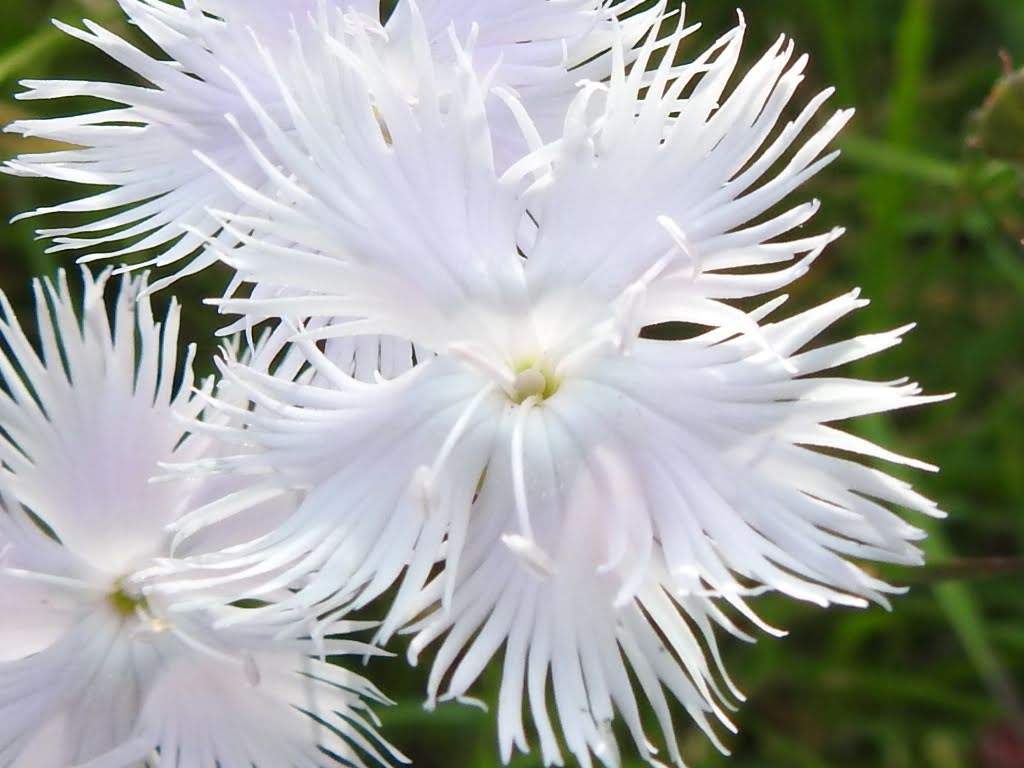
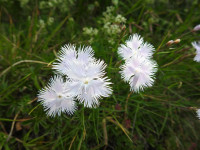
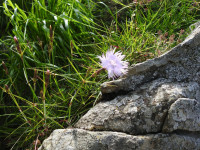
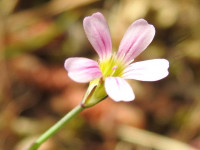
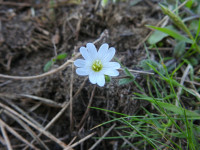
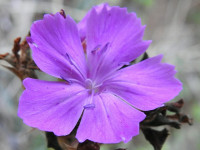
The flowers are solitary or grouped in scapes composed of 3-5 spaced flowers. They are hermaphroditic, actinomorphic and dialypetalous, with five petals measuring 10 to 15 mm long, with colors ranging from white to pink-lilac. The petal blade is cuneate and fringed, with linear lobes occupying about half the length of the blade. The petal claw is linear. The calyx is cylindrical, glabrous and has sharp reddish teeth with striations on the margin; the calyculus scales are about half the length of the calyx and end with a short herbaceous awn. The gynoecium is superior with two styles, while the stamens are ten. The flowers are also fragrant.
The fruit is a capsule containing the seeds.
Habitat and distribution
The species is widespread in the orophytic area of southeastern Europe, including mountain ranges from the Iberian Peninsula, through the Alps, to the Balkans, with possible occurrences in the Caucasus or Anatolia. In Italy it is a common plant, living in woodland environments and dry grasslands, as well as in thickets and heathlands.
It prefers acidic substrates but adapts to various soil types. It grows from sea level up to about 2200 meters altitude, frequently found in rocky grasslands and open woods with bright but not excessively sunny exposure. It is a calcicolous species, also present in mountainous and subalpine environments on calcareous soils, as evidenced by populations in southern Switzerland and the Monte Reculet area.
Flowering period
Flowering generally occurs between May and August, with possible variations related to altitude and latitude. In higher or northern areas flowering may be later, while in Mediterranean or lowland environments it develops in the central summer months.
Ecology and pollination
The flowers, hermaphroditic and fragrant, are adapted to entomophilous pollination, attracting pollinating insects thanks to the fragrance and pale lilac-purple color. The morphology with five fringed petals and the presence of numerous stamens facilitate pollen transfer. The plant reproduces by seed, with mainly local and limited dispersal, as well as by rhizome, which ensures perenniality and local propagation.
Curiosities and traditional uses
No specific information has been reported on medicinal, food or particular traditions related to this species. The common name “Fringed Pink” recalls the similarity to cultivated carnations, although it is a wild species typical of woodland and mountainous environments.
Etymology
The genus name derives from the Greek “theos” (god) and “anthos” (flower), thus meaning “divine flower” or “flower of the gods”. The specific epithet “hyssopifolius” indicates the similarity of the leaves to those of hyssop (Hyssopus), highlighting the linear and slender shape of the plant’s leaves. The Italian common name “garofano di bosco” refers to the preferred habitat and the similarity of the flowers to those of carnations.
Sources
- Acta Plantarum - Flora delle regioni italiane (scheda di Daniela Longo)
- Tela Botanica / H. Coste, "Flore descriptive et illustrée de la France"
- World Flora Online (WFO)
Characteristics
Scheda botanica
| Famiglia | Caryophyllaceae |
|---|---|
| Fioritura | maggio – agosto |
| Forma biologica | Scapose |
| Habitat | with lilac flowers, Perennial plant, with blue-purple flowers |
Domande frequenti
- Quando fiorisce Fringed Pink?
- Fringed Pink fiorisce maggio – agosto.
- Che tipo di pianta è Fringed Pink?
- Fringed Pink è una Hemicryptophytes (Scapose) secondo la classificazione di Raunkiaer.
- A quale famiglia appartiene Fringed Pink?
- Fringed Pink appartiene alla famiglia botanica Caryophyllaceae.
Where I found it (5 sightings)
Classification
- Kingdom
- Plantae
- Family
- Caryophyllaceae
- Full name
- Dianthus hyssopifolius L.
- Synonyms
- Dianthus marsicus Ten.; Dianthus monspeliacus L.; Dianthus monspessulanus L.; Dianthus sternbergii Sieber ex Capelli subsp. marsicus (Ten.) Pignatti; Dianthus waldsteinii Sternb. subsp. marsicus (Ten.) Greuter & Burdet
- Life form
- Hemicryptophytes scapose
Similar species
Search for species with similar characteristicsFurther reading
Noticed an error in the identification? Write to me
Other species of the same family
Caryophyllaceae
Explore
Other species of Caryophyllaceae