Botanical species
Petrorhagia saxifraga
(L.) Link
Tunicflower
Description
Morphological description
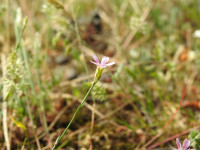
The garofanina spaccasassi is a perennial tufted herbaceous plant, with a height ranging from 10 to 40 cm. It has a prostrate-ascending habit, with thin, glabrous or slightly hirsute stems, branched mainly in the upper part in a dichotomous manner and with finely scabrous lower internodes. The stems are rigid and slender, forming dense tufts.
The leaves are sparse, arranged oppositely along the stem, sessile and linear-acute, measuring between 6 and 15 mm in length and 0.3-1 mm in width. The leaf surface is herbaceous, often with a ciliate margin especially at the base, and the main vein is single and well visible. At the base of the leaves, small dense tufts of hairs are observed.
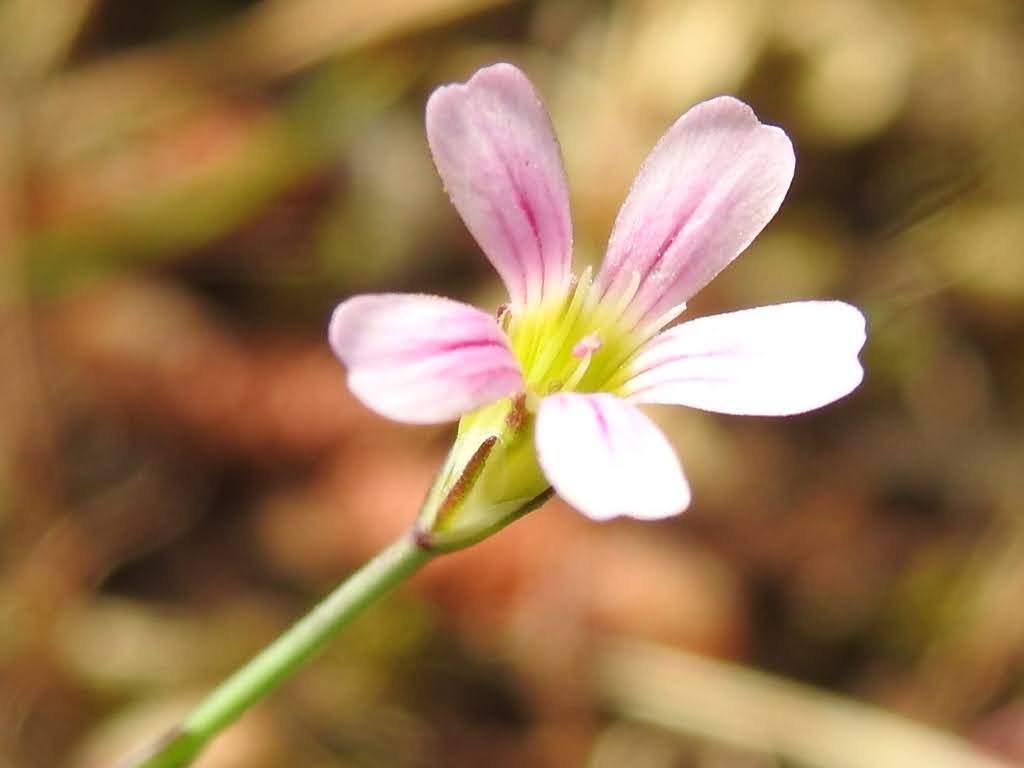
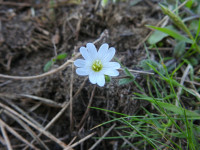
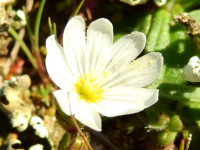
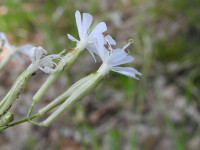
The flowers are hermaphroditic, solitary or grouped in small clusters (corymbs) at the tips of the branches, supported by long peduncles. The corolla is dialypetalous, composed of five free petals, light pink in color with three longitudinal veins of purple or violet. The petals, ranging from 4.5 up to 10 mm in length depending on the variety, have a truncate or slightly retuse apex. The calyx is campanulate, 3.5-6 mm long, with rounded teeth about 1.5 mm long, ciliate along the edge. At the base of the calyx there are four scarious, mucronate bracteoles, ranging from one-third to three-quarters the length of the calyx, forming a characteristic calyculus of the species.
The fruit is an oblong, denticidal capsule, about 5-6 mm long, containing compressed, brown-black seeds with a tuberculate surface. The root system is not specifically described in the sources, but as in many Mediterranean tufted species, a taproot or fasciculate system suitable for dry and rocky soils is presumed.
Habitat and distribution
The garofanina spaccasassi is a eurymediterranean species, widespread throughout the Italian territory, from inland reliefs to the coasts, with a presence extending throughout the Mediterranean basin and some areas of continental Europe. It inhabits dry and sunny environments, preferring arid, sandy or calcareous soils, often on rocks, dry stone walls, and stony slopes. The species grows from the plains up to about 1500 meters altitude, also adapting to submontane conditions.
There are several subspecies and ecological variants, including:
- The nominal subspecies, present in most of Italy.
- The subsp. gasparrinii, which grows on siliceous soils and exposed mountain rocks, with a bushy habit and larger flowers of dark purplish-violet tone, typical of cooler and windy environments.
- Varieties with more marked pubescence and broader leaves, typical of some areas of Southern Italy and the Salento Peninsula.
Flowering period
The flowering mainly extends from May to September, with peaks that may vary slightly depending on altitude and latitude. In some mountainous or cooler areas, flowering may start later and extend until October.
Ecology and pollination
The garofanina spaccasassi is a perennial herbaceous plant that reproduces mainly sexually through seeds produced in denticidal capsules. The flowers, hermaphroditic and actinomorphic, have pink petals with purplish veins, features that attract pollinating insects, especially small hymenopterans and dipterans. The solitary or grouped flowering facilitates cross-pollination.
Seed dispersal occurs through the fall of mature capsules, which open releasing compressed and tuberculate seeds, probably favoring limited short-distance dispersal, suitable for the rocky and arid habitats where the species lives.
Curiosities and traditional uses
The common name "garofanina spaccasassi" refers to the plant's ability to grow in seemingly inhospitable rock crevices, almost "splitting" the stone with its presence. Traditionally, the specific name "saxifraga" is associated with an ancient belief attributing to the plant the property of "breaking stones," probably referring to its medicinal use for kidney stones or other ailments related to internal "stones."
No recent specific food or medicinal uses are documented for this species, but its presence in Mediterranean natural environments makes it an interesting indicator for ecological and habitat conservation studies.
Etymology
The genus name derives from the Greek "petros" (stone) and "rhagas" (cleft), alluding to the typical habitat of the plant, which grows among rock crevices. The specific name "saxifraga," of Latin origin, combines "saxum" (stone, rock) and "frangere" (to break), with a dual meaning: the plant that grows among stones or the one that, according to ancient beliefs, could dissolve stones or "break rocks." The Italian common name "garofanina spaccasassi" precisely recalls this ecological and symbolic characteristic.
Sources
- Prof. S. Pignatti, "Flora d'Italia"
- Acta Plantarum - Flora delle regioni italiane (sheet by Mirna Medri)
- World Flora Online (WFO)
Characteristics
Where I found it (17 sightings)
Classification
- Kingdom
- Plantae
- Family
- Caryophyllaceae
- Full name
- Petrorhagia saxifraga (L.) Link
- Synonyms
- Dianthus saxifragus L.; Tunica saxifraga (L.) Scop.
- Life form
- Emicriptofite cespitose
Similar species
Search for species with similar characteristicsFurther reading
Noticed an error in the identification? Write to me
Other species of the same family
Caryophyllaceae
Explore
Other species of Caryophyllaceae